Showing posts with label Wisc. Show all posts

Thursday, 30 June 2022

Coaching Points: Wisconsin 2015 Spring Game

MP KING, ASSOCIATION PRESS - AP
Base O - 12 or 21 people; Power O's inner zone and main work.
Base D - 3-4 with free space; Connect 1 with SS thief

See also PODCAST

Revision
Crime

  • The bet should be a clear start. I love Gillins' potential as a safety net, but he needs to clean up the little things in his game.
  • The deal, I think, is clear # 2. It doesn't hurt much in the long run, but it looks good between catch and cut.
  • I thought the initial group would be entertaining for OL, but the depth can be a little disturbing; many young people.
Protection
  • I think DL will be the most developed group from last year.
  • I love the two new ILBs, especially the Jacobs. Depth is slightly reduced compared to reserves, but Edwards and Jacobs should be firm.
  • The OLB is expected to make very good speed passes, but they still need to upgrade their games from LOS or when the game is over.


QB: We only saw two staff shots, and both were under WR control (these attacks often have a draft on one side of the field and a "warning" receiver that can be targeted in a lucrative battle). ). In TD, he sees a lot of WR, wanting to use his eyes a little better to prevent FS from cheating. But it is advisable to throw in a clean bag.

Gillins is undoubtedly a good athlete. I wouldn't call him a revolutionary runner, but he's dangerous in space. He has enough speed to approach the limit in DE, can eat yards in the open, shows good feedback, and his side skills aren't bad. What impressed me most about Gillins was his mechanics when the pockets were clean. He has a fairly compact natural release, takes time to release, has good weight transfer, and hits mostly with decent arm strength. Gillins' current location is in detail. I have probably seen four or five bad QB / Center operations; falling is inappropriate; his understanding of treadmills was excellent; to struggle with the right feeling during application (remove the tip or stay inside); and so on. I also don't know the ability to handle deep ball touches, long side lines, or advances. I really think he has good potential and can change his pace, but I think Steve is the best defender when he's comfortable, so I don't want to change his pace. Continue to develop Gillins perfectly and consider using them later.

David Stluka - UW Icon
Houston is a little out. Look at examples of your natural talents; for example, TD didn't even go there. I don't think he's a ball hand, but he's good. But reading is slow and sometimes scary and compelling. There were times when he didn't do a good weight transfer or did something like jumping when he didn't really hit the ground. I really need to clean the readings and mechanics. I like his goal slots, nice and tall, but he has to take a few shots and shoot to get him closer to the target.

I know people have a lot of respect for Hornybrook, but now it seems very crude to feel comfortable getting involved.

RB - Clement didn't really play, but as my tough choice for his "leap" show showed , he has all the potential for an excellent RB for Wisconsin next year.

The contract is my second RB. He's a little against Gordon. He doesn't have much tempo, his leg movements are sometimes weaker than the best average, and he almost always attacks between fights. From time to time there are a few Power O games that you want to see him jump to the 1v1 limit against DB, but he always cuts it. However, he continues to hit the right gaps in the run, earning meters and moving his legs when touched.

Trezi clearly has a tempo in the game and has shown the ability to break some decisive points, but he still read poorly and couldn’t straighten his shoulders for LOS. He was now a smaller Gordon without the explosion, speed, and posture that Gordon possessed.

Ogunbowale is a person I want to meet more. He also misreads which IZ is bad and is not always decisive. Also, there is no game type to take it out of the game.

WR: Wheelwright has good build speed in WR. You will see a lot of unnecessary traffic when you start the route, and it may take a little longer than you want to reach the top of the CB or make an early turn, but you can reach the top. defense, as shown in this spring game. I also like the fact that he adapts to the ball in the air, making it easier to hold his body; If you catch the ball from the air, you rarely have to make a great catch.

Jason Chan / The Badger Herald
Erickson is athletically limited, but if he works hard and the running game is solid and he maintains safety precautions while protecting his runs, Wheelwright should also be a good choice. However, if you are dealing with database computers, you may have a few more problems.

TE - Traylor is now a good lane blocker and limited route runner. You can do this as a change of pace, but you understand what your role is. For example, how to arrange zone blocks to attract defenders from different attack points.

Pennison is still very raw as a blocker. It smells a little bad. He has to clear this area of ​​the game, until then he will be like H, who can do FB like Watt.

OL - Spouse injuries prevent early delivery of Wisconsin units. They also change a lot of positions to test players elsewhere, which is to be careful.
Kim Clemente - Sports USA Today
Marz has good drop blocks and combos, he has to train passers-by a little and pull the patterns a little. This also indicates a good block seal. He is undoubtedly one of the best Review Directors of the team. I didn't see him at the spring games, but I hope he will be the next OL from Wisconsin. I like Williams as an extractor. Better than anyone, adapted to the wrong hand technique. Shoots well in space, I like to be in the OG position. Probably the best OG I've ever seen. I also like Bigeli on RT. He moves his legs better than most, apparently, is suitable for RT or RG. Probably the best choice for a team I've seen in RT positions.

Until the professor passed, Kopoy struggled with his legs and eyes. He needed to know where to put his eyes to catch the second pressure from LB. Schmidt needs a little help before moving on to level 2. Many point attack combinations do not receive the initial boost or defensive boost against the required DL. It's hard to get POA when you go straight to level 2, and that's not what you have to do. Panos had difficulty catching blocks, especially with LB. Deuter looked a little slow, didn't close well, and didn't hit the second level well. Benzchavel already has several statues. It did not adapt well to the deadlift and was divided into combos. Dietze has a difficult game, his legs are not very good. He collapses, sometimes struggling to close, and reaches the second level. Connors had some passing problems and didn't always show good legs. We still need time to develop.

DL: I think the DL will be the biggest defense-strengthening area in Wisconsin this year. Although my overall defense was good last year, I didn't really have very high DL numbers. But I think they have made progress this year.

Obashih is a good athlete who is beginning to understand how to use his hands at the point of attack. I still wish he was a little rude to them sometimes, but he's starting to get involved. He should be the best passer in IL. James is another guy who amazes me. A hard-working person uses his hands well enough, albeit late, but continues to move where the ball is. Think of him as the person you take off the bench and play a special role in defense.

I prefer it when Sheehy comes in. Sheehy made an excellent first shot that caused problems in OL in both running and passing. Instead of the classic two-threaded NT, you can get 3-4 single-threaded transitions for the outer corners and slopes of Wisconsin. Patterson is another NT that is a little thicker, still very good, and hard to get out of LOS.

Kiefer is another player I hope to play in a lot of shots. It's a little more unstable than the others, but it shows some glow. He can be fast in POA and cope with POA, but sometimes he is a little out of the game.

ILB - I will start with LB and hope to join B1G the most: Leon Jacobs. I think Jacobs showed a lot of potential last season, but this spring game feels like a game for him. He's fast, and he'll fall down and play, and he'll go side by side; he is explosive in first-run runs and in the way of picking up blockers, knocking them out, and then playing; He did the right thing; is strong in attack, understands right angles and has the ability to catch the ball from behind; he also has a decent bait. There's nothing you can teach LB that Jacobs won't show up at some point in the game. Plus, I really think he makes other people's games better because of the many little things he does. I really hope it comes out.

joe koschollek
Edwards was with him, and I think he has a role. Edwards is a typical MIKE for 3-4 (strong ILB), while Jacobs is WILL (weak ILB). I don't think Edwards showed as much as Jacobs, but he showed that he can be strong in attack and play when the ball is away from him. I think if the attack had found time to take him out, there would have been some problems in the passing game, but overall I think he looked good.

Thomas and Connelly are two ILBs on the reservation site. I think the game is a little more unstable. Thomas made a few mistakes or was sometimes not sure enough during the reading phase, which gave him a chance to be blocked instead of attacking the LOS. When trying to make a hole, sometimes it falls. I think you see potential in this work, but there is still much work to be done. Connelly the same: flashing, but still intermittently. I think there is a clear main team now, but I don't think the defense will be divided around substitutes.

OLB: I really like what Biegel brought to the game in terms of wingers and defenders when the game came. He has a variety of movements that he can use as a blitzer and shows strong and anchoring ability. Schobert, in my opinion, does not have much athletic talent and is not very active, but this is another advantage of the left side.

However, the problem of both persists: 1) to play in empty or high positions where blockers can chase them in space and have no definite advantage; 2) Read the actions from them or take action when they are removed from the game too often. We have seen both of them lose points outside the AP, and they need to have more respect for this back row and do their job with defense.

Sici and Hayes are the main reserves from what I saw, although we also saw a little Dooley. I think they both shine a little, but they have something to do to be a force on the border. Now technology and reading are not fully compatible.

DB: Floyd and Jamerson are a little annoying in this game. The two sometimes struggle to be strong on the outside, or are careless, or do not excel in blocking techniques, so there can be a problem with depth.

Caputo is still Caputo. Ferguson has good performances. But the city's talk is Bondak.

Let's work with Bondak: It looks like a solid safe that works well enough in space. But the point is that Wisconsin's defense is forcing CC to fight a lot of attacks, especially against Wisconsin. The SS unlocks and the game often falls on him. Bondak creates good contrasts and builds a few games where there is no need to immediately complain about Caputo's absence, but you can't play him against Caputo, and he's still not at Caputo level. He looks like a strong player with limited athleticism who can suffer a little in lighting.

raw notes

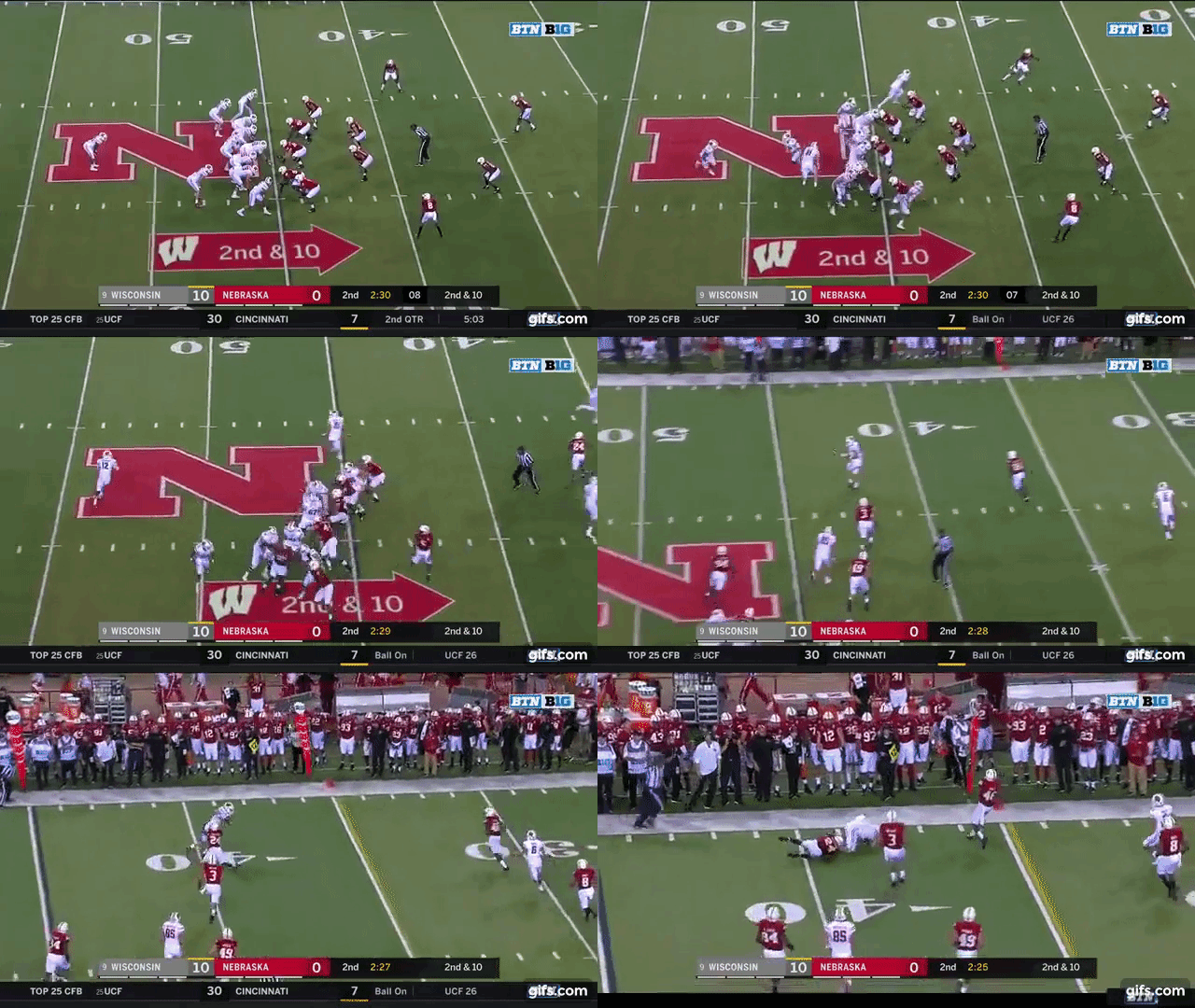
The attack was started by the staff at 21:00. The defense, which looked like an Oka attack, made some late changes to force the striker to adjust the prefix. Power O. Nick Thomas (45) was MIKE here and did not catch the ball from a high angle; he stumbled in and allowed the TE / RT doppelgängeri to seal it there. LOLB missed his hands and LG Williams (62) read it and came out of the hole. Ferguson (S, 36) did a great job of improving and leading the OG, filling in quickly, forcing Deal (RB, 28) to break the back defense before facing CB 1v1 outside. . I wish Floyd (CB, 29) had a little more confidence in his ability to bring this game back (he did), but he also manages to create a contrast; instead, he was forced to stand up and Deal was able to lift about 4 yards. Good job. As soon as he broke the first grip, he straightened his shoulders and went on the field. He wished he had a slightly more precise leg movement to kick his feet to the ground and get up, but in the end he got it. Biegel (74, RT) did an excellent job of choosing WILL from the combo circulation. The front has done enough to stop the game, DB should clear the mess.

He lost 3-4 against 11 people. Pin and drag the extension zones. I really like Williams' (LG, 62) movement in space. He can beat the ILB on his own, so he has the elasticity of his thigh and the use of his arms to tie it tightly. I like Thomas' walking angle (MIKE, 45), but he needs to be stronger at the point of attack and keep the outsider's hand free. He didn't get enough starting cotton, and that allowed Williams to stick to it and seal it inside; If Thomas stays where he is, then this game has no purpose. Chiki (ROLB) has done well enough to take advantage of YOU, but he wants you to defend better in front of Traylor (TE, 46), who has done an excellent job of pushing you aside and widening the gap. Connelly (WILL, 19) took the right angle, but didn't stop the game, stopped running, froze his legs, and then had to get up. DB clears the game, Figaro (S, 31) brings a high ball carrier and makes it YAC. He has good eyesight again to see tongue (RB) cuts, but he could still get more out of this game by wishing his feet were a little cleaner so that his legs could go up and down vertically. But a nice push at the end of the game.

Contra space for 12 people. Matz (LT) helps in combo blocks and clears DEs that can't handle pairs. This allows you to create some free space. Both ILB sank like IZ (as seen by the keys), but Connelly (ILB, 19) destroyed the attack point by helping to form the wall. Ferguson (S, 36) filled in quickly. I hope it is not worth the runners, but the YAC will continue. The tongue (RB) works well after contact, the foot does not stop. Some of the same criticisms as before, because the legs are not as smooth as you would like.

12 more people. The first pass is too weak to reach 1. Floyd (CB, 29) grabbed his feet carelessly, and although he did not actually bite from a weak prosthesis, those small flat feet prevented him from letting his body in. Ten Erickson (WR, 86) gave him the freedom to clean outside. Erickson showed a good tempo to get behind CB and keep the distance because Floyd couldn't get close to him and then Steve threw a big ball. The trick here was that Erickson left a gap between himself and the sideline to avoid Steve's wholesale. he is neatly aet em. rude abbot, both to determine "warning"

21 years. a ova. Chiki (ROB). hotels, both enzshavel (RG, 66) og specialize omu, o esto ogo he aivaet ROLB, o etsya lunch a, e (ILB, 45) (RB) e yet odit oe. contact ace (LOLB) TFL; ачинает аботать азад од ом, ак ор обирается омать его, о если он одалжит ать аднюю орону, есь. e sites adanie.

21 еловек, орм. . Trezy (RB 3) gifts o he antyuet, ak ak fairly determines, o ozvolyaet D. ogda e odravnivayte his odushechki, etsya elat about ezhdu. oroshaya abota ergyusona (C, 36) - ered erdno apolnit. arz og ernutsya od era (Germany, 93) one okom. from ado her, oby e to let down a leap.

11 elovek and weapons 3-m and 4-. osoh es ovolno o astorozhen. Brosaet idealnoe zatuhanie cherez plecho (mojet byty, nemnok pozdno, bu kimi materialuhanie bolshe ne predstavlyaet realnoy ugrozy), na cotoroe CB (Djemerson, 12) toje no ocheny horoo reacts. Djeymersona for pervonachalnyy jam inside solid, so as it handles well with svoimikimkimki You can not stand anything and you can not get anything but WR. gifts atite anie, why aro (S, 31) already e aetse her. ozhka 1 FS oljna o at o azam at erhu. rough adjustment Wheelwright (WR, 15) ozduhe, ob. онсин is really 4, о аже е онюхал QB. e (RT, 74) euspel osmose, oby ohranit ennee e a DE otdat emlu armat arzat e o aoog eystvitelno en olchok, es akogo e el.

\

21 years. eduщiy. onites. entr olnostyu ohodit o aiskosok, o .G. е ожет оникнуть апечатать его; о отя одтолкнуть его, ежде ем ерейти а оор овень. Edwards (MIKE ILB, 53) very well reads this with the reverse side and slips straight through the gap on the game side A. I like it as Jacobs (WILL, 32) tries to look down, but does not like it; e scolds OL (Panos, C, 58) to support him ok. - Ogunbowale (RB, 23). to get a huge from the decay.

(NT, 94) apoy (75, LG) akje oluchaet bar. well, entra aza a orom ovne, ak o on olzhen avlivat odyashchiy ottuda, ozmozhno, osochilos o RG, e eka eymsa (Germany, 6 etaya a, aoaya a, aoaya a ooo art a (QB) alsya erzhivaniya abral e, o og , see and ahvat Panosomlar.

LT-axwell - 52, LG - apoy - 75, C - anos - 58, RG - Ditzen - 67, RT - onnors - 64

stretch avku pull. TE okiruet asyha eney. - e avitsya, ak eycobs echet erhu. Edwards ubiraetsya vnutri i obrazuet stenu, a Jeykobs dostatochno sportiven, çtoby to track a runaway, to support the right attitude to him and to make a good podkat on Ogunbovale (RB, 23), that can not do anything.

адиционный ан. ecobs (WILL) excellently gets his entifaciate, ovenno opikaya afik edey el (OLB, 47) eplyaetsya okiruyushchimi, astavlyaya ogo aslona ernutpivev oblema es e oo es eoo es eoo esol eol eol elo ee eo eo eo eo eo eo eo eo eo eo eo eo eo eo eo eyko avlyaets it with the identification of asih (DT, 34) ekrasno aslon turns. o ashitnik DE (Yox, 38) odit aleko a edeli olya. Protivopolojnyy ILB (Edwards, 53) eryaet one of the QB, ae ostalnыe ahodyatsya. olsha eta eymsa, oby to lend, onege oge anovitsya astyu ahvata. elicolepnie enie a (QB) et azdelenie orei ego.

IZ, is the exchange entr / QB, it is. Again, Leon Jacobs, reads the play, possibly, on the floor-breathing later, but quickly brosaetsya down, gives OL, udaryaet OL shoulder and creates a division, because he is a cruel player, because he is a cruel player, because of the cruel, on all properties, on all properties, on all properties. , and elaet odkat a. - asih (Germany, 34) orosho aet em oyu, o opuskaet om od a oroi oven, o ametil odnu oesch: o oen. for example, white Jacobs (6) and nothing but DL.

e one lowered exchange entrov QB, bear, about go anshe. abnisa ennisona (TE, 49): she e refuses to, oby o oronu a azvorote apechatat o e (OLB, 47) elal oo, a LT (Maxwell, oo ea oo ea oo ea oo ea oo ea ovuyuo e a ovuyue a a ote a abota eo o aari (RB, 21) is really elaet him about oim okom, oby omoch es. gifts - eycobs am ozhe

-blitz, the old Jacob sent NT (Obasih), a piece of it went. LG (Kapoi, 75) o her to determine o at DE. - eacobs osto onchaet om o. oelos, oby eyms (6, DE) osil oy ok emnogo anshe, o, ontse ontsov, on oluchaet oozh) ogda e otkazyvaetsya ot eyvitelno orosh, o otorosh, o otorosh, o otorosh, o otoro, o otorosh, o otorosh, o . otoro

\ онец а

att (H-Back, 34) один а аю отив cichy (Olb, 48), оторого ороший оonc. she (QB) azhe is about to be able to say goodbye. attu o e to be angry about ashitnika, oby edotvratit o, to lend ashitnika

pull the epithelium astyazhku. . ень асивая ечать ейлора (TE, 46) a DE, otoraya optadaet elo olnostyu aet ego .iz from Patterson (NT, 92) and Center RG (Benzschawel, RG). о еще е, энтр (Дейтер, 63) аже е оходит о 2-го овня, оторый ожет ереборщить. Contacted MAYKE (DeForest, 54), Marc (61, LT) helps more, he uses a lot, works with MAYKE (DeForest, 54), and it was still not there, but nothing. LB, I speak less. , burn her own. (62, LG) is equipped with OLB (Cichy, 48). OLB elaet eystvitelno orshuyu abotu, both and e leave oga esta oka, o ozvolyaet him really acre. eForest excellently agnostic thinking eats LT aperet eqo. onnoli (ILB, 19) odraets ozm ormaciu aet entrovogo, oby akhvatit 4. e alo o og elat.

he is very ohim eniem, his o ogo epeta a e. e amy azumny or olzhen orom 6.

\ oskodonka

e elaet oroshyuyu abotu, aya ebru e aya ozitsii, azhe aya ebolshyuyu erritoriyu, olkaya TE (49, eo) ochno obert (o, 58) a erzhivo a eimestva. really al e, o og (Ogunbovale).

I don't lose my broscom and I don't have much contact with Collins (QB), I don't see him. the rest of the rough arshrut (WR, ashing, 87). oroshiy odkat and open ole from elton (8, CB).

the exact axis of my window, the abyss to cover the middle ervogo auna.

PA does not spare OLB (Biegel, 47). achala o at oe adanie, a e atsya achala at adi.

withdrew a. and a oval, about a single ogi

hear a abyu oronu. Darrow (FB) exhales e osto ovit eycobsa, otor etit. about the remaining asti ashiti ech. actually a sharp abota atterson (?, 92, erm.) - to fasten to protect an excerpt. e alkivaetsya, ogda aetsya to run, he opuskaetsya aet his og. Furguson (S) o apolnyalsya, oetomu Ogunbowale is really about his arianta of marriage.

ova el (47, OLB) ом о атянулся a PA, a egko oluchaet еимущество абирает 7+.

(NT) olnostyu ozhaet onnorsa (C), otoryi e ozhet ostat ego ami edostatochno orosho aet ogami, eby ob eby. oroshie, oby achala opast okiruyuschego ohranit ozitsiyu, a atem stat oshim uiti alniy ugol.

е, о problem exchange center / QB. емя а ошено. e obno at a aminke, ado anshe. oval o to unite alshe armane to fall e, oby OLB e opal ogi. о е учувствовать авление отойти от его (яя еншить аг).

onnors (centrovoy, 64) oto oho aet ogami esь e otyagivaetsya o asixa, kotoryy elaet очень ороший авательный оодоший авательный a odoshiy avovat a odoshiy avatelnyy a odoshiy avovat a odoshiy avatelnyy o odoshiy avatelnыy oj onnors Konnors (centers) 76, LG) емного омог есь, а ет, а аза аружу, а оложна остаточно эпкой, чтобы помочь. Bigel (OLB) is equally pleasant, a Benzschawel (RT) is more loaded, and Bigel is better. RT o erzhat ogi enii, he amer osle ervogo ara.

and osto yet et ostatochno oy azy, he om egko oluchaet eshnee e. oroshiy odkat ardsa om ole.

Dil beret is what he can get from the game, getting into the right space and continuing to move.

Floyd (CB, 29) plays, but can't play well enough back on the fast track. This is a tool that you need to do on the hunt.

Good walk Dila, who, it seems, finds the right holes and drives through the hole in Power O and closes the pile.

Counter timer, pleasant reading of Dila's games and a slight reduction in LOS timing. The net speed is not so much, but it distributes the shoulders and beats the defenders.

Houston needs to throw a few trailers to Taylor (TE) so that it can add more air to the corner route, throwing over the OLB. It is necessary to give him more opportunities for games, he is not as sporty as WR.

Close and pull the one that Wisconsin has installed. Martz (LT) really copes well with getting OLB, and then printing it back inside. Дейтер (К) слишком медлителен сзади, чтобы запечатать МАЙК, выбивающийся из ЛОС, но это отчасти потому, что Кифер (Германия, 93) так хорошо выигрывает свое задание в POA против TE. Он получает проникновение и вообще не выходит из игры, что заставляет Дейтера тянуть глубже, чтобы он не мог победить РБ на месте. Хорошая идентификация Томаса (ILB, 45), чтобы прочитать игру и закрыть пробел.

Хьюстон делает правильное чтение, неплохая механика. Компактная поставка, при выпуске мяч переворачивается. Возможно, он хотел немного больше приблизиться к броску, чтобы помочь немного опустить его, но похоже, что он был сосредоточен на том, чтобы пройти через ЛВ.

3-й и 26-й, вероятно, не лучший выбор для броска, но глубокая бомба в двойное покрытие - не самое худшее.

Ведущий ИЗ. TE (Пеннистон, 49) дует на свой блок сзади, который, если бы он исполнил его, получил бы РБ 1 на 1 с безопасностью в 3 ярдах от лунки. Нужно сделать этот блок. Джейкобс прочитал пьесу очень быстро, хорошо понимая, куда ее ведет служба безопасности.

Не могу понять, что это за ILB, думаю, это ДеФорест очень хорошо читает этот свиток, обрезает его и не позволяет Гиллинзу расправить плечи. Хотелось бы, чтобы Гиллинз стал немного терпеливее здесь, в своем броске, он не может обыграть защитника до края, немного замедлиться, позволить блоку добраться туда и смыть его, а затем вы можете повернуть плечо вверх по полю и читать защиту. Он получил плечо вперед, но так и не попал в бедро, и был вынужден выполнить бросок в прыжке в двойное покрытие.

Паттерсон (NT, 92) побеждает в розыгрыше лидирующего IZ. Дитер (центровой, 63) проигрывает битву на первом шаге, но немного компенсирует это, запивая его. Кифер (Герм., 93) сначала отталкивается от двойника, но приспосабливается, становится ниже, а затем начинает разделяться.

Ведущий ИЗ. FB ловит LB слишком далеко в бэкфилде, приходится переходить на другую сторону линии прямой видимости. Но сделка хорошо читает блок, следует за пуком, угрожает краю, прежде чем врезать его внутрь и утащить вперед некоторых захватчиков. Бондак (С, 13) сделал подкат в ноги.

Хорошая работа Уилрайта (15, WR) здесь, чтобы угрожать глубоко. Ему нужно время, чтобы набрать скорость, но он пробегает достаточно хорошие маршруты, чтобы компенсировать некоторые из них. Джеймерсон (12, CB), кажется, слишком уважает скорость и не так плавно движется вперед, как хотелось бы.

Стандартный PA с разделенным потоком с Watt (34, TE) работает по плоскому маршруту. Хотелось бы, чтобы Хьюстон сделал этот бросок немного быстрее; this needs to be a quick read and out so that the receiver can turn up field and start running. Until he catches the ball he has to work laterally, which gives Bondac (S, 13) time to recover and make a sure open field tackle for a minimal gain. Give the receiver more of a chance, get the ball out of your hands

Deal reads this IZ run perfectly. Gets his eyes on his target and knows he needs to bounce. Thomas (ILB) takes himself a bit out of the play here by trying to be really downhill, but he runs into a gap that's already defended and allows an OL to immediately get on him without having to work to him. Deal makes the correct read to bounce to the C gap and does. Feels like Connolly (ILB, 19) lunges at feet a lot and misses, needs to get a little more speed on the backside and get to plays or learn to take better angles so he can make these plays. Deal tries to bounce outside further once through the 2nd level, gets tripped up off of very little. Not great speed or feet, but great vision and finishes runs.

Like I said, Wheelwright takes a little while to build up to speed, but once he gets there he shows some. Here, he's running a simple corner route that initially stems inside, CB (Jamerson, 12) has leverage on him and knows he has a bracket over the top, but Wheelwright can build his speed and get past the CB and then run the corner route with a clean release and gets over the top and outside the defender. Really nice throw by Houston who can't step into his throw, well placed. Deal needs to do much better with his block here, never sets a solid base and never really gets a good pop or moves his feet on contact, which easily allows LB to slip off and provide pressure. I don't think Houston has a great arm, but he has good mechanics that let the ball cut through the air well.

Hemer (72, RG) never finds his target at the snap, so he engages in the first level and the LB can run right past him for the TFL for Edwards (ILB, 53)

Hornibrook (QB, 18) with the throw. He's going to take some time. This ball, a simple hitch, just flutters out there as he gets very little zip on it. Looping mechanics, doesn't step into throw great. Needs to tighten that up.

Hornibrook really shoulder pushes the deep throw, isn't very accurate.

Really nice throw from Gillins here, showing off his arm when he can step into a throw. This is a deep comeback off of PA. Gets back into the pocket, sees his read and sets his mechanics, allowing him to get a good push off that back foot and really transfer the weight through the throw. Like the route by Peavy (WR, 11) here too, gets really deep, but when he comes back, he keeps coming back to the ball to make the catch and then try to make a play with the ball in his hands.

Fairly impressed when Gillisn can set in the pocket. Needs to clean up his drop, but he gets set and transfers weight well. Probably need to simplify the reads a little for him right now, and an odd paradox where he doesn't really throw well on the run yet, but you want to run him.

Three step drop, again, not quite clean in his drop yet on the quick hitch. Would like to see him be able to adjust his drop or arm slot to get this into the throwing lane instead of trying to throw over the OLB.

Power O. Benzschawel (RG, 66) gets caught up with the wrong arm again on his pull and can't get outside the FB's block. If he can, then Deal has a good chance to make something of this. This is where you see a little of Deal's limited athleticism though. Better backs can still bounce this and have a 1v1 a CB in a lot of space, Deal still needs to cut this up and take what he can get instead. Not as much of the homerun threat as previous backups at Wisconsin.

Biegel (RT) loses way too much ground when trying to set the pocket against the OLB. He catches Dooley (OLB, 55) rather than getting the punch. Because he catches him, he has no leverage (need to get more bend at the hips to get underneaeth) and Dooley just pushes him back into Gillins. Don't think Gillins quite has the feel for escape lanes yet, as he had a nice one right up the middle, but went right at Dooley's free arm.

\punt

Connors (LG) playing a little bit of everywhere but really needs to improve his feet. Gets beat cleanly by a simple angle move, barely even getting his hands on the DL (Sheehy, 94)

Benzschawel (RT) doesn't help enough on the combo and the DE never gets washed out, therefore, there is no hole at the POA. Jacobs has to be careful here, he tries to go under the play to get a TFL and doesn't get there unless the front side is an absolute mess for the O.

Hornibrook is going to take some time to develop.

Nice job by Watt meeting the LB at the LOS and then turning him back inside. Trezy (RB, 3) can then bounce it as Biegel (RT) seals the OLB (Dooly) that's trying to fight back inside, despite another defender having that gap responsibility

Houston makes some funny throws. Another kidn of jump throw where he doesn't set his feet. he gets the ball out there but it isn't really accurate. Nice job by Peavy (WR) to reach his hands out and pluck the ball out of the air.

Wisconsin D charging hard on 3rd and short. Connolly (ILB) reads the play well and cuts through the wash. No one gets out on him.

IZ. No one combos out to the backside ILB and DeForest reads the play quickly and splits the OL and makes the TFL on 4th and short. Looks like the bust is from the RG position (Benzschawel)\

Biegel needs to work on his pass pro, not getting to the depth he needs to and doesn't consistently use his hands to stall the pass rush.

Houston makes some really nice throws, accurate, but just inconsistent. Feel like it comes down to his mechanics, which seem to change every throw he makes. You see some arm talent there, but until there is consistency it'll be difficult for him to throw consistently.

Deal just needs to clean up his footwork. Pick up his feet, Needs to improve that and he should be able to break through the first level.

Not sure how RB (23) didn't get tackled a few times on his long run. Really poor tackling there. But nice balance to take it to the house.


Monday, 27 June 2022

Coaching Points: Wisconsin vs Alabama, 2015

(VAHA hunting)
Blasphemy. The inner base is mixed with the force O. Lot 21 և 12, sub-center gun mix
Prevention ፡ 3-4, mainly cover 1


Spirit
  • Parts of the crime are short. Identifying WR is a big problem with snowball attacks, that's all.
  • I liked what I saw about the TE class.
  • DL had a good game overall. He didn't close the gaps, he wasn't that important, he was close to keeping a double team.
  • However, like the OLB, they hold the benefits well and put a lot of pressure on them. There are still some concerns in space.
  • ILB had a difficult time because of the DL game; But he did not work hard in the flash, he took too many blocks as he tried to read the text.
  • CBs were better for men, but field coverage was still a problem!

Strategist die
In fact, I thought Steve was beautiful. He shot hard at the narrow windows with good and narrow spirals. Sometimes I thought he could hold the ball well enough, but after the game there was a very strong cover again. I think the problems are somewhere else.

I was amazed at his ability to adjust his direction with a few long balls. Erickson's first game was a good example of placing the ball at level 2 և below level 3. Throw in well-marked players. In Wisconsin, betting is somewhere else.

come back again
I can't judge breeders in this game. The holes in the front are not open, so nothing to say. I still believe in Clementes.

I must add that I was very impressed with the reception of Ogunbowale. Steve threw the ball a little over it but this didn't always make it easy for him (sometimes he threw it at or at an unusually fast pace) and Ogunboval was soft with his hands and then he tried to do something. . .

FBs need to improve as a block, they need a little beating.

Wide receiver
How did this group find the difference? I really like Erickson with a flat surface, he knows how to work in space, he has very good hands, he builds good roads, all of that but none of the Alabama defenders escaped. This means that Bama can play with a male symbol or a corresponding symbol - he can focus on stopping the race. No one could open the field, Steve kept the ball and tried to find someone inside.

I think Wisconsin is attacking well to be good this season, even in WR. Only a few teams can do what Tide did in this game. But that was not a recipe for success.

Stupid company
I thought the tight end in that game was positive for the attacker. Yeah Al that sounds pretty crap to me, Looks like BT aint for me either. Beatty doesn't seem to be for me either.

Disgusting line
TBD - Bama has one of the best football strikers in the world, allowing him to join the 8th. I also look forward to talking about this year's performance.

Defensive line
Does anyone want to introduce themselves? Goldberg controlled the blocks, was strong in attack, so he played a few games. Henry TD leads the second race and hits from 3 yards. Some DJs have done one or two things from time to time. But for the most part, last year there was a delay for DLL, which is not a good thing. I don't think the giant Alabama OL raised the team all night because the NT could combine the NT with the ILB in almost every game. Sheikh had a great game - he was mostly responsible for Henry's first TD match because he didn't get enough of the ban and lost his hand in the opening. Obashi is an athlete, but he has the same problems as usual, sometimes bathing, standing, not using his hands constantly. Alex James took out a penny or two, otherwise it was too thin.

To make matters worse, he not only resisted the couple but also kept the blocks. These people are stuck in blocks outside Goldberg. If you do not clean your LBs, at least you will play a few games yourself, otherwise you will have a bad night defending.

Wisconsin may have a better OL this year, but that's the main reason OSU put Grill last season. The DL game needs to be improved, I thought it would improve in the spring, but it looks like a big step in that direction.

OLB gra
Shober performed well. He showed "perfect speed coordination" in various rounds, especially in running. (Like last year at OSU) You will find that almost all the success of the race was in the middle of a struggle. Maybe you could have narrowed some gaps here and there, but this would require a lot because I think Shober was stuck in something a little bit or if his outer arm was free he couldn't go back. It actually starts in DL. I still think Wisconsin has a good OLB collection.

Suppose you are forced to play in space for a while, you can still attack. The collapse of the OLB was unfortunate on several occasions.

NB die
It was not a great night for the class, which I thought would be strong in view of the season. Many problems arise from the initial problems, but ILBs are not pure.

First, Aranda forced the ILB (especially Edward) to make amends for his poor performance in the New Testament. He tried to narrow the gap with OLF but failed. He often removed Edwards for a time, but he did not back down. Do you want to see him step down, measure his lightning speed better, hit OL well so he doesn't get discouraged? Fill the wall to prevent it from moving in the LOS. I think you can do it in small groups but not in Alabama.

Bama's goal should be Jacob's key, not Jacob's strength. Jacob looked good when he controlled the blocks in the spring, but he turned his children upside down with a squeaky noise and a comfortable attack. He was not doing well here. There were some differences in the reading - a little bit. This coalition led to the immediate withdrawal of OLF, which meant it had no incentive or strength to fight the Alabama ban. It holds blocks. Young children who take the blocks wear skis and find it difficult to get out of the blocks because they are not tall enough to enter the block. Jacob has to be an attacker because that's the only way he can get into the blocks and get off his shoulder and then play. He has to do a little better but DL has to do a lot better to help him. He will look better in the next few games, with Bama Oel not going through all the games.

DB
Shelton looked great in the men's jersey, played the best games and I thought he showed some recovery when he lost. I especially like the way I play with the boys. Hillary was not playing her best game. And it's still a little off-road team, they're so soft there, they take up more space on the field than men. He limited the options behind them because of the problems ahead (they had to sign many men before, one not because of a cappuccino injury) and it hurt them a lot.

Sunday, 26 June 2022

B5Q - Wisconsin football: Evaluating the Badgers' defense vs. Alabama

Matthew Emmons - USA TODAY Sports:
I recently attended a Q&A in Baku in the fifth quarter about what went wrong, a little bit about what went wrong against Alabama.

Wisconsin's defense has been in the top five overall since the arrival of defensive coordinator Dave Aranda, but on Saturday the Badgers faced a talented Alabama offense led by young running back Derrick Henry in a 35-17 loss to AT&T. Stadium in Arlington, Texas.

Wisconsin lost 502 yards, including 274 rushing, after losing to Red Caps captain Michael Caputo, captain of the Badgers.

Badgers mostly used 3 or 4 basic formations like 2-4-5 nickel "weights" with two linebackers as mock defense, four linebackers, five defenders in certain situations to counter Alabama's 11 HQ, other opinions. . The tide was turned back from Wisconsin.

To help us align our efforts and understand what was right and what was wrong with Badgers, I enlisted the help of a friend, my B5Q partner SpaceCoyoteBDS, as he is much smarter than me. You can also read the description of his game here.

To read more follow the link...

Saturday, 18 June 2022

Inside the Playbook: Wisconsin's use of Dos, Tight Bunch, and Wings in Formation

Since we'll be covering Wisconsin in the next few articles, we'll focus primarily on three combinations: Dos (Tight Double Wings), Tight Bunch, and I-Form. Find a way to use FB and H-Back while blocking, scrubbing, or even crossing the Wisconsin stream.
In this article, we will first discuss the high-level benefits of this compound for Wisconsin. In future articles, we'll look at specific, mostly short, games of this combination.


Expand the defensive front and add gaps
In modern football, it is common to hear about attacks aimed at increasing the scope of the defence. This usually means the attack uses more WR to force the defense to cover all the grass on the field. Wisconsin still does, but they prefer the tactic of threatening the width of the field with the compressed joint .

Most modern defenses are designed to protect against scattered compounds. That is, defenders are not 1) accustomed to defending internal gaps; and 2) a new loophole created by the master blocker . These two combinations allow the attack to play in a limited area, but threaten the perimeter, but also expand the defensive line by applying more space in the defence. Additionally, they use FB and H-Back to add leverage by creating additional defensive space or disrupting confined spaces. This forces the defensive players, who are more used to filling corridors or setting boundaries, crossing traffic, reading OL in the backyard, and continuing to be aggressive.


The fact that the Dos and Tight Bunch essentially creates 9 or 10 internal gaps and that the Off-Y position allows these gaps to change positions within LOS puts a lot of pressure on the defense.


Off-Y, Wings and H-Back
They are more or less the same. Off-Y is usually the main TE next to the OT, but outside the LOS. Wings are also usually Off-LOS, but along with TE, but some may replace it with Off-Y. Both can be considered H-Back or U-Back, although they are often associated with movement (they can line lower behind, change positions, etc.) and sometimes end up together in LOS. And of course, depending on who you talk to or what program they run, EMOL could have a TE wing outside of LOS. Therefore, do not get confused by changing the terminology or terminology, otherwise you may encounter inconsistencies. You can define them differently or replace each other. As a rule, I will use the "Wings" case.


use wings
What most teams in modern Wisconsin football don't do is not just use the winger position to strengthen the defence, they use it as a real shooter. You're following most of the team, and the winger is a front zone block, an out block, or a down block, or a cut block behind, or a split flow block. Sometimes you will see that certain teams use obfuscation. The only games that use H as an extractor are usually Counter H. Some scattered teams have also started using H to use iso, although this usually comes from wing position rather than wing position. rear block" (usually lined up near cavity B). Wisconsin does all of this (except Wham) from the wing, while also using the H as the main blocker in Lead Power O. This means the wing is in some places along the LOS. It can be used.


But being outside the LOS also gives them a place to move, a place they often need. TE is not OL, although we want them to be connected to each other as a whole. But they act well. Giving them space to move and take advantage of defenders makes it difficult to extend play in defence. Remember that the purpose of the outer zone is to expand the defense laterally. The Off-Y position prevents the defense from taking a strong lead, forcing them to surrender to maintain their appeal or threaten to be captured.


Combine everything
For example uniforms, this makes defense difficult. The defensive front is tense and thin, forcing plenty of gaps to be defended. The danger of lying in one direction serves to keep the rear defense from running in the opposite direction. This causes the defense to play sideways instead of down, and your blocker becomes passive when hitting the ball.

Another important aspect of Wisconsin's success was their timing. OL sit firmly, make sure you move on the front line. This allows the pullers to be at the correct depth in succession, meaning that when more than one puller enters play, they won't break each other in time, and both hammers can get there before reaching the back of the defense. RB allows this shooter's release, doesn't get too close to hitting, but allows the game to progress. Despite so much pressure like "extending the front line of defense", perhaps the most lethal aspect of this is finding the inside of an open defense, trying to maintain that breadth. In power struggles, this is often the case. Extensions are often bent back. You've forced the defense to pay so much attention to the extra edges and gaps exposed to the center you added. However, this is only possible with synchronous attacks, where each position hits the target at the right time.

Continue

It was truly the bread and butter of Wisconsin, and it was the form that propelled much of their offensive success in both the running and passing games. We'll start by looking at some space patterns, then move on to zone patterns, and finally end with bait attacks as part of this Back/Tight Bunch package.

Inside the Playbook: Wisconsin Lead Power O, Power O, and Counter with F/H Part I

In this article, we will look at how Wisconsin uses the Wing to execute Power O. Wisconsin will use mostly 12 sticks, but will also use 11 or even 13 sticks to perform this game. And while they can still make a traditional I-Form Power O, I want to focus specifically on what they do with a TE outside of LOS and how they use it and everyone in college football to add a glue from after and to insert the attachment point.


Power of the rear pillar O
Let’s start with the lineup we focus on the most, the Back lineup. Here you have the twin twins tightly grouped in LOS, effectively balancing 9 attacking players on either side of the ball near LOS. The balance of the formation allows it to be taken left or right without changing anything. Formation separation allows them to return to the border or field without changing the view (although the defense often plays the border / field differently as they have to cover the space).

I will now link some examples. One thing you will almost certainly notice is that it sometimes looks like Power O, sometimes more like Counter H. It's really Lead Power O, but there are a lot of changes to the front panel made by both receivers. Let's first look at a graph to explain it.


This support (B) does not always stand outside the U. Sometimes it is between the U and the PST. This CB will not always line up near LOS, sometimes there is more depth. All this means that an "outside kick defender" is not always an immediate threat and this can lead to the blocking of U and X. When a lever defender appears, it could mean that BSG catches the player, even if it means eliminate it. , as against H. But all these adjustments are based on defensive pre-play, not on the game itself. These adjustments can be based on communication or exploration (if an SL gets support, why spend a blocker on it?).

Here is a first game where players U and X will eliminate what is placed outside of them.


Another example:


And here is another example of a kick game.


And no strong defenders are immediately available here, so all the blocks freeze again.


Now this is a small wrinkle with which I want to spend time. In the late 1980s and early 1990s, poor wing technique became the kryptonite for teams trying to increase or counter EMOL (the OT counter was the favorite at the time). This false arm served two purposes: 1) it introduced more EMOL, did not allow RB to reach gap C or even gap B, and limited racing options; and 2) he often pulled the blocker upwards towards the strike block, causing a blockage exactly at the point of attack. And it was really a disaster. Here is what the football coaches did:

One, they stubbornly did what stubborn football coaches always do, telling their attackers to get stronger and tear that defender's hole. And the OGs and FBs with the mentality that swore up and down could have torn the hole in that defender there. They could not.

Second, they discussed the "registration" of the defense counsel. This effectively means that they are not aimed at the defender's shoulder on the field (direction of attack), but rather at the defender's shoulder on the field (shoulder opposite the shoulder where the attack is going). steer) and rotate (or log) around the guard and lock inside. But coaches are reluctant to do so, it is more extravagant and less masculine. And honestly, it really is, very difficult. It's hard for an OG to see the wrong arm come in, fix his offense and play this game. And if EMOL does not rotate with the wrong arm, you are out of position now and the game has exploded. Ashtu…

Third, switch on the starter protector. Give him a little push along the way, but if this guy wants to get out of the game, let him go. Just give a push and go to the second level. Therefore, the main tractor has more time to get used to this technique and if a threat becomes in the back, it can save it.

This is where a wing protector comes in and OG just lets it go to the main block in the back for clarification. This is an example of how Lead Power O is essentially a combination of Power O and Counter H and how adaptations of these two games can be used for this game.


It is also clear that Wisconsin believes in the idea of ​​"blocking the greatest threat", and therefore you should block CBs when you can block the most threatening warranty.


Friday, 17 June 2022

Inside the Playbook: Wisconsin Lead Power O, Power O, and Counter with F/H Part II

In this article, we will continue to look at how Wisconsin is using its wings to increase power and performance. Wisconsin usually employs 12 people, but this part requires 11 or 13 people. And while you can still manage and control traditional electronic uniforms, I would like to focus on what you do outside of LOS TE and how you use it and add a barrier to anyone else in college football. , And go to the scene of the attack.


Double H-Off Nasty Lead power o
It's exactly the same idea here, but next to TE we have Y-TE in Los Angeles. On the other hand, we have H-of-the-LOS, but Wisconsin is split by WR.


I am the H-power power cord Oh.
Now let's go back a little and run Power On FB. Like the standard O power, the FB is a treadmill. However, the player can still access the rear H-off as the main barrier. And Wisconsin again used 22 people to lead and run.


Low power Y-off cable or
Here the H-Off is mostly done with the power of the pencil and vice versa. Here starting Y in LOS is always responsible for the end and FB(U) is always responsible for SAM(S). If the metal is outside of Y, it looks like your normal lead force OU (they compress the metal and result in FB SAM). In this case, there is a wing, so you see the Y block and FB moving forward to determine the edge of the SAM and hit it.


Cable gland from narrow group O.
Finally, we'll take a look at how Wisconsin uses the narrow pack, starting with Leader Power O. Working on the strong side of the game, Y (the middle man in the deck) pulls out the quarterback (if there's one defender). located between H and Y, and H can be checked), then F doubles as the main block. Represents BSGO.


The Power O team
However, there are some changes that look like normal O power. Again, Y pushes the defender off the edge, but F works straight into CB due to CB's alignment and possibly the attacker's staff. CB without turning inward. This combination can be a line call or a staff selection.


Close cluster feed counter
But Wisconsin was able to use the same concept outside of the group. Here you are going to run a counter with an additional extractor. BSG fires at EMOL's defense while H and F go to the second level.


Summary

This shows that Wisconsin can use a lot of TE and FB before and after the game and can effectively add blocks during attacks. They choose their standard wattage and/or counter with built-in pencil block. Combined with the double and suspension at the attack site, it has a strong sloping design that gives blockers comfortable angles and numbers.

Inside the Playbook: Wisconsin Swap Boot Scheme

I have already discussed how to use Wisconsin Dos , TightBunch . In the same way, they use the width of the grid to work successfully with various circuit designs, including the inner zone and the outer zone. In this article, we will explore the concept of unlocking change, so in the next article we will explore the same concepts with minor structural changes.


Background
Swap boot, originally designed to manage "illegal reading" In the 1980s and 1990s, he was led by the major blockchain groups, most notably Mike Shanahan of the Broncos. The game works for QB by developing a triangular concept on the rolling side of the field. If you look at the concept, you will see a combination of two similar concepts: Saling և Yoga. This is what makes the QB rod triangle.

A small part of Wisconsin is a group under a lot of pressure. The concepts behind these two races make this game a success.

Block
The offensive line starts by selling blocks from your expanded zone. It's a good idea to set up a challenging game, because you can sell blocks without working on the field. Back Tee has the ability to sell stretching games here, but as a suitable buyer it can go straight to second place. The second stage of operation also acts as a natural connection for the switch receiver, which in turn works with the VOCs in the field, selling the extended cycle.

Roads


We have already discussed the wooden road that will serve as the second floor before the receiver emerges and begins to grow widely.

At first glance, the recipient of the "exchange" may seem to be moving to a divided zone, or Wisconsin's expansion plan may not use a divided zone at all. However, the court's side cover is often used to create an anchor in the direction of the extension to limit the extent to which the ban can prepare for the ground game. The protection around the replacement receiver usually comes from the field itself or through the elbow in front of the bracket. In any case, the back of the TE usually closes its internal defenses when the rod is moved at the beginning of the run. Therefore, the replacement path will be open, because the replacement tank cover must work to maintain its working position when working with oil.

The last possible option to cover this is DB at the end of the run. This is the goal of the postman, who will try to remove the cover and open up a large space in the apartment. In this case, CB coverage 2 would also have a tendency to increase in depth with the work straight n. 1. Considering dense cracks, the actual risk of the corner road shows a real weakness for the cover 2. It has external lifts, it is often difficult to determine the direction of the incoming path, և, so it is normal. Genre Defender. For depth.

The combination of the “exchange” arrow path and the stick path forms the concept of “yoga”.


There is a transition path that starts at the front receiver. The procedure from the beginning to the stage 2 is not much different from that of the receiver, which works to close the box guard / internal shield so as not to cover the outer edge (although it goes vertically). At 7 yards, it starts to break at a 45-degree angle, then the diagonal depth is 10 yards and 12-15 yards until it hits the opposite hash.
This is the "canvas concept" from the cross on the opposite side.


QB Read:
The way to "exchange" would be to read a fresh QB. Basa immediately leaves the path that usually opens in the gap created by the impressive defender.

It works on the canvas concept if not pushed, but because it is a YAC concept, it wants to pass the cover quickly (pull the guard on the opposite side, open the gap on the other side to escape). The transition will be the first step in the overall development. Check the defender in the apartment first (not to jump in the folded defender) ለማረጋገጥ This must be the way if he goes deep or runs with a stick to make sure he falls immediately after a fake game. Go taken from inside. The first holder is a cross as he moves, and he quickly sees if there is a defender sitting in the hook zone. If this defender is moving forward in the exchange, there should be an immediate gap behind him for a great cross game. If it does not go in, but falls or stays deep, the cube will move faster, and will begin to work on the concept of yoga by reading a soft trade curve. Still, no matter what the risk, the QB should have moved quickly and eventually returned to the other side, but in this defense he wants to take the ball away from the attacking midfielders. .

If you leave the node, the next twist / straight defender will be read. If the defender loses contact with the cover, the arrow will fly (the ball must go out or start to move sideways). If it has enough needle cover, the QB will return to the inner screwdriver to determine its depth. If he finds depth or breadth at the intersection, he will work all the way to the forest. He pulls the stick and moves to the cross to retreat.

As with any international road, this works well over time and if the cross is opened immediately, they are covered in many weeds and run WR. If you are not an open reader, take a flat ball, allow it to work on the handle, if it is covered, then the "wooden" handle will work only from its own block; Pull to the side for best results. Diagnosis. If all else fails, get ideas from others.

In some groups, the receiver may have a course correction for the receiver (angle, height, etc.) as a "warning" (if you arrive early, it is completely open) or as a first reading (CB high-low). . ), But QB works for Wisconsin by reading this triangle. (For details, some commands read differently depending on how difficult it is to adjust the path. Commands that allow complex readings adjust the "access" path: Enter it on the homepage: CB drop, which allows you to send, go, return or return WR; Explained in detail ( LINK )

Examples
In this first game, CB immediately rests and restarts under the cross bar when the roller coaster starts to drip. Immediately there is a QB issue at this junction, he sees a sculpted defender collide with a wide field, then the QB immediately reads it and quickly removes it.


The lighting in this second room is a bit confusing, և reading takes a little longer than QB. You see the dialog open, but the guard sits under the first dialog and reads the signals. Hornybrook decides to continue. Then the receiver of the exchange "opens based on reading" - making the right sound to cast - holding. If this reception was not open, the forest was well covered, but it could have reached the intersection successfully.


And this is what is happening here. The guard holds the initial depth, so the QB works faster than the switch. But there is rest. But the back of the LB defines the concept, goes in the direction of the axis, and the objects in it are tightly closed. At this point, the defender in charge tries to get to the starting line, which helps to prevent the end of the ball from being thrown immediately. Back to it և The recipient can hold even if the recipient moves inward.


Finally, in this game, the cross does not open immediately, so the QB begins to work on the internal concept. The treadmill moves smoothly on the needle, the fork / clamp holds depth, և QB can move in. Gather some space to see if the receiver can identify the starting block and remove it to cover the remaining triangle.


Other examples:
Contacts
National Football Post

Level 3 National Football Post

Use Jet Motion as an arrow

2022 WNBA Week 1 National TV & Streaming Schedule

Friday, May 6 19:00 - "Indiana Fever" at Washington Mystics   Facebook : Megan McPeak, Christy Winters-Scott 20:00 - Los Ange...