Showing posts with label Coverage. Show all posts

Friday, 24 June 2022

Inside the Playbook: Illinois RPO vs Ohio State "Solo" Adjustment

Illinois were not very successful against Ohio's defense, but they had a really good transition option (RPO, also known as a pack game) that continued to benefit from Buckeye's fourth base defense.


installing
Illini spent most of the day in triple groups with pros and cons to attack. This attack actually simplifies some fast-paced escape-run options, which prevents many Cover 4 teams because they do not include defenders up to the slot run / pass option. However, the Buckeyes use their safes deeper than many Cover 4 defenders (e.g. Michigan), which is one way to adjust their spread, as it mitigates some of the trigger / transmission conflicts that a particular country may have. attack and give you more time. to read security. play before answering.

However, some thrips do not relieve tension from the defense. This continues to involve more than one player in complex passing conflicts and requires defenders to withdraw from the field to help defend the defense. Let's see how the USO usually reproduces sets of thrips.

Cover 4 Shock adjustment
Buckeyes usually make trips called solo deals. The designation "solo" is for the fact that the isolated CB will no longer have excessive security assistance, but will fit on an island with a separate receiver. Initially, the security built on it will be responsible for covering №3 WR on the opposite side of the field when attacked vertically.


Run-Pass options
One of the main ways to defeat this cover is to attack the remaining defenders on the island. However, he is usually on the border and assisted by the LB below, so he must go deep enough (the attack must be sufficiently defended) so that the receiver can go deep into the field; Illinois did not sharply criticize the proposal. Instead, they chose the corridor option.

The first reading for QB is the standard DE area reading. Adjusting the RB in the set of cuts allows the first and second readings to be on the same path for the QB. If DE stays at home at the end of the game, QB replaces RB during the inner zone transition. When DE crashes into RB, throw the ball and pay attention to the second reading: a straight defender (usually OLB on this side against the Cover 4 scheme).

Therefore, the right defender is forced to stay in the bubble n. 2 of the owner or stay at home to avoid traffic jams. The delay is about 7-9 yards, deep enough to go beyond LB, but between levels 2 and 3 , but low / fast enough to prevent safe play on the opposite side of the field. and run and cross. Will be placed in the lighting space.

When the right defender jumps out (points to the side of the shoulder), the QB will watch the swing. If the shoulder stays straight or turns inward, it usually cannot pass through the bubble screen and thus releases the QB bubble.

The outside receiver will basically control the post, but actually pushes the CB out of range and tries to block security by taking care of two defenders at the same time. This keeps her confidence in line with the thrips ensemble and forces her to play deep (does not allow cheating).


eXAMPLES
Here are the 2nd and 10th parameters.


What you will see after filming is that MIKE, Illinois, in a yellow frame, is actually reading ILB. Fill in, then draw the QB. It then reads OLB, which rotates and operates with a bubble, as you can see. You will also notice that the FS is pulled deep into the coverage area, while the SS remains in a kind of semi-deep cover.


When it comes to catching up, this is the SS that will help you CB over №1 in the longest progressive game and help you roll down.


We are two draws after Illinois' first loss. The same system, but vice versa.


Immediately after the shoot, watch as Mike is loaded on the run and like an OLB (Lee turns his back inside. He's about to swell.


The ball player goes beyond Lee's limits, which leads to a 20-meter win.

The other show, OSU, is already like that.


QB makes a mistake and trusts what he has read before, which tells him that Mike is in charge, so he is out of the game. Then stretch your arms. You will notice that the safety of the thrips band is further reduced to eliminate the quick hit, but the slope (where this path is turned) is still open in the middle of the field. This is a bad and impatient reading of Lanta.


Buckeyes is eliminated and wins the TFL against the mile with extra LB. However, we will discuss this parameter with MIKE below.

USO regulates the housing system
There are some things OSU can and can do. First, their blitz package is usually 3 less, 3 more or 2 less, 3 more clothes; or, in general, it is a three-height guard that differs from the standard cover 4 and has a different rotation (thus changing the position in which the QB should appear). Therefore, teams simply cannot be predicted.

Of course, there are things they can do with the Cover 4 scheme, such as running a cover trap (allowing the CB to take any bubble, such as a bubble, running away from the apartment immediately) that can stop reading QB. .

When it comes to OSU, most of them have the best players. OLB Li, which is usually assigned to play in this low area, is a kind of safe hybrid and LB, where it acts as a safe, but beats like an LB. It goes well in its line beyond №2, so it is very difficult to cross it, even if a bubble does not form immediately. The rest of the defense, especially BB, is athletic and mostly strong. This allows them to leave the KB border on the island.

But sometimes even a large database is not enough to cover. After several executives in this game, OSU has made changes to its system. They relied on boxing with 5 men to win 5 OLs and split MIKE in key positions between the EMOL striker and Nr. 3. As you go down reading / running, get out of the place where you are trying to lower the traffic jam, ie lower yourself slightly below where you want the attack to go. This forces the buyer to go further, allowing the remote guard to respond and gain coverage.


Has Illinois adapted to this?
In fact, they did. When splitting the shirt in width, lean on the top 5 to win battles. But you also put pressure on your safety to help you escape the cabin. Trust in a thrips belt is still largely a cover protector, but safety, which is far from a number of thrips, puts more pressure on them when running. This makes the crime look like this:


It all happened in the middle of the third quarter in two rides and it was very interesting to watch.

result

Illinois also failed to move the ball to the Buckets all the time, but in many ways it was due to their inability to move the ball completely to the ground. Over time, they became less successful. Regardless of the outcome of the celebration, the game of chess offers Ohio a good movie for its next closest rivals in terms of skills. However, in the end, OSU is still very strong on defense and simply proves that even if the scheme is in your favor, good players and good performance can overcome some schematic shortcomings.

Tuesday, 21 June 2022

Football Fundamentals: Cover 2 Defense

Cover 2 is the most widely used zonal defense in football. This is because defenders need to focus on the side of the "area" of the lid and need little movement. In the same way, due to the movement and small design of the cover, all eyes are usually from the back, which in itself makes it a good running protector. What was once considered a defensive line in football has become obsolete with the development of more sophisticated and sophisticated vertical attacks in recent decades. However, the concept of "fall" was somewhat delayed, and remained familiar near the gate line.


To perfection, humanity is described in another article below.

basis


Increase weakness How to attack
Strong running protection (eyes on back) The ship must cover the ground Lau Verch
Low coverage (5 of 6 areas covered) Fast straight roads in holes / corners Concepts of flood
Easily adapts to 4 or 5 attacks. Wide cracks create lines Side ratings (eg Smash)
The highways are covered Continuous internal numbers (Tampa 2) The "hole" between the wicks
Road crossing Corner roads
Strong in TE

2nd degree
With Basic Cover 2 Shell we will start where it all started. Cover 2: Two deep defenders play "half" and split the field in two. Safety is generally adjusted to a depth of 10-14 meters outside EMOL, although some teams prefer to line up with LS with a solid safety up to 7 meters to finish and support the race. LB TE to cover. Finally, the two deep players play at a distance of 15-25 meters depending on the situation and other factors.

Then there are the last five defenders. In this case, it is up to the CBB to cover the plate, which can usually be seen on the receiver and on the back, from the outer shadow of the receiver. CB hanging technique (usually 3-5 meters and two meters away from the shoulder) or external purple / lock technique (internal support is provided in a short time. Road and depth) Road). If all the roads are straight, you will see that the CBs continue to fall to protect the fuse.


OLBs play crocheted areas depending on the area of ​​greatest urgency. Even better, OLB does not allow anyone to pass through the area without changing or affecting the time of the match.

MIKE views the connection area according to call depth and range. With Easy Cover 2, MIKE will generally be closer to LOS and consequently protect crocheted areas. He is generally open and seeks transgender people coming to his field.


Tampa 2
Tampa 2 is very similar to your base cover 2, the obvious difference is the depth of MIKE. The MIKE will sink - usually turning and running - to cover the gap between the center of the fuse center and the bottom area, which is called the "hole" in the center of the area for depth. Of course, MIKE is not as good as coverage security, so security should be "half" covered like coverage 3, but you can do a few more tricks, which will help a lot more - support CBS . On the other hand, the two OLBs should cover a little more space at the bottom, which is the same as the bottom cover of the third lid. Force him to come in for help.


wait
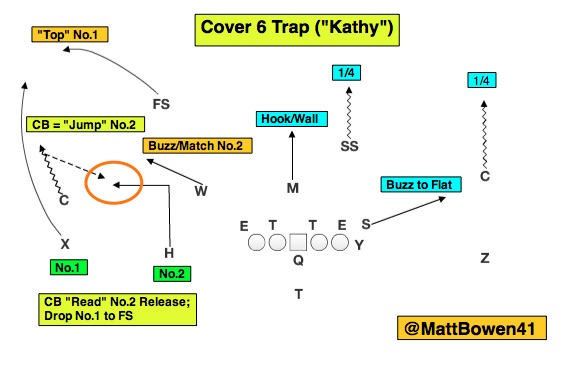
Stairs (2-step) have long been, but have recently become fashionable. With a bitter cap, read receiver CB # 2 at number 1. In this mode, it serves as a "2 matching" version of the second cap, with a slight mix between the 2nd and 4th caps. .
Here, CBs are generally (though not always) WR compliant because they have to explore # 2. They use a technique called 'soft squat' to dive, which drips into every face and second outline. Or simply CB's task is to read # 2, and if # 2 walks down the street, CB will make its way. Or, to put it bluntly, number 2 enters the trap set by CB. When this happens, safety is the number one responsibility, so you need to be able to move forward quickly.


Matt Bowen - This is cover 6, more on that later
Now that number 2 is going vertically, CB will continue to sink before it falls and safety will continue to follow the second standard coverage rule.

Reader for cat scratches
Matt Bowen - Note that CB will drop 1/2, then more

robber
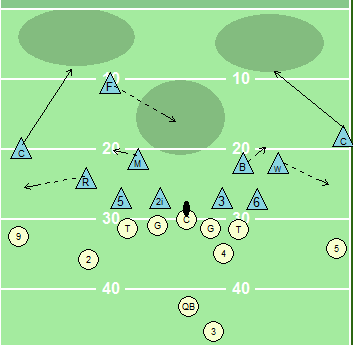
When he tries to interfere with QB reading, the thief seeks security by checking the hook area. When security drops to LSS, the external CB controls half the depth. Due to the deep drop in CB's external orientation and security, QB coverage may initially look like 3 and QB may be tempted to attack from below. However, the defense holds 5 of the defenders and this may not be the case for QB. Overall, the two-dimensional look is a great way to laugh with a single high-resolution cut and even after release.
This coating has the added benefit of frequent nickel casting at the edge, which adds safety to the runner's defense by throwing it behind the CB.


CB Deep 1/2, Safety Buzz
In this case, we can easily copy the CB security and safety responsibilities without displaying this preview. Like "Pirate", this single requires a high level of security, as security is often left locked when CB starts to withdraw. But by turning the lid, they gave security to the LSS and enforcement responsibilities, which could have increased speed in the background. This is a great way to simulate what you are trying to do in a twin or group trip and can allow the defense to have a greater response to the WW screen game (as security decreases quickly, which it does easier making the outside out). gaps compared to the faster WR screen when CB captures the preview.


Keep in mind that while there are two immediate threats on one side, most will come from this call. If you decide not to do this, work vertically on both # 1 and # 2, making sure your OLBs are ready to take any vertical path from # 2.

Copying should not be restricted. Many teams wear "Cover 2 Invent" on both sides, especially for workers who work hard (12, 21, 22 people) to gain safety in the race and do their best for the SBs.

Gridiron Strategies
Or you can copy it to Tampa 2, where the security hole is protected.

Shake Jugun
Also works well with nickel containers. Nickel can fall to a semi-deep depth and get stuck in the outer CB WR.

Copy (button formation, security mode)
"Flip" puts the CB where it is and the CB is usually safe. Often brothers do not like running races. Acne can be caused by blisters or a dull ligament, which often turns the road into a vital force in the race. To find a player who is best suited for this skill, teams can easily play CB and Half Depth and Half Depth by copying CB and vice versa.


Green 2
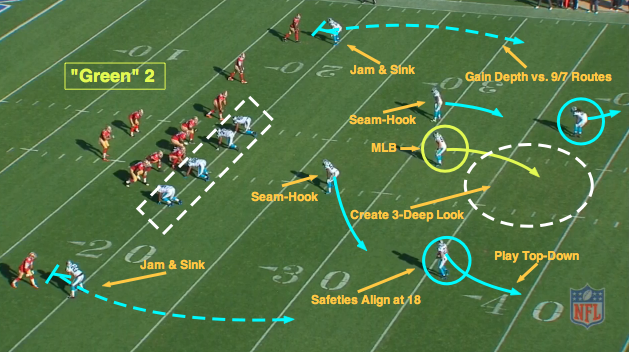
2 green is usually reserved for clear transient conditions. As the SBs lower and protect the handle more, he secretly places the guard in a "tent". The fuse generally bends slightly before lifting and MIKE can better cover the hole. The SL may push or close the first release to interrupt the path time, but then it is likely that the line cover will enter under the receiver (if the receiver leaves it inside, the SL will dig deeper into the area). The CB area will be external or more accurate than the flat area. Provides a level, but allows the defender to climb onto highways and gather at each crossing before descending.

Bleacher report
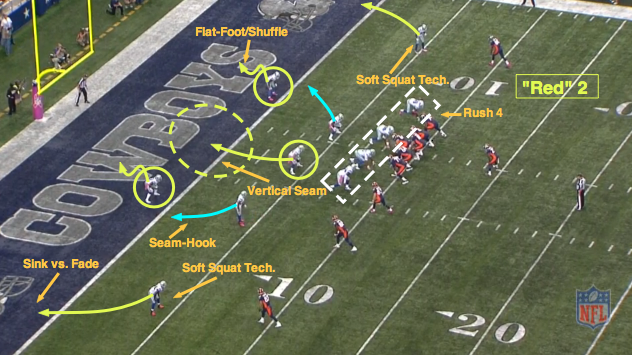
Red 2
Red 2 is a Redzone second round tournament. With fewer chances of reaching the top, Safety is more likely to play with flat feet and swing than rush. This allows them to get more involved in the run and helps them quickly avoid paths like slopes and potholes.

Cibs usually use a gentle squat technique to hold and protect the fuzzy track, as they do on the 4th skin.

Many game models in this field are fast, so they should be able to play faster than usual on their LB sites. This means that OLBs need to be expanded to better protect hooks and seams. MIKE also responds immediately to crochet and loop protection threats and hits the receiver, for example, on a cracked SIM fuse.

Lightning tracking
Many groups like to install, but are concerned that they will have to improve their coverage (or just do what they can not do). The cover can hold 2 to 5 people and still has a double-sided surface with 4 sides under the cover. CBs are flat, while OLBs cover the elbow areas. It may be a little weak in the middle, of course, but when the pressure comes home, there is no time to react and the back cover remains stable, allowing for a higher level of performance if your base is D.


Turn the flash
Another option besides flash is to copy the skin to the flash. This usually happens when DB interferes with the pressure pack. For example, if an SL enters the border, border security will rotate to cover border security and CB at a distance or nickel will drop to half depth. The rest of the defense, on the other hand, covers a flat area as seen below.


Combined coverage
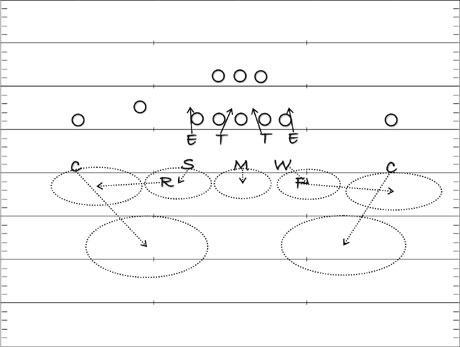
One of the advantages of the two top layers is that you can split the field in two and basically combine two top layers (0 decks, 2 decks and 4 decks ). This means you can steer the trap to the extreme and 2 standard pitches on the field.

Cover 2 can move to the border and Cover 4 leads to the MOD area, often referred to as Cover 6.


Two: You can use MEG on the one hand and hold on to the other if you want more human-human vision.


This could mean sending a flash to the edge of CB and playing it behind cover 4 (hold it as TE # 2 and push CB or DE on each RB release in that direction).


This allows you to combine coverage based on distance and distance, cracking, stretching, personal, exploration or more.

relations
Bleacher Report Cover 2 Primer
In the Matt Bow trap report
Shakin 2 matching models on the Southland cover

Monday, 20 June 2022

Film Review: 2017 OSU vs Indiana - Fade, Back Shoulder, and a Coverage Adjustment

AP Photography / Darren Cummings

Almost halfway through the game, the Indiana Huskies seem ready to sweat the rest at the start of the season. This will not be the first time this year that the team has planned a great game and an opponent is looking at a so-called enemy.

While on defense in Ohio State, Buccaneers wanted to play a wide range of defensive games, especially his body near the touch line in " Cover Sheet 1 " and the Indiana athlete. The OSL dominated the DL vs. OL war. But despite the relatively good position of the defenders from the outside, 'Indiana' has played almost perfectly. It can be said that the show certainly failed, but repeatedly with one of the two hires (disappearing or disappearing from the shoulder), IU QB Richard Lago found an easy pace to follow, especially with a large, safe body. Hand WR Simi Cobbs.

In this article (and later), we'll look at the original game plans that came into play and how Buckeyes coordinated the tie in the second half.

OSU Defense vs. Indiana Attack
Buckeyes pushed their LB and threatened to hit them from outside with a deep stop. The first push of the match was 3-3 nickel:


Here they can press with a normal one from both sides, play a MIKE charge and a funnel between two OLBs and RBs, or put one or two lbs in holes or curls to clear the underlying shortcuts. These are 1. Different surface techniques including LB.

IL will return to the traditional four-person front with different styles, but the concept of skin remains the same.


The first part was that the overthrow of the OSU was mostly because it threw a wrinkle cover 3 or put pressure on the LB (I'll get to it in a second). In this case, they have used safety rubber and replaced the protective devices.


But that, for the most part, left the Buckeyes vulnerable to the same Indiana attack, with one reading and two shots.

So let's take a closer look.

USO 1. On the surface

Although the OSU of the frame threatens several LBs of LOS, the cover is not hidden at all. The Buckeyes are challenging Indiana with this report and the IU knows they don't care what they do. This is Cover 1, Foreign Press, Athletes vs. Athletes.


We see CB in a decent position, mostly a little behind WR, but basically in a place where he can control WR with his hands and possibly play any shot behind the receiver. So throw the missing. Due to the position of the CB (shoulder compatible with the WR), the shot is best positioned to protect the shoulder with the back, but in the difficult position of being in phase with the WR, able to control the body and be able to. Create a blur game without PI.


The ball is kicked just wide of the goal. The coverage is strong, but not perfect, and the receiver leaves little room for play and the CB cannot detect the ball.


A little later, again 3-3 in defense, and again no doubt about coverage.


When WR is kicked, WR presses on the defender, protects with his left hand, and CB cannot reach after his turn, WR moves vertically at the moment of firing.


Okay, we're not hiding anything here.


The CB climbs fairly well on top of the WR, so it's best to drop it off the shoulder. But here CB synchronizes his hands and eyes with the movement of the WR to catch the ball and break the pass.


And another and the same


So you start to understand


Good coverage, but still a finish. The IU knows what's coming. Different configurations, more OSU coverage itself, and IU coverage 1 have made significant progress with Free Kick (human blow). They were able to combine a high percentage of games with a basic attack against what they would get. . Shelter


How OSU IU planned to slow down
Earlier I mentioned that Greg Shiano wanted to run like crazy on Cover Page 1 Speed ​​Ball: LB Lightning and Cover 3.

LB Blitz didn't make sense in this game for two reasons. The goal of the flash is to hit the boys in front of the defender and throw him from the starting position. Basically, he breaks his rhythm by hitting, speeding up his footwork, or moving instead of following his progress. 1) However, IU shot three-shot shots (vague, with a choice of back shoulder or pitch, so the ball comes out quickly), the attack never hit the target in the first half; 2) OSU DL only shouts at IU OL and presses itself when the ball does not come out. Defenders didn’t have to add in a fast-paced manner, they had to add to the cover.

The second curved ball is common to the 1st deck team, as it is clearly seen during delivery.


But here the UI puts it aside, so it is a similar version of Lagow. When the root structure takes shape it does not really help the external CB, so it does not affect the reading of the QB.


Advanced two security modes
So Bukiye is moving in the same direction, isn't it?


Well ... they're good in disguise, but what OSU will play is the 2nd cover (red) near the red zone, which will create obstacles.


There are some subtle suggestions (note the alignment of the external CB in the WR with the depth of the security area, to name the most prominent width of the security margin, but still subtle).

When you click, quickly close the two fuses in half and see the two CBs open from the inside (allowing them to release from the inside, they want their eyes on the QB).


After CB, when Logo sees his marginal WR pass, he wants to play Fed immediately. But now he has a security that he sees at the last second and grabs his fist. You have the idea of ​​a lost zone in the middle of the field. In this case, it is the concept of shock . And it's open. Open. Even with the indifferent path. But Lagov doesn't look that way, he has already decided which field he wants to play on.


It's her window when she pulls


It's sitting at the bottom of a CB and the security is a bit high and both defenders have a chance to get INT in a ball shot directly in the WR. Central bank councils were given the opportunity to provide security services and the crisis escalated.


Make an adjustment
I say this because OSU used the Cover 2 scheme in the second quarter. But they still haven't adjusted the game plan, it was just a curve. They return to the "cover 1" game plan and take a shot from the shoulder. This causes one TD unit and another to shut down until they return to the two maximum covers (in this case the 4th deck, before entering the IU FG series). Within the last two minutes of the walk, IU again took a shoulder shot against Deck 1. The regulation adjustment period, therefore, has only been effective in the second half.


In the second half, OSU had a lot of confidence in the top two defenders on the 2nd and 4th backs. And severely compromises their security, providing excellent support to their CBs and allowing outside WR to enter them.


This change forced Lagov to read the defense. This has prolonged his fall and forced him to stay in the bag against the onslaught of storms from his home. And when the single-high cover was used behind the bombing, Lago could not immediately turn back and shoot the shot pale or over his shoulder because it was no longer open. After OSU switched to two higher bases, the Hoosiers stopped moving the ball with lasting success. IU passed a few rugby against the front, but it was a rare and timely achievement.

Now a few things. Why didn't Shiano realize before that it seemed clear that his CBs were breaking down? There are several reasons for this: 1) OSU probably wants its base page on page 1, which they probably represent the most, they probably think it fits better with other groups in the program and they have a young composition; 2) Because of this application, a quick adjustment of the game plan can lead to failure (and the game has several lighting errors) because the boys do not understand what they need. Not only sound education but his alertness and dedication too are most required. 3) CB Buckeye didn't go so bad, so Shiano Hoosier's success could be considered unbearable. However, IU supported most of the half and changes to OSU did not work, so it became clear in the middle that something else had to happen.

The Ohio State coach knows his team best, knows the game plan best and knows what they want to do in the future and how to implement it. So it's easy to say that they've waited too long, but the reality is it's a chair training session.

There is probably no other group in the OSU schedule that can implement this scheme. Passage is a dangerous game in Oklahoma, but it's very different. Many other schedule groups can handle OSU DL better than OSU (OSU's DL though the real thing) and this may stop them from using OSU's 2nd base cover (and this may be one of the reasons they want a deck). )

There are a number of factors involved in game planning and season scheduling, but in the end, Indiana was able to take advantage of Buck's game plan, but OSU was able to direct and stop IU attacks. . In the second half.

2022 WNBA Week 1 National TV & Streaming Schedule

Friday, May 6 19:00 - "Indiana Fever" at Washington Mystics   Facebook : Megan McPeak, Christy Winters-Scott 20:00 - Los Ange...