Showing posts with label Defense. Show all posts

Wednesday, 29 June 2022

Football Fundamentals: Cover 4 Front Seven Leverage


We previously talked about Cover 4's various coverages, which allow defenses to change their appearance and how they respond to the trajectory while playing, which is basically the same as the original. This time around, I'll take a step back from what happened after the snap and see how the defense can benefit from a pre-snap pose. They are: leverage and depth. This allows you to fend off some of the attacker's strengths while maintaining your archetype. This article focuses on the seven forward positions and what they can do to take advantage of the hedging program.


line of defense
I won't go into details here as this has already been discussed . The point here is that you can play around with some techniques, especially with your DL, to help your LB adjust its leverage. Let's focus on the clock and cage modifications that drive the ED rather than the abusive EMOL.


In each of these cases, he put DE in it so that it could penetrate the space within the EMOL more easily. This is useful for the following reasons:

  1. However, given the location of the OLB, ED is likely to be responsible for the gap; If you push it, it will get there faster and without giving the barrier a chance to close it. It also puts OLB in a better position to fulfill its fitness and scope responsibilities.
  2. Identifies offensive player shots, making it easier for defensive players to read running/passing conflicts. When the EMOL is free, the OLB knows that it is progressing to bind the edge. When the TE falls vertically, they know how to run their coverage sequence (depending on whether TE is #2 or #1), when the EMOL stops, the OLB knows it's running on their outer shoulders. Basically, it looks simple: touch the outer shoulder EMOL for a race fit.
  3. It is very difficult for EMOL to create second level screens and therefore run/pass conflicts are hard to sell in play because the ED is oriented upwards and inwardly sloped. Which makes it difficult for EMOL to obtain an internal copy.

The drawback here is that overtime or TE has clean throws against the OLB which means the LB has to be strong at the point of attack and not hold back. In this case, you must rely on your DE to stay focused on your target and as an OLB stabilizer, scratch the game from the inside out.
Let's see how it works

backside
We'll look at five OLB positions that can play defense: Inside, Stack, Loose, Top, and Split. The interior is aligned in the defensive EMOL. Stack is stacked in EMOL. Loose has an outer color on EMOL. Apex will split the attacking EMOL and the next attacking player equally. The split is played within the split receiver shoulder, and the closer the receiver is to the configuration, the more the impact is matched to the outer shoulder.

in
From a 4-3 perspective above, the inside is the standard OLB position. He stands on top of his space and stands between him and QB with his offensive switch (usually OG). This position certainly helps the defense to deal with deep training and can be performed against pro or double formations. The key to the latter case is that security needs to understand their LB location.

Against a pair of twins, the Safety might want to play close to the LOS but more shaded on the receiver's inner shoulders. You're still reading n.2 as normal, but you should be able to accommodate fast exits because OLB won't be able to exit quickly. The degree to which you play against LOS depends on your game plan and the capabilities of the vault. The OLB can't be redirected to the bottom, so it's likely just a man-to-man cover on the outside. If security isn't great, you might want to play around a bit and move it around depending on how your LOS receiver looks. However, he blames himself for more running/passing disputes at other LB sites because security knows his eye has to be on a number. 2 in the whole game (and can't get into it that often). in the backcourt) and the OLB knows to run first and doesn't have to worry too much about getting out fast until the ball is thrown.

The main benefit of such a spread is that it makes it extremely difficult for attacks to cross the road, especially in shallow lands. There is a lot of clutter in the box, but OLB is in a position to clog inside easily. This allows the security to read all of the shallow interior spaces and move quickly to fill the doorway in a racing game.

Let's look at some graphs:


Note, however, that with any outing style, especially when an OLB is underway, you won't be able to go out to defend the ground. So security has to play consistently and jump quickly on whatever comes out. The security advantage here is that he doesn't rely so much on run/pass conflicts, and his eyes are always on second.


The advantage of this deep mode for WILL is that it blocks any escape route from #2. SAM in this case #2 moves to its side (when RB is less than Y-TE, it becomes RB #2 and follows SAM), but this leaves two LB to block All inner track dividers and the entire tone split into two outer sections and eliminate midline space while providing a security assist at the top.


pile
Stacks are not much different. The main advantages are twofold: it is difficult for the candidate to achieve the OLB cleanly and the OLB and DE can play gap responsibilities or even require the OLB to implement the appropriate DE depending on how it is liquidated.

It also brings the LB firing a little closer to the outside, but not too much. This gives you more chance of a flat spin compared to the standard deep poses. It can also help against the TE because it is in a head-on position at the time of the snap and it is not always possible to come out clean, especially in off-field action where the TE threatens to flatten the PA.

The stack doesn't hold transactions much differently than I would expect based on the lineup.


However, it allows the defense to play some responsible play in the gaps, forcing attackers to quickly adjust their blocking patterns on the fly.


If the SAM is stacked, it will be difficult for him to carry the Y-TE from the inside, so MIKE WILL KILL Y-TE and SAM will continue to attack the outer shoulder of the Y-TE. So when Y blocks that MIKE (eg Power-O) that automatically brings the SAM into the hole; If Y tries to exit, it corrects DE and maintains the correct gap (if DE is closed, it stays outside, if DE is open, it stays inside).

overseas
This is often associated with cage or jam technology, but not always. If so, you can check out the benefits and concerns above. But if DE is always on the outside, it has a slightly different front and bottom.


On the other hand, it can be sensitive to internal running, especially when MIKE is having a hard time filling up quickly. However, it is very effective against games and scenarios that take place abroad. Teams looking to unblock OT or TE on the spin screen or tunnel screen will now have to play slower development screen games, as these must be unblocked outside before the OLB is unblocked. This gives the OLB time to read, interact and play with the ball. Likewise, you can overload the edge and prevent attackers from picking you up and trapping you inside. They are basically forced to play fouls between tackles if they want to run the ball.


Here you can see that stick in #2 allows Will to get back into play and allows the upper security to assist.


summit
Now we go a step further and divide the difference between offensive EMOL and post-receivers. It is also often associated with cage and jam technique, but not always (particularly if the offense is committed on a larger stick, such as 11 sticks when two LBs alone can explain all the difference).


However, the main benefit of this lineup lies in the scrolling game. This puts the OLB in a position to cover the floor with a rapid overhang while still blocking any internal ventilation. Likewise, it can even allow redirection when the receiver enters the interior for the first time. Even with bubble screens and the like, an OLB can get to the point of attack faster and continue playing from the inside out without having to start from inside the box.


All external playbacks force receivers to think OLB with screens because they can force players. This allows for safety play on the inner shoulder of No. 2 Take into account the gaps outside it. This track filling technology can significantly overload the secondary and jams are difficult to bypass.


However, most of them still allow free exit from the hatch. This emphasizes the run/pass conflict where safety lies. OLB is a bit of a scrolling game, which is a nice aspect of positioning, but it adds to the run/scroll conflicts for LB. And security.

split, rip
The common attitude obviously took OLB out of the running game a bit. Having said that, security is often more involved because they have a responsibility to fill in the gap at #2 (OLB has responsibilities outside of #2). However, due to MIKE streaming, security does not need to be as responsive as other systems.


Security can also start a little in the future. Because OLB is well positioned to maintain the flat/curved plane of the field. However, it cannot be set to prevent internal versions; Each internal release must be countered by changing the path and then looking for another threat to replace the free receiver (as in case #2 blocks the internal gap or RB performs the swing path; OLB follows no internal release). This means that MIKE now has the responsibility to block cross roads, but recipients have more room to adjust their paths, allowing them to easily evade MIKE and swipe cleanly.


The biggest advantage of this is that OLB can forward any vertical path. This forces the receiver to define their intentions and puts far less security in run/pass conflicts. It also reduces routing time, giving the security more time to respond and position itself properly on recipients who will have trouble getting in and out of the break.


In addition, this mode greatly hinders the operation of the screen, especially bubble screens. The OLB is organized in such a way that it can meet the number 2 and follow it on every mission abroad. Besides, impose everything. Whereas the inner position (inside, back, and out) divides the plane in several ways, and the peak position divides the plane into three (outer end, middle end, and outer edge); Separate mode only fills the playing field, forcing objects to pass inside, and works against tight or sparse formations.


conclusion
The point here is that you can make tweaks on the frontend to help with the backend. Play OLB in stacking boxes with 7 defenders and force the attackers to pass the ball. Likewise, it reduces the running/passing conflicts that safety often encounters in Cover 4 layouts because it is known to be responsible for passing play at all times and can allow players in the box to focus more on running care. It also blocks the midfield, forcing attacks to play from flat ground.

At the other end of the spectrum, the split mode allows the OLB to prevent the release of loose slots. This slows the game down a bit and provides a safe time to read, react and make informed decisions when playing with playtime from an offensive perspective (OLBs can crash knowing they have more support). It also forces strikers to play in the middle of the field, which many modern strikers do not like. This reduces space and reduces the basic principle of violation: use field width.

Then there is the first place. Apex is basically trying to take advantage of everything. Segmentation of teams allows OLB to be part of the movement and execution. This increases the number of passes and ends the game if executed correctly. The difficulty is that more and more players are involved in play/pass conflicts, including OLB and security. But if they diagnose their keys correctly, there's nothing they can't remember.

Splitting this random formation forces attacks into a guessing game. You stack squares and the focus should be on outside play. You split the OLB and the focus should be inward again. It adapts to the higher position and the focus should be on creating run/pass conflicts. But the constant change of these positions forces the offensive line to constantly change what they want to do, and prevents them from increasing the speed or perhaps taking their favorite game from them in certain situations. It's about defense that controls what an attack can do, and if you can do it defensively, you're one step ahead of your opponent.

Tuesday, 28 June 2022

Inside the Playbook: Breaking Down Michigan's DL Scheme and Personnel

Brian recently wrote an article on MGoBlog in which he is waiting for protection while he waits. In recent days, he has also discussed the defensive line and has seen the recently released Michigan Depth Map . The question constantly pops up, is unconsciously answered, and then asked again. This is a common and understandable confusion when looking at football nomenclature.

photo AP
In this post, I'll take a look at the Michigan DL and why Henry plays 5-Tech (nominally called End) and Wormley 3-Tech (nominally called Tackle).


What is the race in Michigan?
I agree with Brian that the score is 4-3 short. Michigan won't go there with LOLB and ROLB, they won't go there and they won't take many steps (although 4-3 down often gives about two spaces). Sometimes 4-3 underfoot. On top of that, the defense won't constantly keep the Boys in a two-point position and will move the DL to either side, such as 3-4 ahead of Wisconsin .

Only 4-3. Let's all remember the tasks of gaps:


And let's see what par 4-3 less looks like, which most of you are familiar with from Mathison's early years.


Here, we'll call Weakside DE (WDE, 7-Tech) Buck (that's money, because "B" stands for "Backer" and MIKE stands for "medium to medium LB") to keep Darkin's terminology. This is actually more than LB, but can sometimes be lower (see picture below). We'll just call DE's forte (SDE, 5-Tech) The End. 3-Tech We'll call this DT (or Pen). 1-Tech We will call NT (Nose).

MGOBLOG

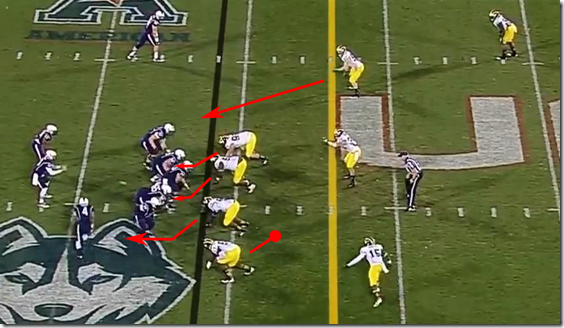
This is close to what works in Michigan, but not quite. In fact, the picture above is closer to what Michigan will rule now than what Michigan has done in the past with Mattison as D.C. Note that Beyer (SAM LB at the top of the screen) is in free mode. For the Michigan fans, it's like Greg Robinson put Stevie Brown in his run 4-3 under Stevie Brown when he managed to have a really good year. This is what we call a "free" extension, which means it's 5 and 5 (5 steps from LOS, 5 steps from EMOL attack). Ross, Will in the photo above, also uses free technology (in this case it allows DE to play or spy indoors, and Will allows you to play in a flat open area where you most likely have a direct threat in a running game).

With Ross, some SAM LB, Michigan will play more than lose 4-3.


Many 4-3 Under teams usually move FS into the penalty area as an eighth man and move SS to midfield. They do this because Buck and DT usually protect FS from any underwear, which is more common with ILBs (WILL and MIKE). It will look like this:


But Michigan won't do much this year. Instead, the SS man (who always stands in line to give the command) will be the eighth man in the box. It can be listed as follows:


But he will often come close to it.


In fact, this is done by another ILB missile. He is slightly defended until the end and the defense will not go unnoticed as the CC holds the lead and the SAM can work from above to provide additional support.

Rumley and Henry Primer
Wormley, for example, created SDE Design. Its price is expected to range from £270 to £300. He has good straight line speed for his height and shows a lot of explosions when he's comfortable with what's in front of him. Unfortunately for him (and in some ways happy), he is too tall and too tall. With the reluctance that sometimes comes when he has to take blocks from different angles, he often gets back on his feet. This makes him struggle with tasks.

Henry, on the other hand, has always been a DT. It is designed as a triple technology penetrator that can also slide and play with the nose when needed. He is squat, but he has the first step to beat OL to the level he needs. The speed of the first step gives him the ability to become a two-gap player, and his stockiness gives him a solid foundation so he doesn't get confused when he has to choose between two gaps. He also sometimes climbs very high, but he has the strength to fight him.

Brian expects these guys to perform well in the tutorial related articles above and there are videos showing these qualities in these players.

So why change position

dual purpose
Like I said, this has been explained but never answered. But the answer is very clear once you discern it. Wormley fights against doppelgangers more, technology will never give you 3 of these doppelgangers. 5 is likely to double in about half of the games, especially given how close Michigan is.


Please note that technology 3 is not repeated in its direction.

This means that 5-Tek has to hold off up to two teams at times, and it also means that 3-Tek can only release penetrating power inwards. If you can get him out of your three moves, you cut half the field and give Buck more chances than a pass because he doesn't have to worry too much about speeding up.

Whether SAM is in free range or indoors, tech 5 often doubles up initially against accelerated zone attacks.


Tech 3 multiplies here so he should be able to handle quite a lot, but the multiplier is unlikely to last as long as OL is trying to get out as he pleases and is in the background of Play.

Against human blocking schemes, it will multiply in any strong direction (e.g. Power O, Counter F).


He must remain in this position if the hasty defense succeeds. If he doesn't fight back, he bathes in ILB and big wrinkles as a defense, especially when SAM is playing a loose lane.

two way player
But there is one more thing that 4-3 Under-Teams usually do. From Pete Carroll to Will Mushamp (and I suspect Dworkin), these 4-3 deputies want 5 tech variations, which means they'll put him at the top of the OT (4-Tech).


From this point of view, in the end, Seattle put everything on Michael Bennett and why they created Frank Clark as his understudy. He is a boy who can slide inside or play outside. He's a guy you can play games with while still maintaining the same defensive base. Keep things simple for 3-Tech and let them attack, but get a 5-Tech who can do a little bit of everything.

This scheme is well described in some places ( here , here , here , here ). This is what Henry will have to do on normal landings and distances. Henry will probably dive a few times and miss a touchdown because Wormley is the most natural runner. Both can play indoors and the other goat can fold. But that's why the Michigan depth chart looks the way it does today.

So DE can get more involved in escaping from it.


He can also reverse the block in his own running direction, setting MIKE to break the barrier at the point where he wants to reach the sprint state.


The ability to leave both spaces allows Last to blow up block missions at the point of attack (imagine a blocked opponent trying to corner him, he can easily see it) or push inside the block and play in the backfield. (I think OG pulls in his direction and End explodes when he runs from behind.) Anyway, it could be more intuitive and more fun, and MIKE can fix that. It also helps him to be more flexible and instinctive in speeding up the transition. To do this, of course, you need a player who can play doubles, can read the tracks, and is athletic enough to play. Michigan is looking for Henry to play this guy.

Sunday, 26 June 2022

Football Fundamentals: Defensive Gap Discipline vs Formations, Pulling OL, and FBs


For the defense to be successful, they must have "gap discipline". Having an "empty sound" means placing defenders on each side of each blocker to stop the attack. If you have a defender responsible for filling the game on every empty field, the defense in the LOS forms a wall, and the attack has no chance of success. The purpose of the attack - to lose the discipline of the defensive gap or not to narrow the gap (free up space). Any empty space is an option for the ball carrier, and any empty space is useful for leaving an attacking play. In this post we will see how gaps are formed against certain formations and we will see how blockers and shooters change numbers at the point of attack.

Standard Pro-Style O
Let's first look at 12 employees who are apparently supported by just one company. This is a common aspect of many modern bands like Iowa or Wisconsin. Usually these groups have a zone attack and add TE and wings to add its gaps throughout the LOS. It must be a disciplined defense, both forward and sideways. 10 spaces go from A to E on both sides.


Standard stretch
Well hired about 10 employees with double twins. Note that the gaps are equal; The presence of WR does not mean that protection should not take into account gaps on both sides. Many fast WR screens use protections that cannot take external errors into account. During the game, defenders can often "two gaps" (protect two different gaps), and continuing will help you fill another gap, but the game also allows you to stay locked on the field, which means to give meters (just the front closing does not mean that the gap does not exist, its origin is below the field). Advanced pharmacy works next to its advantage, with some "big" gaps.


travel training
You can change the numbers by placing more blockers on one side of the center. Something like a pharmacy has spaces between A and F on one side of the pharmacy and on the other side of the pharmacy there are gaps between A and D. There are still 10 spaces to protect, but usually let them adjust. High School or LB.


An unbalanced workout or victory works the same way. Usually the method of protection is to determine the location of the third PR (central) and make it the nominal center; No matter who enters the ball, the OG can snatch the ball, you start the spaces with the middle OL number.

OL tiranne
By dragging the OL, you do not add a space, but move the space. The advantage of this is that you remove the empty space on the back of the mold and add it to the mounting point. The problem for protection here is that they have to adapt to the gaps. They usually have problems with gap manipulation in groups of zones, especially in extended formations. Gaps are gaps, and defense knows the gaps that need to be defended. By pulling the lock, let the defense adjust to the flight. Adding more gaps in a practice game makes it a little easier for the ball carrier to take advantage of the gaps left by the defense.


Of course, sometimes you even get rid of OL. It does not change anything. Dragging the OL from the outside adds two spaces from the outside, removing one space from the inside.


Insert FB
Using FB as a crime will lose your vertical threat in a passing game. To complement it, add variety to your run. Starting with LOS, it can be inserted into the FB game to add spaces throughout the LOS.

The power unit adds outer space to the playing side of the formation. Typically, a unit is an ignition unit that opens a gap in that ignition unit; Sometimes, however, the blocks fall, and Belarus can bounce. The demand is the same, but an empty space is inserted inside and outside the site.


The advantage block also adds a gap in the gameplay, but now it's in format. Typically, this causes the LB to adjust in flight to protect the gaps. Of course, before the game they do not know where the gap in the formation will go.


In the case of separation zone E, an empty space is added to the background formation. In this case, the defensive back makes it difficult to enter the game and closes other internal gaps, which opens the incision of the Republic of Belarus.


power over
Games like Power O (or Counter F / H ) turn the empty square toward the mounting point and add an extra block to the game. Basically, the playground adds two spots to the snap. The defense must, of course, be brought to court for reflection.


Closure
Each style has its notable strengths. Expanded formations create larger spaces by displacing and forcing defenses to cover the space; However, they do not support a wide range of games during runtime, as there are fewer blockers to work with, and external acoustic protection can create two gaps in most external gaps. Formations with FB can insert spaces anywhere in the LOS; The downside is that you lose the vertical threat, and from the LOS you have to defeat the defender to the point (or he can start making two holes or walls, like the formations scattered outside). Headquarters with 12 identify the best gaps in the front tie, and two gaps in defense make it difficult to penetrate the LOS for most attacking players; However, as in extended formations, it is more difficult to hold different running matches, and you are usually forced to play in narrower places because you do not have blockers to stretch the playing field more horizontally.

So they all have their strengths, they all struggle to defend, and they can all be used to advantage in the offense. But ultimately, because defense plays football, it can block any attack.

Wednesday, 22 June 2022

Inside the Playbook - Michigan Defending the OL Pull

The Michigan attack will bring a lot of OL. Also, the Michigan defense will take more teams to the OL, which is getting longer and longer as more teams return to the men's / space lineup, keeping the team focused on their belts. Opponents of these games are arguably more dependent on power. In this article, we will look at how Michigan protects Power OK and why they support it. In the next post I will tell you how crime can react.

Earlier I discussed how MSU protects the food supply .


Power information:
I talked about Power O for a while, the ability to break the blockchain from the start , run it and read from different configurations .

But it all comes down to FB LOS with a lock, leaving the guard behind and creating an extra opening on the side of the game. It brings security.


Defender B's side gap has disappeared, but now there's an extra gap in the C և D game that the defense needs to consider. We'll see how Michigan does it.

How to get to the playground?
Here are the basic Michigan settings for most power and lock models of most games.


The center will stick to the back NT. This means that the NT is responsible for the gap between the centers. Part of the 3-Tech game: Part of the DE game is responsible for the B and C gaps, respectively. SAMD is in charge of security clearance. This means that there are two gaps left in the side of the game that LB can fill. . The extra space C created by the attraction, compared to the space A game.

Example 1:

Michigan is developing a strong eye-shape. The protection 4-3 slacks are on top, as shown above, at the edge of the SAM, above the MIKE, with a strong side opening. Red Zone is the defender to follow, and Yellow is the OL leader. Behind the red-circle defender will read his OG keys
Appearing in a wild blue box, it is safe to read to fill the path. OGIO will be the target of attraction, because all DLs in OL LOS have blocked և LB Note how fast you will redirect OG as you watch OG pull.
He makes an opening strike on the A side of the game, with which he tries to break the extended OG and starts a vertical cut towards the LOS. OL did not respond as LOS was being sued.
Cut, deepen হাতে hand blast waiting to meet safety.

Football reunion

Example 2:

The same thing applies with Michigan straight twins. Michigan has raised the LB a bit by playing close to their LOS. Note that the DE game is not too far away from you, it will start a call from OL, which will force TE to try to disable DE և FB tasks before SAM.
Again, Red Square is to follow the defender, Ozi that kicks in Yellow Square. The OL locks down anywhere in the front, when it hits the TE, starting to move through the և FB hole.

Ignore it for a second when DT dominates his man, he comes back as soon as it is not useless. Note that the defender in the red box is working to open the A side of the vine with a long oz.

OG really works security. If it weren't for the LB (և DT, winning the attack point) it would have given a great victory to the well-blocked. But LB's ass is doing his job, no one can hold him accountable.

Slice, on the back, that Arabic has nowhere to go, although the front side is very tightly closed.

Unable to read key
Here's a little out-of-place play. FB is meant to be a trap when RB և Jet Motion removes the protection of WR games.

The boys canned like before.

Quickly, the LB moves quickly vertically instead of retrieving the original key. He was caught with a fake key. This is potentially bad, as it is released at the OL LB level compared to the game and is made for 3-tech block cheat.
3-Tech does a great job of taking blocks to the second level, after which it works faster. Trap blocker can't maintain adequate level և it needs to rotate around 3 technologies, try to lock inside. LB now realizes he has to follow the trailer, but it's usually too late. However, in this game the FB has to go 3-tech before cutting the pitch. The result is about 5 meters. 3 technology games reduced the fact that FS could save 10 meters before meeting FB, or continue SAM because LB was late for his job, which he had to return to OL. : Fill in the extra space on the playground.

Consequences:
It's a very aggressive way of playing defense. It's not about working from the top down, it's about going down, but attacking from the bottom. Strong intrusions can kill any game, as an extra blocker during an attack cannot explain what is behind it. But that doesn't mean there is no answer to crime. We will discuss next.

2022 WNBA Week 1 National TV & Streaming Schedule

Friday, May 6 19:00 - "Indiana Fever" at Washington Mystics   Facebook : Megan McPeak, Christy Winters-Scott 20:00 - Los Ange...