Showing posts with label Offensive Line. Show all posts

Saturday, 25 June 2022

Football Fundamentals: Pin and Pull Scheme

Zone expansion schemes (outside the area or wide area) have long been preferred for attacks across the area to go outside or at least emphasize horizontal defense. Teams like Iowa have long used it as a support for a single support group (often 12 people), while teams like Northwestern have often used it to threaten protection against growing formations. Several other teams, including Maryland, Indiana, Penn State, Ohio State University, Michigan and Michigan State University, recently played this game in their files. But if it is known to be the basis of your hurried attack, it has a fairly direct lock that allows the defense to attack and cover it, either by shaping or by attacking after the attack, so it is sometimes helpful to have options. from the same play. This is where the concept of betting and traction comes into play. The "pen and pull" concept is basically a slit / person shortcut that will switch to OL to attack with what is essentially an expansion scheme. Let's see.


Outdoor area
Basics of football: without a scheme of zones :

Prohibition rules
To really simplify this section, we will treat all rows as if they are equal, instead of dividing the front and last OLs. There are two main principles: closed and uncovered. Closed means you have someone in a row above you or near the playing interval; Hit means there is no one above you or in the gaps on the side of the game.

If you are protected, you will be responsible for the person who attacked you. Many coaches talk about what the 90-50-10 rule is all about. If you are selected but there is a defender in the queue for the match, you will be designated with a 90% probability to guard the combined unit at the first level. If it goes into stop mode, the probability is 50%. If it is shaded at the end of the game, there is only a 10% chance that you will be the main one.

If you get caught, you will see the working side of your barrier and you will work in lock groups from the first defender to the second level. Again, it is important to note that you continue to block your territory while working on the second level. When you leave your area, wrinkles are created for penetrating protection, so you should not stick to your block. Depending on the type of region mentioned, the first level is equipped with aggregate or unit blocks and works on the second level to close the LB.
As for Belarus, it is of the same material
Teams going outside the zone will have an initial RB pass somewhere 4 meters outside the EMOL to the inside of the TE foot (or a hidden TE). Again, this is usually a reading of RB by two people, the first is EMOL (or forced ball) and the second is the second DL inside. As inside, the judge defender must be patient and not wait too early and not jeopardize his defensive ability to put together Belarus. "Click on line" only applies.

Although the game is designed to reach the edge, the ball rarely bounces and reaches the edge (unless the defense is inadequate); However, this is the main task of the district office in the so-called "regressive reading". If the face is filled and the game is forced to return, it is considered a pair. This is called "reading noise" and is included with EMOL. Finally, when a piece is removed, the RO can do what is called a "curvature reading", reducing it to a space in the game.

Here's what it looks like:


It more or less covers the general plan in terms of stop rules and target points of Belarus.

Protection of the expansion zone
To understand why teams often turn to these alternatives, it is important to understand how teams generally support long-term play. The purpose of the outer area is to create a horizontal deviation. She does this by either washing off the shield on the sides or covering it from the inside, which creates natural wrinkles.
  1. This DL is provided to "install"; That is, it keeps its outer arms free, reaches its slender body up to the septum, and absorbs forces and blows from the outer legs so that it does not move outward. This closes the gap.
  2. LBs, especially in the second level, are quickly filled by open compressions. Sometimes called a "bright or cloudy" reading, that is, open curls that you plug in and then hold while holding a square base and shoulders with LOS. They can attack quickly because the OL directs them towards the ball, so if they can read the alignment quickly, they can attack immediately. It effectively forms a wall.
  3. In terms of configuration, one of the best ways to disable an outdoor playground is to have 7 Technologies. This means that one leg is extended to the inner shoulder of the TE. Note the outer area diagram that the RB has three pruning options: bounce, noise, and bend. Well, hack 7 technology eliminates two options and causes the RB to deviate from within. The Tech 7 must therefore be effectively sealed from the inside, but because it is on the Tech 7, the OT is really difficult to overcome the unit combined with the TE. This causes the TE to delay its exit to the second level and allows the LB to fill the edges and form walls at the point of attack. Thus, the offense remains a forgotten, distinctive feature of Tech Seven and has a wall of troops and possibly a free LB on the edge to take over the right wing of the RB, or quickly leave the combined unit and the stack to get troops inside.
These reasons are the reasons for the efficiency of tariffs and withdrawals. DLs can no longer dock because they are looking at the block rather than approaching the block. The LB cannot read the coverage area faster because no current flows in the opposite direction, which delays its reading and causes it to occur frequently. 7-tech is now installed indoors and pulls shutters around it to fight edges more effectively. As a change, get right and drag, take advantage of how defenders try to cheat to stop the area from expanding.

Define the forehead against the back
Let’s start by defining the front and back game, as this will change the way graphics are closed.

Forward : Most teams define it as any block that joins the schedule from and covers the middle after the game - OT in the middle

Rear : each dam is connected to a modulator in the back of the middle - OG from back to back TE).

Some teams will include back OG as part of the front, especially if they do not use TE on the game side. The other team does not determine the front and back, but will stand out and play the whole team. This is a variable that changes the scheme a bit, but the rules remain the same.

rear base
It's simple, you block just like an area extension.

rules of confrontation
Like area diagrams, there are two scenarios for OL: closed or not.

Covered: if you are protected, it means the defender is on top or between the side of the game, you cover him.

Hit: When you get caught (without hitting the player in the head or in the slit of the game), you lure and block the first boy to cross your face.

Now some teams will change it a bit to help their players or some players. For example, some teams will treat a vertical defender as a person who has to stop. It depends on your team and players how you want to define it. Others will identify the defender on the side shoulder as "covered", and they will need a closed barrier to reach that defender to prevent the defender from penetrating off the field. It depends on the preparation.

An interesting basis
Like I said, it's a sign of emptiness / people expanding the area. This means that the bottom block covers the gap, and the box has a ball of the second level, which is responsible for the blocking. For the most part, they will try to lock their defenders inside to allow them to play outside, which essentially bends the defense. To do this, they will try to get out of line if they can.

All traction devices must be unlocked. Save pull work on Power O, because the boxes do not have to go completely. By means of a needle and a suction, they are better opened by an external leg and clipped in place.

Sometimes the first load may need to thwart attempts to lock in the protection and use impact blocks. Often defenders try to establish an advantage with the second level ball. In this case, if the defender reaches the LOS before the drawer is rotated vertically, the first box coming out of the formation will hit the defender block to let in the RB box. He had to enter this block with his fifth move, and then, when he was disobedient, ran out onto the field and tried to seal. Once the box is vertical and square, it will look inside to close the fence inside.

The second attraction, or if the center is the only one, will work a little differently. They should try to include the defense. They also want to theoretically get out of shape, get rid of the back of the lower outdoor unit, move the field and help cover up the internal defense. However, they must quickly defeat ILB; When ILB leaves the game, the defense can form a wall at the point of attack and make life difficult for the attacker. Therefore, the boxes do not want to add depth. If the shield can penetrate forward, the box will get a clean first-hand screen that blocks it.

This is therefore the nominal closing position:


This is what happens when the second level loader moves outward and when the first level defender moves forward, forcing the second level over the OL.


TE and OT
At the front of the outfit, the general rules had to be adjusted, often due to unreliable hinge fences with lower blocks. Let's look at the different combinations of these two players.

ACHIEVEMENTS
Blocking of clean access will only occur if there is a guard in the space outside the TE, and there is another shield in the space between overtime and TE.

Nutrition (strike and intervention)
The EAT unit will be a combined unit from TE and OT to level 2. Basically it is your standard open area block diagram. TE and OT will team up on the first level and work with a second-level defender, usually a strong LOS surprise defender.

TEX (Final Transformation)
Not to be confused with the action of TEX on DL, the TEX block sees the TE block below and the OT below. The chair will use the usual lottery rules: when a guy leaves the LOS, you leave when he hesitates or stays on the second level, you hit his outer shoulder and lock him back.

It is important to note that the TEX block can be played with one ball outside the TE and another between the OT and TE or with one ball between OT and the TE and the second level ball.

TESSY (SS intervention and cessation of production)
Usually spelled as TESS, but the words TESS and TEX sound very similar, so I just wrote TESSY not to confuse them. TESSY will only work if the LOS has only one defender, and in our case this Defender was set up outside the TE to distinguish it from the TEX.

by T
Down T is an interesting option that is not widely used by teams as it is difficult to play if the defense is not configured in a certain way. But Down T is similar to a mix of TEX and TESSY. It can only be activated if the defenders are outside the TE and the LBs on the second level are far enough in line so that the TE can shoot them directly at them. In this case, it will release the TE from the inside and immediately try to lock the LB from the most playable side (its release has the added benefit of making it look like it is locked inside). The additional player then hits or reaches the defender outside the TE. The game works well, especially with the bullet blocker in the form of FB to deal with any minor players trying to fill the gaps.


example

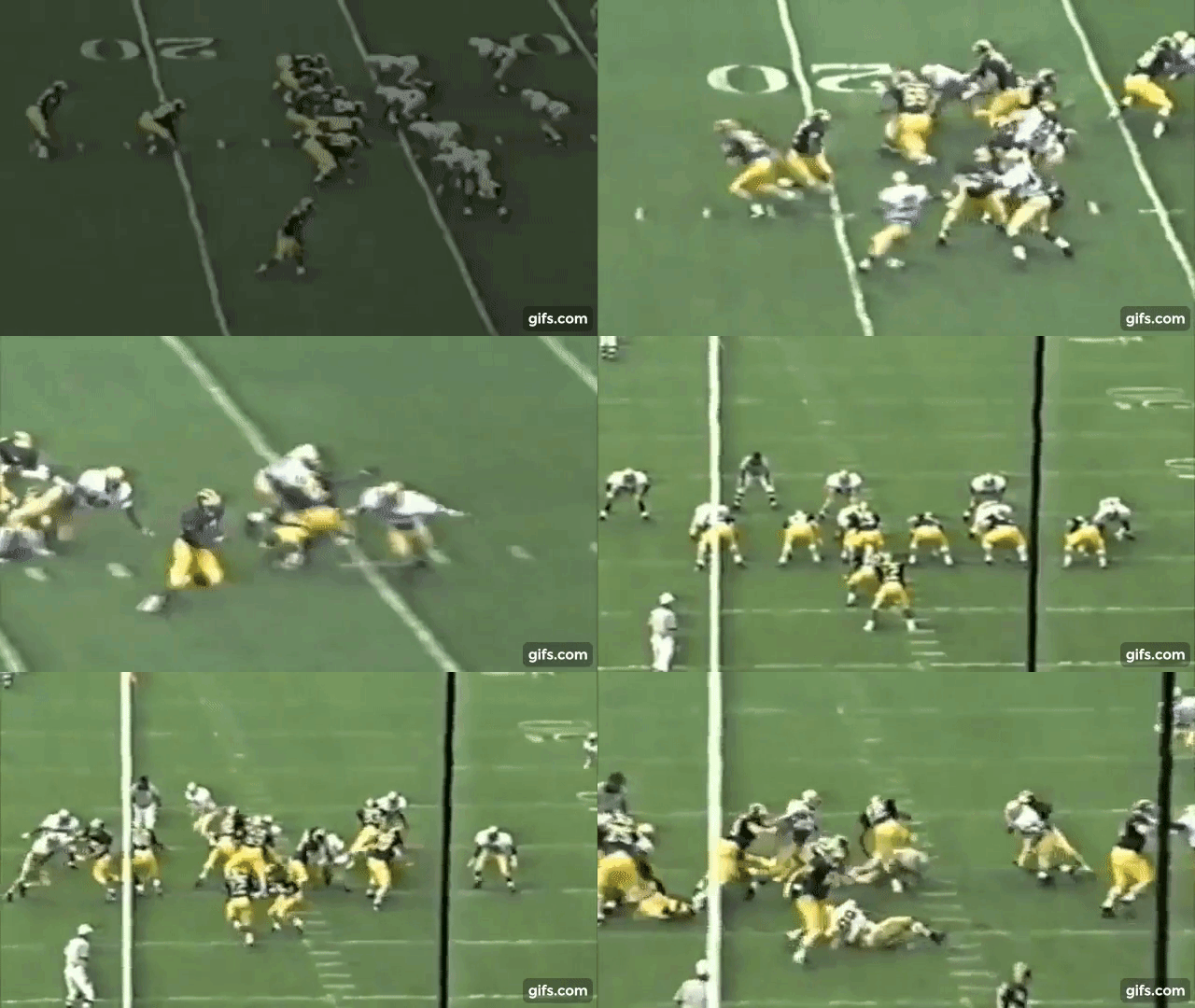
Of Indiana's broken tendency to run outside of MA :

TE and OT are established here, and forward OG and average are extended


Here the TE is fixed, and the OT is subtracted and the front of the OG. Note that everyone in the middle of the buttocks is just doing the work of blocking the outer area


Finally, here is a look at the TE mount and the front of the OG, and the front draws the OT and center.


Monday, 20 June 2022

Inside the Playbook: Michigan State Pin and Pull

After a period of unsatisfactory years for MSU OL, the Spartans plan to reshape most of the class and put an honest youngster in the starting lineup. Here are their current lineups and key players .


position LT LG VS Arji rt LT2 floor 2 C2 At 3
player c chew T. Higgins We have B D. Beetle L Campbell D.Finley K Jarvis Mr Allen J. Reed
Year RS-SO RS-SO RS RSJR RS-FR RSSR IN RS-FR IN
Long 6-8 6-5 6-2 6-5 6-5 6-7 6-4 6-3 6-4
ballast 284 293 302 329 293 307 312 301 271

I would say some of these weights can get "academic details". It's not the calf that's growing at Spartan Stadium. Michigan State quickly unveiled one of the most diverse running books in the league, right there with the team's Michigan Harbaw. Run Power, Counter, Sweep, Traps, Internal Zone, Outside Zone and Yes Pin and Drag. But as his skills dwindled, so did his notebooks, and most of the strengths he attributed to Deep Zone teams have evened things out over the past year. This year they also introduced the small but nimble units listed above with an emphasis on "Let's get people off the ball" and "Force the defense to move with us and rely on the corner to find gaps." This should lead to more outdoor areas and pine trees and pools, which will be the focus of this article.


before
I talked about the outside zone a few times and blocked and shot a lot. In reality, little has changed. The idea is that behind the scenes, you're basically enforcing the rules of the outside area. On the front, if you have a man inside, pin him. Otherwise, draw and get a secondary block. The beauty of spit and drag is the collision on the front 7. Low and drag blocks provide more useful angles and are combined with a plan to prevent the defense from accelerating and reaching the "square".

But MSU is doing a thing or two differently than before, and I wanted to address those things.

closure of the outdoor area
For basic stretch games, MSU uses two different types of blocks: "area access" and "fixed access".

Zonal target
If MSU is not covered, OL will use the zoning method when receiving in-game assistance.

The first step should be to play from the side of play with the outside of the defender's outside shoe. The second step is to split the back leg of the defense. The third step is to build external capacity and start gaining access to the court.

The inside arm of the block goes over the forehead (the inside arm of the shield) and is pushed into the chest. Taking this hand does not allow the defender to control the block and allows the defender to move more freely. The outside hand must work to benefit from the protective chest.

Strict access
So the OL Comp next to you and behind the game cannot help you.

The footwork starts with the same "zone range" but the hands are different. Here, instead of hitting him in the arm under the defender's arm, pull his hand across the chest and close to the chest. The purpose of this block is not to scatter directly, but to use defensive power to get out of play.

If you're not covered, you'll have to do what MSU calls "short endurance." With this blocking technique, the blocking penetrates the defending knee area and determines at the third level whether the rescuer should continue or move on to the second level. The first step is to point the foot of the defender and move to the side. The second stage starts vertically, the third stage is the decision to stay or to leave.

Add and drag tags
MSU uses an in-game system that allows you to apply a specific PIN and shoot whenever you want. This means you can start the game with a combined 1-T block to start the game, but block the CAGE later in the game (block the bottom block with the player's defender, turn in the center). You can also place TAG (Win and Hold), TEX (Win and Finish) on the outer block where the inner wiper folds. And sometimes they pull the OGs back and tie them in the center with a "badge".


Folding lock
The first feature of the MSU pivot and tow plane that differs from most other planes is that it does not always carry the ball. Of course, they don't have to worry about pinching the defense and putting the game on the net. But just because the trailer is designed that way doesn't mean it pulls all the way forward. In fact, whenever possible, they prefer to "block" when exposed to the second level.

It looks like this:

side by side


From the final area


Practically. The red box is the pendant. Note that the traction increases. MSU uses a diving pool (type of toboggan for bikers).


(at the same time)
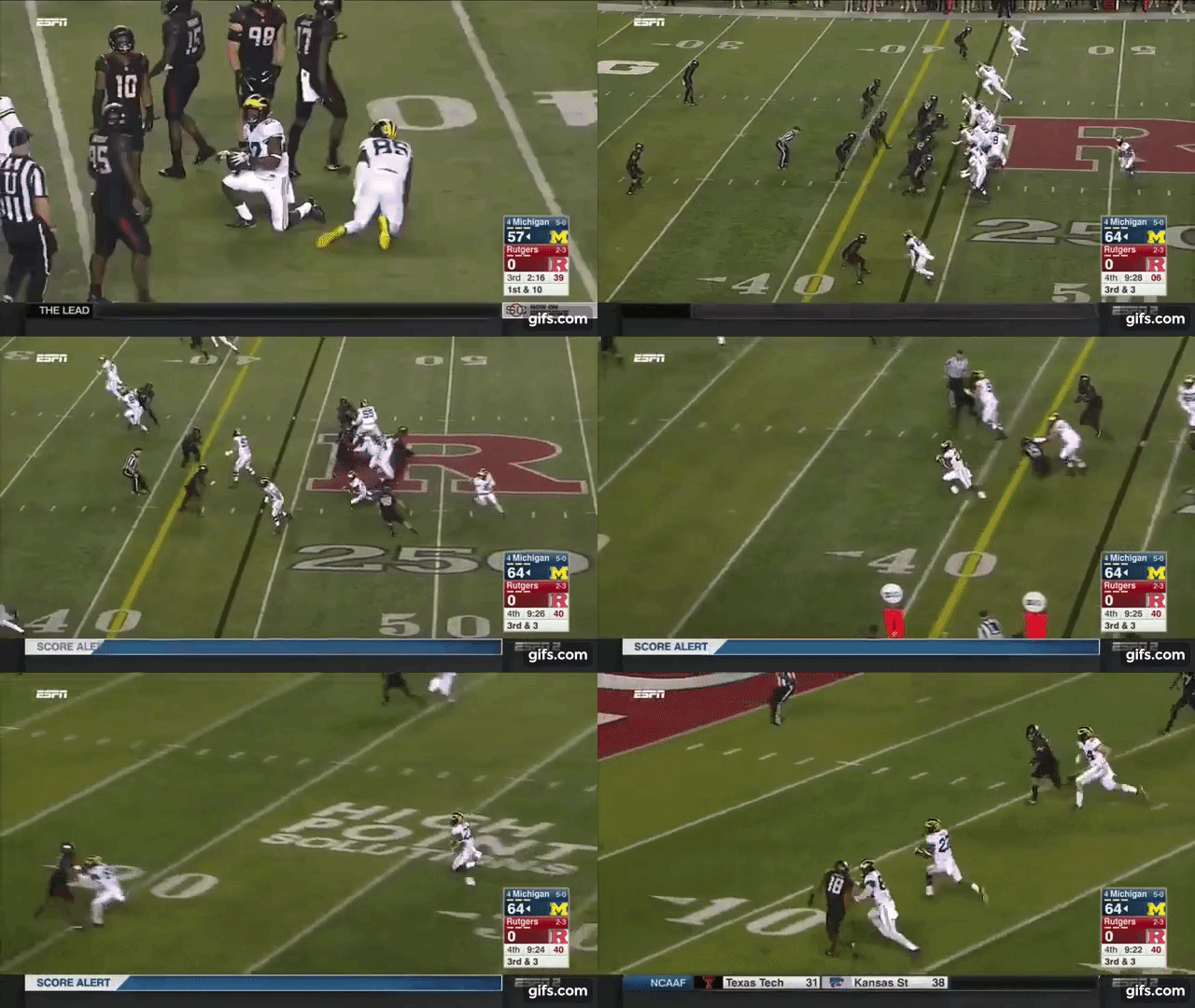

Watch the middle work down to the level of the rear LB and cut it off when the trailer reaches the front LB.


This can be seen in the Vimeo 1 ፡ 06 06 video below.

In other words, in theory, the lower blocks and the back blocks are the transition zones. This is an important point, because to bring a person to the second level, it is necessary not only to bend, but to bend to increase the angle of the lower block, but also to "pull" the observed " curved blocks" . According to the rules. Area restriction rules. That is, when DE enters, it is the cross-blocking work that exerts an external influence on the charged DE. MSU calls this connection "5" (or someone who vibrates from 5 techniques; originally it is called "connection with 9").


Look now, DE starts running inward. The Old Testament allows him to go with little pressure and begins to progress to the second level. In between, anyone who looks like they've started jumping needs to get that shiny DE first. Remember he changed OG zones, this is the first DE to enter the zone. RB, he had to read EMOL defensively, he had to see all of this happening in front of him and he had to fix it. Now he knows he's not cutting like he usually does in EMOL, but he wants to get out of it.


From now on, the center and the DE are fully involved.


Notice the middle leg here. Lower your waist and fully bend your legs. This allows the DE to rotate inward, allowing the cultivator to work outward.


This can be seen in the first two episodes of the Vimeo video below.

cross ban
Another change made by MSU is what they call "cross blocking". This is for overkill DLLs, but try locking and unlocking. When DE tries to play hardball, MSU stops at 3T and leaves with the gamekeeper.


Note DE does not work downhill, slide down, try to limit outside. Many teams do this in the face of area damage to build a wall in Los Angeles.


OG was present when FB went to LB Playside.


And again, a good job is to get outside influences in and imprint DE from within to keep RB out.


This can be seen in the Vimeo video below at 4:30.

shortcut
Here is an excerpt from the pine and billiard plan (Vimeo video)
Pin and Drag Theory - Michigan State University by Eddie Ostepo on Vimeo .

Mike Kuchar also took a closer look at the MSU PIN and Pool method in X and O Labs . Here is the link to the article (everything needs an intuitive approach, I don't have one). For me, it has all the coolest pieces you can put on below.

expansion plan;


connect and pull;


summary
This pin and pool plan combined with the plan allows MSU to become a favorite and not be relied upon for big advances in LS control. This way they have the right angle to the bottom block and a different but unitary plane that can still fight simple rules on every front. This way you can cover some of their weaknesses and focus on their strengths.

Wednesday, 8 June 2022

Let's Speak Technique - Blocking the Draw Play

Draw is one of the most successful racing games in all gaming collections. It's universal. As for dates 1 and 10, it works for dates 3 and earlier. At first glance, it may seem that this is a game with bait. But it allows the attacker to pass without much movement. Of course, if the DL rushes and hits out of sight, that's fine, but as always, you just need to have good footwork to get between the ball carrier and the defender. In this article I will talk a little about the techniques used in painting.


point of attack
The place where the prohibition varies from plane to plane is attack. You can't let the defense talk here because if you do, you'll ruin the whole game behind you. Your preferences as an employee and experience may vary.

Fixed units


This is a unit of total area in which two judges set a high limit but do not receive an important position (i.e., they do not move). First of all, these two had to stay in the territory of the VOC and stay together so as not to part. If you are protected, you won't be able to reach the ground from the side, instead focus on getting half your protection. If you are an unhindered unit, you will be ready to close the gap between you and your united partner. You have to be patient and let the defender go where he wants to, not get out of temperament and balance, otherwise you risk splitting or not being strong enough. Protect your land in LOS. They do this to invite the passer-by to go where they please, but to keep the forces equal and close, so that the defenders are not divided. When the DL bats out of combination, the offensive player pulls the defensive player out of the hole. When the other OL is released to LB, he turns or pushes the defender (you can no longer split) to ensure that the partner maintains his strength when released.

AUTOMOBILE


This is usually done in an attempt to immediately remove the tear protection. If you find it difficult to move OL from a block located in the current block, simply exit and block to make sure you are bypassing the attack and not allowing the inside defenders to enter.


Short Compilation - Drive


At least a short set with at least one point will be enough to make a high class hat and make the inside protection look like tops. When you have completed a full set (after restoring the foundation), change the momentum and start the machine block. The idea here is that the defenders can't shoot harder and lower like they usually do against the current block, so now you can use them down and pull them out of the hole. This is a faster and more aggressive tactic. It is important to prevent the defender from changing the gap when building this car assembly. If your body can move, your short gathering won't give you enough strength, or you won't be able to quickly rebuild the foundation to reach your goals.

Combined block


Another option is to sell the surrounding blocks, but treat them like a real block at the time of the attack. This is usually done to remove Breaker A from the roots. This opens the door for the first action at the attack site and allows OL to turn objects into a traditional blockchain. The rest of OL shows its drawing effects.

tuck


Drawing allows you to play with pencil blocks without using RB blocks. The wrench can also be used with short sets and discs. In this case, the folding unit should have a deep drop before turning the machine unit (i.e. one step deeper) or a short knot (2 steps back) before turning. In his collection, he wants to close the gap between him and the driver for sharing the whole plan. Briefly - Add the combination you want to insert first, and then the folder will be deleted correctly, but only if it goes to the second level.

Come out for free


Some groups do not unite the first block, but only "influence" the covered PR. The uncovered immediately go to the secondary ones, often to prevent the defenders from working in the gap.

Stay away from the attack
Hard Pass Set This is a relatively strong set of passwords commonly used for level 3 and 5 invites. "Impact" is another word for it where two or three steps are highly valued. First, you need to get up; If the tail is turned in the hole, the defender may start hitting the running line. Use folded, tightly, at an angle of no more than 45 degrees (again remains in the first box).

Your every move should be accompanied by powerful strikes and anchors. This can be done if the other half is actively working. If the human body is more than halfway moving, start rotating in and out of the hole as much as possible. Each outdoor activity involves sticks ( the same technique used by defenders to form a stick with the arm to hit an opponent on the shoulder and off balance) or bullets (raising the arm up and over a strong arm hole) and move to the second level. If he enters the game (if you still can't drive the car), start logging him out of the game or taking him out of the game.

example
Management is a queue
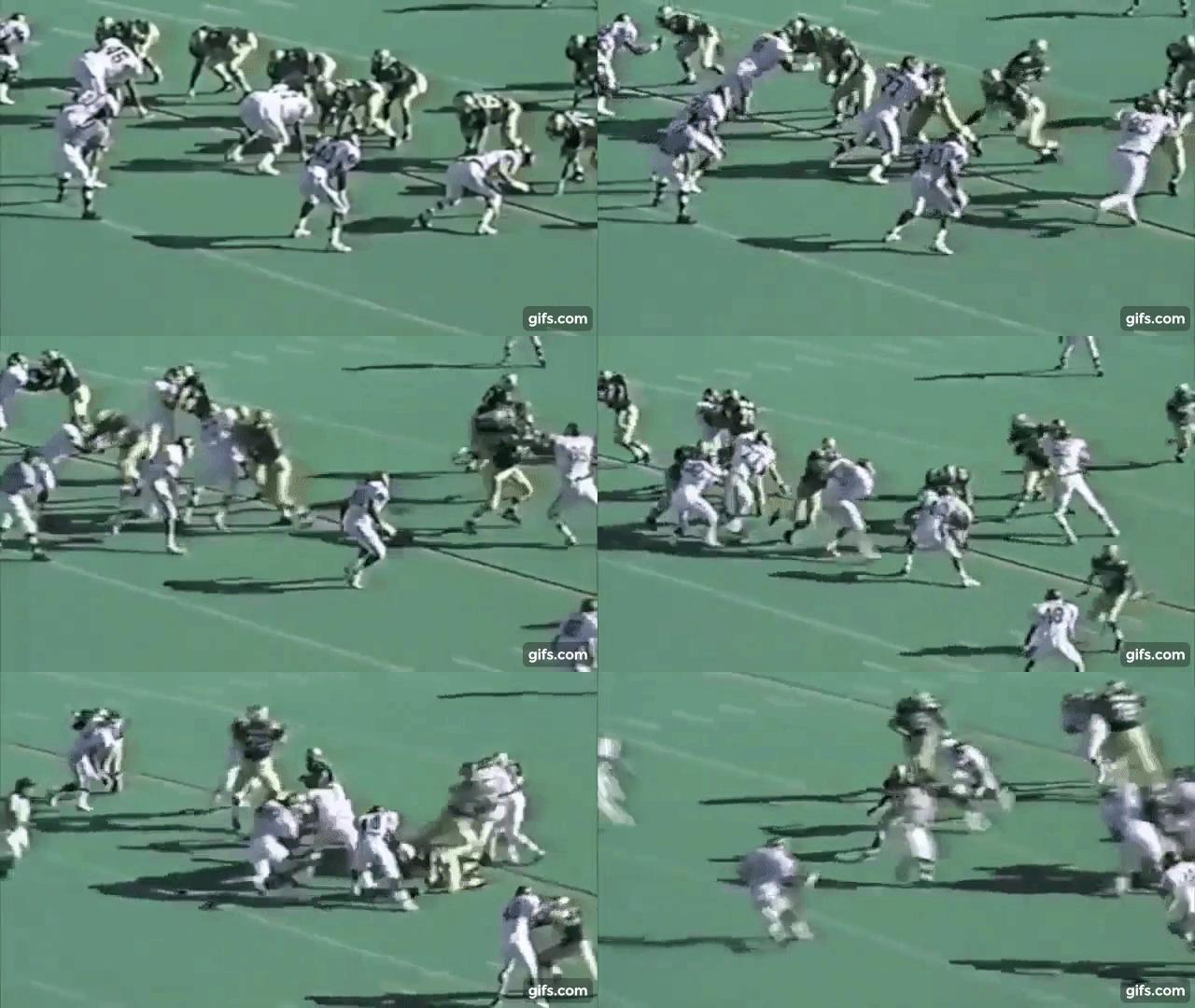
Here is an example of how to twist and turn. When the remaining damage was dealt, it immediately exploded in the middle. D.E. Both were unable to get far enough away to let him go and instead both OTs tried to hold onto the defender while he played.


Fixed set
"Center" and "Guards" reduce the division into short groups to prevent anyone from splitting up. As soon as NT runs outside of OG, OG takes over and the center moves to the second level.


Good — body torque.
Here you see RG and LT. Both are trying to hit or destroy their defenders. When D.T. tried to enter the inner room, R.G. a short circuit has occurred. As soon as the defender tried to do so, RG tied him up with a powerful punch and then flinched. LT DE let him work the field and once it sank, the two-handed shot tried to turn the game around (there wasn't enough pressure to let it go).


An association
Here, space combination A is blocked, only the backyard and play corner OT are sold bypass. Please note that the OG background is immediately sent to LB.


right on the secondary
Check LG here. As a result of the first move, the DL was slightly superior, but he got in and quickly passed to the second level, missing the DL in collecting statistics in the tail of the LP.


Club and exit
There are many examples of clubs, and here they move to the second level . Here is an example from this post.


And a lot of cartoons (including sprint drawings). See for yourself which method is used.

2022 WNBA Week 1 National TV & Streaming Schedule

Friday, May 6 19:00 - "Indiana Fever" at Washington Mystics   Facebook : Megan McPeak, Christy Winters-Scott 20:00 - Los Ange...