When we attack football, we often talk about the verb "match sequence". This means that we are building the base game at the beginning. As soon as the defense does something pointless to stop this base game, we "sequence" the "limit" game designed to take advantage of this bug. Once the defense has reacted to this "limitation", we keep repeating it to take advantage of this reaction. In this publication, we will consider the sequence of events leading to repetition.

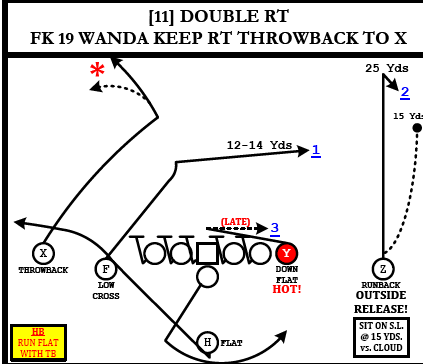 |
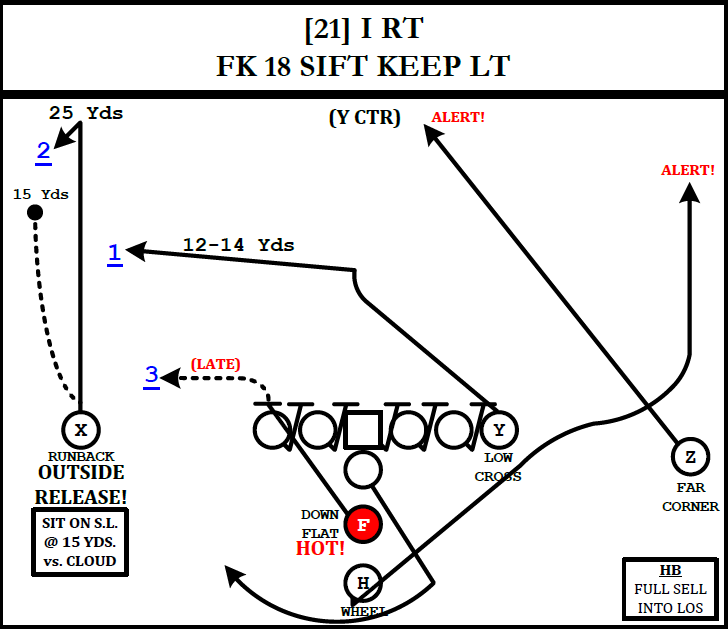
| 2014 Falcons Playbook - Sequence |
Create Rule
In this sequence of events, the main game is traditionally racing. Whether stretching, power play or counterattack , this basic running game responds horizontally to defense. Looking at a wide box, the guard should move horizontally behind it to offset the gaps and smooth out the gaps.

In the face of game gaps such as strength and counterattack, the defense (especially the rear of the defense) must react horizontally to equalize the number of first squares and defenses.

Teams and formations can now change the way you play defense. How many defenders will be in charge of covering versus the number of defenders in charge of combat readiness? This can change the way you protect yourself from 7 people to 8 or 9 people. Typically, there is a quarterback who turns on a QB pass every time (9 men's distances) or in a running game that is more than a defense (8 players split space against a QB race; or 7 men's distances at least one space) against any work)?
But for simplicity, crime usually has 9 blockers and 11 defenders (no QB or ball carrier blocking). The criminals try to recover this in several ways:
1) Castle around the perimeter. Blocking Crack-Push The WR must defend against the most dangerous defender, leaving the second auxiliary defender (covering the main defender or whoever is in charge of the deep zone) unlocked and, if possible, with two defenders on the interception. The crack block itself often attracts a defensive linebacker who is not ready to run. The Booster block will leave your external CB Builder unlocked because it's too far away from your player and game author, so why not do the same?
 |
| Iowa Playbook - an example of block amplification and hacking |
An example of a bad crack exchange: a crack blocker takes a cap from a person, blocking LB/DE.
Take advantage of the full range of OSU trends and break yours=TD pic.twitter.com/LtobffTD3y
— Space Coyote (@SpaceCoyoteBDS) September 14, 2021
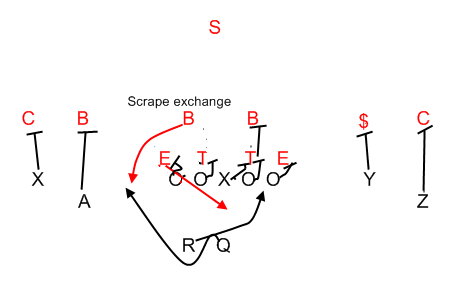
2) Read KB . This applies to fast start readings (where QB is execution threat) and RPO readings . But be careful, the defense was made faster. When the idea of acting as a "reader" block is to get each other's number together, the defense can do a few things to deal with it:
a) They may make false readings, such as changing skimmers.
 |
| smart football |
b) May be absent from the reading, for example, by wearing the top men's cap against the RPO, or completely disclaiming the responsibility of resisting the defensive reading.
(c) They may limit their responsibilities through "managed conflict defense" to maintain their defense. What does it mean, for example, that behind the RPO there is a conflictologist who is responsible for the external break behind it? The offense will take longer to reach this time because they are out of bounds and behind, which gives the defender time to read the net and react accordingly.
3) Allow the defenders to leave. Defenders on top or behind are often too far from the ball and must overcome many obstacles in order to play the ball correctly at the point of attack. These players can avoid good explosive wins, so you prefer to count them somehow, but they should not be banned for the game to be successful.
 |
| Jack opened here and is not part of the RPO reading. |
4) movement. Moving behind or to the side of the receiver can simulate new operational threats and energy changes/breaks. Because of the immediacy of this threat, you can often get a 2 to 1 effect if you use it correctly.
5) contraband card.
smuggling
The pirate pass is a way to mimic the movement of your main games and then run away from the movement after mimicking a QB hand. For a threat midfielder, this emphasizes the last edge of the defense, bringing the athlete into space. But even for a football player with limited sports data, this is a limitation for protection. How to do it?
 |
| 1998 Wisconsin Travel Guide |
Even with limited athleticism, if the defense doesn't account for the QB, the QB has so much space and time that the counter can gain coverage by trying to hook on the receivers. But in general, this also affects the defense when a pass is threatened.
Pirate passes usually work in three ways: 1) a 3-person level concept; 2) The triangle says. 3) 1) and 2). This means that typically three to four threat recipients are on the same side of the defense.
USE
— Space Coyote (@SpaceCoyoteBDS) February 4, 2022
The power of tight formations lies in their ability to add numbers to the other side of the formation. OSU is finally (instead of going backwards) starting at 4 man speed.
Please note that the back button remains on the other side. Supports triangle and space pic.twitter.com/aTaYtC9wfc
In terms of defending the penalty area, as a general rule, the further you are from the ball, the more areas you need to cover. This usually makes sense: the further away from the ball, the longer it will take you to receive the ball, and the longer it will take you to respond and defend the pass. But as the ball moves towards the edge of the axis, the areas responsible for covering more space now move closer to the ball. There is also no longer a protective underguard that obscures the quarterback's view and can land low shots. What this really means for the defense is that they have to flip cover on QB to reduce those windows before QB can clear the ball with energy shield before breaking cover.
To cover the men, the difficulty comes from the side of the lever. The men's cap is designed with "support" in mind, and the strength of the cap depends on where the help is, as well as where the ball is. For example, in cover 1, the outside defenders cooperate with the inside levers because the inside helpers are close enough to support them; So instead they use the sideline as support. But the inner guard is usually the same as the outer arm, because the inner guards help the inner ones. But if you change the position of the ball with QB, the defensive lever will change, and often covered defenders will have to work hard to try to get back to the right lever after the shot.
Stay away from defense or use inside attack
The purpose of the fake play is to get QB out of the lane and threaten the edge. On the other hand, QB now has shorter sideline shots and doesn't need to work on offensive and defensive lines. Without a powerful defender, he stays behind a quarter of the defense, trying to reach him before stepping on the ball, or covering a running defender and trying to pass to a defender who is trying to run (really RPO).
Now, just like with Zone Read, the defense has a few responses to make sure they have the power in the back. The simplest answer is: "Keep your hands in the back of the house." He looks great until the RB gets cut and this defender, who defends well from the run, gets stuck in the grass and smuggles instead of defending the field. You expect to play both, but if anything happens that suggests DT cleared too much inside the DE, then the cannabis might be too big to protect even the best players in the space.
So the answer to this problem is to switch one or two defenders at the end of the speech to read the free kick.
Bama has some time to open the download. But WR is sitting in the shooting window. You need to go early to give QB options pic.twitter.com/fGpAIQuuWA
— Space Coyote (@SpaceCoyoteBDS) January 18, 2022
Michigan
— Space Coyote (@SpaceCoyoteBDS) February 7, 2022
Download Action Defense 2 Max cover 1 pic.twitter.com/aZB8uqEygG
This allows one to continue while the other stays at home. All is well because the defense is healthy now, but the defense chose a defender specifically for QB and off the running RB and limited what the defense could do in cover.
Finally, we can talk about "string replacements". Many bootlegs have a rear visor (TE or RB) that is responsible for protecting the back, and QB does not immediately threaten to try to sell the shutter (barefoot exception) and can break inside. To deal with this, when confirming the initial action, the defender (usually LB or guard), who was originally part of the cover structure, will be left without a rounded CB to create a feature, and the defender will be blocked by the "tireks" of the castle. “If this block comes out, Cover will be responsible.
 |
| San Francisco Defensive Playbook Cover 1 Dash Replacement Please note that if version F is late, they must cover SAM or have a different game plan. |
rolling coating
So we figured out what the front end is going to do to try and speed up the QB and not make it a tear threat, but there's still the issue of rear coverage.
In boxing, boxing defenders usually turn the lid over. Rear defenders will move towards the touchline and slide across the penalty area, often tying up with attackers instead of covering the grass.
A deep back causes the back spin to expand. For example:
- 1/3 Deep Defender will switch to manual coverage.
- The linebacker will become 1/2 deep back or 1/4 deep back.
- The back 1/2 player will either join the attacker or become a MoF player.
- A player with 1/3 depth in the back will become a medium depth player.
In handball, the deckers will try to extract the lever by inserting it into the bottom and inside the receiver so that it is between the ball and the receiver, as in basketball. The ball is moving, so it is necessary to change the position of the defender in order to maintain this position.
Then the defense has a chance to figure out how to keep the responsibility. But there are usually three ways:
1) Deep zone players see a return;
2) Dedicated defender "Drop".
3) Combination of 2) and 3)

 |
| 2008 sponsored by the 49ers |
 |
| Defense Handbook of the Former Soviet Union, 2017 |
 |
| 2006 Miami Dolphins Playbook |
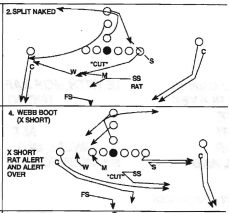 |
| 2006 Dolphin - 1$ |
 |
| Dolphins 2006: Warning |
 |
| 2006 Dolphins - Cover 2 |

 |
| 2006 Dolphins - Cover 7 |
 |
| 2006 Dolphins - 7 MEG / Switch (plays 7 MOD / Fist) |
 |
| 2006 Dolphins - Cover 8 |
 |
| Dolphins 2006 - 8 Megas / Kura |
 |
| 2006 Dolphins - 9 rats |
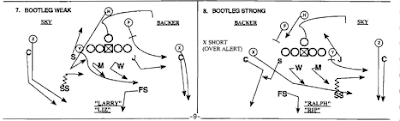 | ||
| Dolphin 2006 - 3 cars |
 |
| 2006 Dolphins - Frisco TO TED |
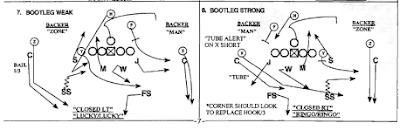 | ||||
2006 Dolphins - Field of Fire
|


 |
| 2014 Wisconsin - Dog |
The discipline of these players is to try to hit from behind. Can you believe they are not trying to get into play after the ball? Can they be trusted knowing that they are responsible for covering the defensive play? Even if they maintain discipline, will they win the game or survive the loss?
Half barrel reverse flow
So now we're trying to create a defensive advantage, which means they've chosen a quarterback to try and explain to QB and get out of cover. The return half no longer tries to get past that defender by faking the circle, stopping and allowing QB to recover. You will need this because you are throwing the ball around the court.
Today, the lighting that sees the work of imitation has begun to turn. Attempts to cover the area to reduce the area they need to defend close to the ball, leaving more room to defend in the back, defenders trying to respond to gestures, or defenders trying to "break down" to achieve their goals. New role inside. The defense, not expecting a clearance before the playoffs, would take advantage of the counterattack.
In the next post, we will look at different ways to do this in Crime.
Clip Bears Throwback / Leak, which is played against the Ministry of Internal Affairs. Nice pattern without creases to protect the edges of the middle part. And lost in traffic jams and shaking. Diagram from the Bronze Age during the reign of Mike Shanahan. pic.twitter.com/TEvvUjdLAv
— XandOJunkie (@Spread_it_Out) August 18, 2021


