Presentation
At the university (and high school) level, RPOs are becoming increasingly difficult to prevent. With loose rules on field players, defenders are forced to maintain long and long coverage after clear points. There is no game other than Bluff and Go RPO.

Original - Reading environment
When the reading area was first installed, it was as easy as walking in one direction, falling backwards, and completely unprotected.

But they know it quickly: If you want to be a QB, all you have to do is stop following DE. Run a garbage business (or other game) if you want to trick Cubin into saving.
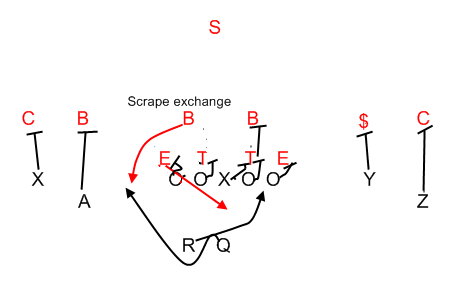 |
| Smart football |
There were two main ways to soften the attack. One of the three alternative versions was running, which allows the QB to always be correct. We will return there. Later, defenders began using the arc screen to effectively block attempts to prevent QB reading.

And when the defenses are adjusted, attacks also occur, two forward blocks are sent from the defensive position, and the scattered elements begin to enter the dense and heavy structure.
GAP READ ... Ravens Run Fense is not a basic game. Player 1 ALLEY (WR in this short movement) and Player 2 blocks FSLB (here behind TE) behind OL GAP BLOCK (double team). pic.twitter.com/jM8Qw2TNH2- Paul Alexander (Coach Paul Alex) March 26, 2020
Original - screen action
In the early 2000s, Rich Road offered a three-fold option to read in the new field.
But he did not want to force a double attack, so he changed the Pitch Man screen bubble three times to RPO. As the field expands, bubble man field becomes an option, and field-side WRs serve as external blocks for DBs outside of the "Peach Reading" shield (usually a tip type shield).
As more and more teams return to the bubble attack screen, they will begin to see QB Top Defender being dropped by numbers, especially during the ongoing game.
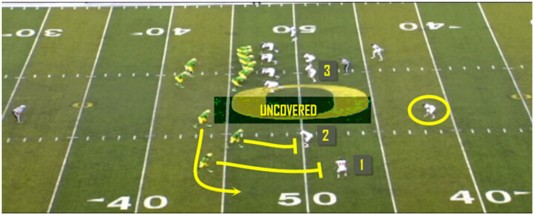 |
| Fish duck - As the group often beat the bubbles, they began to avoid safety measures in the bubble action or immediately followed the bubble action with its top defenders or both. |
The strong natural response to this defense is similar to the concept of game action, which I often call " screen action . " Externally, the initial movements are the same as those seen on a regular screen game at one step and at a crossroads.
Screen action works with different WR screens . I will return to that in the next article.
RPO Bluff and Joan
I first saw this idea in Ohio State vs. Michigan State Week 6. Although I'm sure it was implemented for the first time, it was a great idea because MSU is trying to get the CBs to the edge to protect the QB address.

Here the Buckeyes are effectively implementing the double concept behind the wheel. The Spartans play in the back field with the outside stick and eyes using an extra cube in cover 2 / trap mode. Messages # 3 and # 1 work to block security. Meanwhile, CB Bluffs # 2 seems to be clearing the way between MSU Apex Defender and CB. Once the CB is attached to the rear eye, it returns to the WR field and returns vertically behind the CB and out of safety. The original concept behind the wheel is a good use.
Note that OL does not preclude. This is not an Arab ARPO. The only rush option in this game is QB shuttlecock or shuttlecock, which acts as a place to read the action in the background.

A week later, both Illinois and Michigan share the same conceptual differences.
First, Michigan. Here Michigan 3x1 starts with 12 employees. Indicate overview of the arc field (this is a stream outside the room area )

Nub TE first deletes the DB block from the outside. When DB jumps out of it, he breaks the te and returns to a corner.
The good thing about the knot is that it often emphasizes the known defenses. This adaptation can come in the form of "copying", CB is following the WR on the opposite side of the field, "copying" when security is now in the hands of an outsider, or when security is at its peak. ) Or employee (CB is currently responsible for establishing the benefits of the race).
Here, the dB, which is aligned with the umbilical cord, is clearly seated at the tip of the lead and is placed on the te to protect the outer rod. A single MOF is highly secure, facing QBs and WR sides on the field and eagerly matching the numbers. All of this means that your priority is to support TE, especially for someone who works far away from you.
Note: The offensive line is being blocked (maybe a little more) and given a chance.
Note: The offensive line is being blocked (maybe a little more) and given a chance.

Note that following the grid point, the QB works directly horizontally, as if it were initially slightly backward. This path gives you a distance from the DLL and gives the CB time to attack, cover or move (ie, extend the CB reading time). In this case, the QB is reading the database in the receiver, and has the ability to perform an in-depth security check to prevent it from working.
The exciting thing about adding Bow Block is that Michigan will try to implement the idea earlier this year. Here CB gets deeper and WR can never be blurred and narrow enough gaps. No problem, there are key attackers to make the QB implementation plan go smoothly.
Illinois later came up with the same idea but came up with the WR series.

Here, WR relies on the blockchain in CB. CB will give you an internal release and WR will return to the generation. The internal opening makes the transmission angle extremely difficult, but the WR passage can vary from CB to fall.
I want to add bubbles at the top of the screen. It does a lot of security in that direction, but it does a lot to draw LBs that way. In addition to the high level of coverage, you will also receive free border protection support from the central bank, so avoiding protection from other areas can be of great benefit.
I want to add bubbles at the top of the screen. It does a lot of security in that direction, but it does a lot to draw LBs that way. In addition to the high level of coverage, you will also receive free border protection support from the central bank, so avoiding protection from other areas can be of great benefit.

Surprisingly, the Michigan bluff go to Arc Zone and MSU RPO is back.

Here, like Illinois, they run from a 3x1 field, only one receiver is a common WR. Unlike Illinois, WR fractions are compact. It helps a lot. When WR moves through the collection block, it can gain space and have more space on the side. When it hits the screen and the CB eyes start to go back, WR can break and win the side line, which makes the QB pass angle easier, and Michigan gets a simple TD.

The final point is the final game of the year against OSU. OSU, under Nickel CB, is called Defense 4-4. When Michigan moved to TE-Wing with 12 employees, CB WR resumed. This means that LB was responsible for this structure.

To make these LBs more controversial, Michigan uses a zoning concept, which seems to protect the OLB division zone. RPO enters opposite RB. When you look at the QB's deep security, you can be sure that the LB is getting support from above. Without this support, you would be worse off knowing that your TE is LB 1v1, and at most conflicts with the performance provided by the LB TE partition.
In addition, the structure of the TE wing allows it to be expressed within the internal TE structure , which normally results in protective coating problems, as the group is forced to care for receptors with internal LBs rather than wings. They are especially known for their outstanding performance. You_ _
The TE layout acts as a "compressed" WR partition, which gives a lot of edge space. Here, with the defender outside Los, it can be assumed that the TE has closed the box. These trunks allow you to work towards the tip, not to the side and not to the side of the corner.
A great project game from Gettys. I know that controlling the OSU structure from the 12P wing "overwrites" the cover game at high angles. LB remains abnormal. https://t.co/WhtiSK5xtf- @JamesALight November 30, 2019


/cdn.vox-cdn.com/uploads/chorus_asset/file/13357131/wisconsin_fly_motion_inside_zone.gif)


