Cover 2 is the most widely used zonal defense in football. This is because defenders need to focus on the side of the "area" of the lid and need little movement. In the same way, due to the movement and small design of the cover, all eyes are usually from the back, which in itself makes it a good running protector. What was once considered a defensive line in football has become obsolete with the development of more sophisticated and sophisticated vertical attacks in recent decades. However, the concept of "fall" was somewhat delayed, and remained familiar near the gate line.


To perfection, humanity is described in another article below.
basis
| Increase | weakness | How to attack |
|---|---|---|
| Strong running protection (eyes on back) | The ship must cover the ground | Lau Verch |
| Low coverage (5 of 6 areas covered) | Fast straight roads in holes / corners | Concepts of flood |
| Easily adapts to 4 or 5 attacks. | Wide cracks create lines | Side ratings (eg Smash) |
| The highways are covered | Continuous internal numbers (Tampa 2) | The "hole" between the wicks |
| Road crossing | Corner roads | |
| Strong in TE |
2nd degree
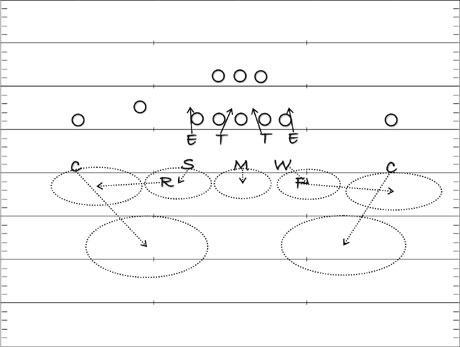
With Basic Cover 2 Shell we will start where it all started. Cover 2: Two deep defenders play "half" and split the field in two. Safety is generally adjusted to a depth of 10-14 meters outside EMOL, although some teams prefer to line up with LS with a solid safety up to 7 meters to finish and support the race. LB TE to cover. Finally, the two deep players play at a distance of 15-25 meters depending on the situation and other factors.
Then there are the last five defenders. In this case, it is up to the CBB to cover the plate, which can usually be seen on the receiver and on the back, from the outer shadow of the receiver. CB hanging technique (usually 3-5 meters and two meters away from the shoulder) or external purple / lock technique (internal support is provided in a short time. Road and depth) Road). If all the roads are straight, you will see that the CBs continue to fall to protect the fuse.


OLBs play crocheted areas depending on the area of greatest urgency. Even better, OLB does not allow anyone to pass through the area without changing or affecting the time of the match.
MIKE views the connection area according to call depth and range. With Easy Cover 2, MIKE will generally be closer to LOS and consequently protect crocheted areas. He is generally open and seeks transgender people coming to his field.


Tampa 2
Tampa 2 is very similar to your base cover 2, the obvious difference is the depth of MIKE. The MIKE will sink - usually turning and running - to cover the gap between the center of the fuse center and the bottom area, which is called the "hole" in the center of the area for depth. Of course, MIKE is not as good as coverage security, so security should be "half" covered like coverage 3, but you can do a few more tricks, which will help a lot more - support CBS . On the other hand, the two OLBs should cover a little more space at the bottom, which is the same as the bottom cover of the third lid. Force him to come in for help.


wait
Stairs (2-step) have long been, but have recently become fashionable. With a bitter cap, read receiver CB # 2 at number 1. In this mode, it serves as a "2 matching" version of the second cap, with a slight mix between the 2nd and 4th caps. .
Here, CBs are generally (though not always) WR compliant because they have to explore # 2. They use a technique called 'soft squat' to dive, which drips into every face and second outline. Or simply CB's task is to read # 2, and if # 2 walks down the street, CB will make its way. Or, to put it bluntly, number 2 enters the trap set by CB. When this happens, safety is the number one responsibility, so you need to be able to move forward quickly.


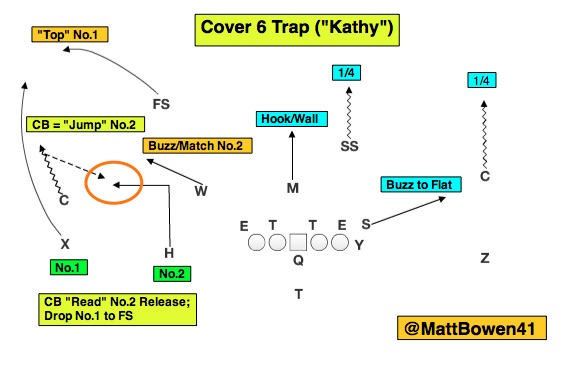 |
| Matt Bowen - This is cover 6, more on that later |
Now that number 2 is going vertically, CB will continue to sink before it falls and safety will continue to follow the second standard coverage rule.
/cdn0.vox-cdn.com/uploads/chorus_asset/file/4137708/normanpicksix.0.gif) |
| Reader for cat scratches |
 |
| Matt Bowen - Note that CB will drop 1/2, then more |
robber
When he tries to interfere with QB reading, the thief seeks security by checking the hook area. When security drops to LSS, the external CB controls half the depth. Due to the deep drop in CB's external orientation and security, QB coverage may initially look like 3 and QB may be tempted to attack from below. However, the defense holds 5 of the defenders and this may not be the case for QB. Overall, the two-dimensional look is a great way to laugh with a single high-resolution cut and even after release.
This coating has the added benefit of frequent nickel casting at the edge, which adds safety to the runner's defense by throwing it behind the CB.


CB Deep 1/2, Safety Buzz
In this case, we can easily copy the CB security and safety responsibilities without displaying this preview. Like "Pirate", this single requires a high level of security, as security is often left locked when CB starts to withdraw. But by turning the lid, they gave security to the LSS and enforcement responsibilities, which could have increased speed in the background. This is a great way to simulate what you are trying to do in a twin or group trip and can allow the defense to have a greater response to the WW screen game (as security decreases quickly, which it does easier making the outside out). gaps compared to the faster WR screen when CB captures the preview.


Keep in mind that while there are two immediate threats on one side, most will come from this call. If you decide not to do this, work vertically on both # 1 and # 2, making sure your OLBs are ready to take any vertical path from # 2.
Copying should not be restricted. Many teams wear "Cover 2 Invent" on both sides, especially for workers who work hard (12, 21, 22 people) to gain safety in the race and do their best for the SBs.
Or you can copy it to Tampa 2, where the security hole is protected.
Also works well with nickel containers. Nickel can fall to a semi-deep depth and get stuck in the outer CB WR.


Copying should not be restricted. Many teams wear "Cover 2 Invent" on both sides, especially for workers who work hard (12, 21, 22 people) to gain safety in the race and do their best for the SBs.
 |
| Gridiron Strategies |
 |
| Shake Jugun |
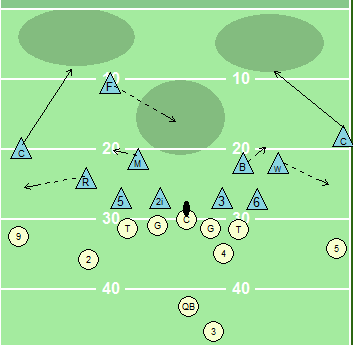
Copy (button formation, security mode)
"Flip" puts the CB where it is and the CB is usually safe. Often brothers do not like running races. Acne can be caused by blisters or a dull ligament, which often turns the road into a vital force in the race. To find a player who is best suited for this skill, teams can easily play CB and Half Depth and Half Depth by copying CB and vice versa.


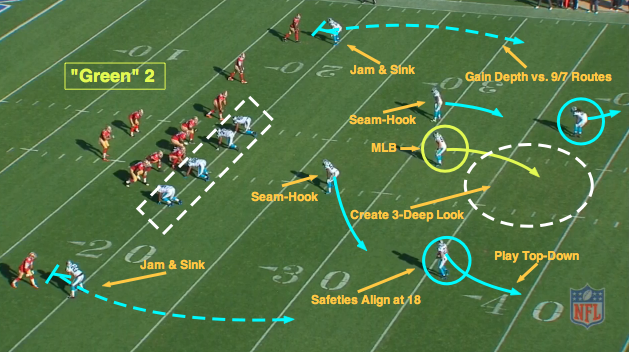
Green 2
2 green is usually reserved for clear transient conditions. As the SBs lower and protect the handle more, he secretly places the guard in a "tent". The fuse generally bends slightly before lifting and MIKE can better cover the hole. The SL may push or close the first release to interrupt the path time, but then it is likely that the line cover will enter under the receiver (if the receiver leaves it inside, the SL will dig deeper into the area). The CB area will be external or more accurate than the flat area. Provides a level, but allows the defender to climb onto highways and gather at each crossing before descending.
 |
| Bleacher report |
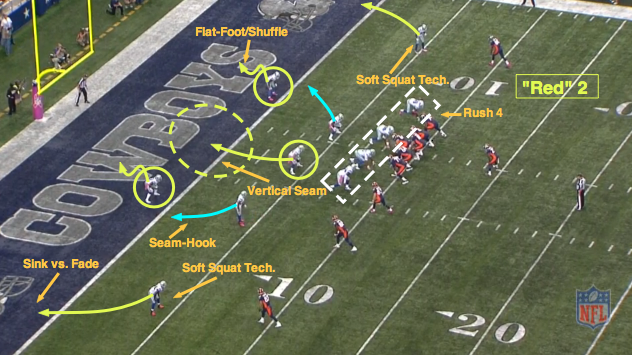
Red 2
Red 2 is a Redzone second round tournament. With fewer chances of reaching the top, Safety is more likely to play with flat feet and swing than rush. This allows them to get more involved in the run and helps them quickly avoid paths like slopes and potholes.
Cibs usually use a gentle squat technique to hold and protect the fuzzy track, as they do on the 4th skin.
Many game models in this field are fast, so they should be able to play faster than usual on their LB sites. This means that OLBs need to be expanded to better protect hooks and seams. MIKE also responds immediately to crochet and loop protection threats and hits the receiver, for example, on a cracked SIM fuse.
Lightning tracking
Many groups like to install, but are concerned that they will have to improve their coverage (or just do what they can not do). The cover can hold 2 to 5 people and still has a double-sided surface with 4 sides under the cover. CBs are flat, while OLBs cover the elbow areas. It may be a little weak in the middle, of course, but when the pressure comes home, there is no time to react and the back cover remains stable, allowing for a higher level of performance if your base is D.


Turn the flash
Another option besides flash is to copy the skin to the flash. This usually happens when DB interferes with the pressure pack. For example, if an SL enters the border, border security will rotate to cover border security and CB at a distance or nickel will drop to half depth. The rest of the defense, on the other hand, covers a flat area as seen below.


Combined coverage
One of the advantages of the two top layers is that you can split the field in two and basically combine two top layers (0 decks, 2 decks and 4 decks ). This means you can steer the trap to the extreme and 2 standard pitches on the field.
Cover 2 can move to the border and Cover 4 leads to the MOD area, often referred to as Cover 6.


Two: You can use MEG on the one hand and hold on to the other if you want more human-human vision.

This could mean sending a flash to the edge of CB and playing it behind cover 4 (hold it as TE # 2 and push CB or DE on each RB release in that direction).


This allows you to combine coverage based on distance and distance, cracking, stretching, personal, exploration or more.
relations
Bleacher Report Cover 2 Primer
In the Matt Bow trap report
Shakin 2 matching models on the Southland cover
relations
Bleacher Report Cover 2 Primer
In the Matt Bow trap report
Shakin 2 matching models on the Southland cover