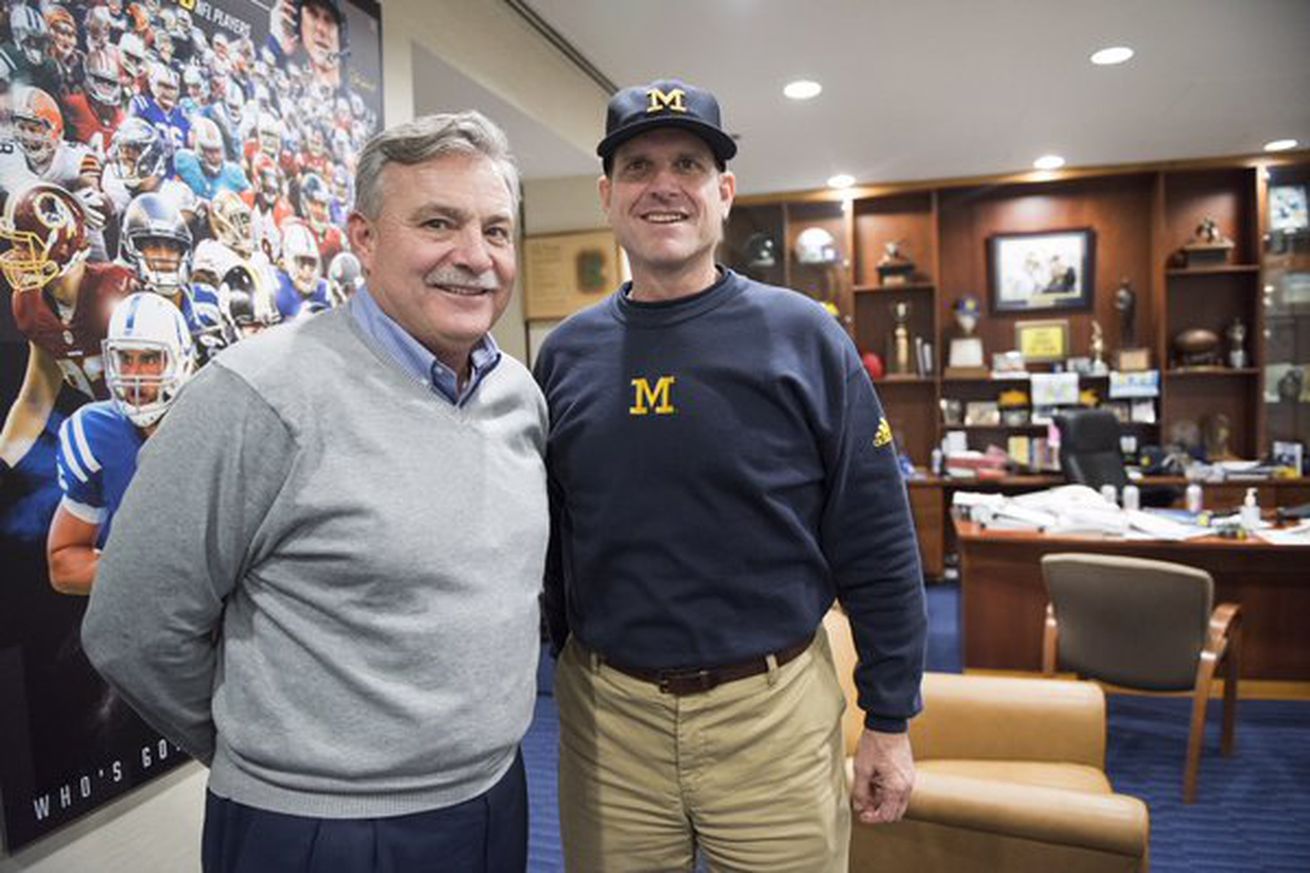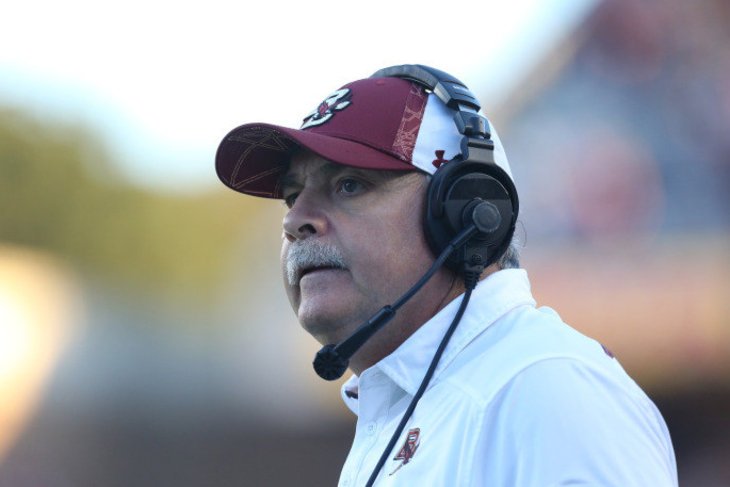
Don Brown - Michigan Defense Coordinator
Since then, he has served as defense coordinator at Brown, Eumas, Maryland, Yukon and Boston Colleges. He has also held senior positions in Plymouth, Northeast and UMass. But that's enough from his Wikipedia page. Let's take a closer look at this delicious and attractive mustache and what it brings to the table from a football point of view.
Philosophy
Don Brown is a coach with two strikers, but his philosophy is to attack with space. He wants to
- Attack the LOS and break the blocking schemes
- Move the ball and stay on the edge of the blocker
- He stopped fleeing on his way to Cuba
- Hurry pedestrians on the descent
This is the essence of his defense. I want to get the rest of the details with my own hands.
Politics
In a study by Dave Arender, Wisconsin's defense coordinator, I had the privilege of learning and getting to know Don Brown's defense, and I've seen him a lot in the last few years. Don Brown is 3-4 years old [update: many fronts], but his one-sided vision expands the whole range, and he will decide at will (formerly known as Buck or WDE) by putting his hands on the ground and running 4 - 3 down, 4-3 up and go ahead.
I've covered space defense 3-4 in more detail before, and the essence of what Brown is trying to do. He will lead a united front

He will run on 3-4 (under 4-3 below) fronts, which he calls the Eagles (usually 2 high defenses), mainly targeting ISO, power or selection teams (Jack in the picture below). .

It will distribute 4-3 of the Eagle's defense, which has support positions outside of Dog Insurance (DS, otherwise known as strong security), primarily cover protection 3.

It has "spark" protection, which is actually an eagle guard, a DL on the nose and an outer shadow on both OGs. He can then shout "spin" and put the ConEC in the middle of the field to let the man play for free. He likes this defense against teams of 12 and 20 staff.

And of course, it has a beer guard like the eagle's front, but it only shows the TE MIKE on the inner shoulder and takes the DS to the LB level. It usually uses a typeless cover on the back.

They will also make real 4-3 overs and 4-3 under defense.

Everything installed looks like this
It ultimately prefers a unified high-security approach and prefers to play without people (update: this coverage he calls "City" where deep security can be established by leaving a separate receiver). But even the territory is more based on human policy than the protection of most areas. Cover 3 is a dense cover 3 similar to Darkin's in Michigan (rarely played in Michigan). Its two heights combine safety features with
Moving part
The most common thing that comes to mind about Brown's defense is all the moving parts. This is not a static "march" defense. This protection has a continuous working part. And with these moving parts, the full range of attack comes from every defender on the field. If you watched the previous video, you said that the CB lights were on from the square and the border. You will see DS Blitz, LB Blitz, curls, tricks and everything to be thrown in the attack. Brown uses block motion and entropy to mix blocking patterns and get free strokes at the point of attack. B. Blitz gives tasks like homework, telling his people to play fast. Be the first on the offensive point and you will win the most (the problem arises when you can't reach the first attack point or when you can put another person in a more difficult position to defend).
It's a blitz zone where Brown will take advantage of almost every opportunity.
It's a blitz zone where Brown will take advantage of almost every opportunity.
Fast transmission
When I talk about all the moving parts and offensive defense, I also note the weakness of the defense. To be successful, cross-country skiing must be intelligent and integrated. Foreigners cannot go deeper than the deepest (otherwise it opens a great way between them and the inner); Must incur internal costs. Bubbles should be protected; Bubbles (pockets) and fast-moving roads through Paris.
Although Brown coached DB and BC, he also coached LB. I'm not going to go too far here, but here's a video about the experience and basics of BC under his guidance.
When I talk about all the moving parts and offensive defense, I also note the weakness of the defense. To be successful, cross-country skiing must be intelligent and integrated. Foreigners cannot go deeper than the deepest (otherwise it opens a great way between them and the inner); Must incur internal costs. Bubbles should be protected; Bubbles (pockets) and fast-moving roads through Paris.
Protect placement
After Michigan was injured by Indiana, fans feared it would be difficult to spread. After the match with the Buckeyes, Wolverine fans were convinced that they could not do it. Brown was aware of this concern even before he applied for a job at Michigan DC.
To save the area, Brown leaves the stage in a bracket covered with high security and a type 2 trap and two high covers. He does this so that he can turn the guard into a support to protect the floor (outer face / TE, inside # 2) or while walking (outside # 2, inside # 1). Sometimes he will choose a look with height and set a deep security folding / alley. His deep security is not as deep as Durkin's; This places a greater responsibility on the CB for success, as the buyer can often exit the defense without much support from above. The box is primarily responsible for the operation (including security) when the CB is almost completely closed before assisting the CB and in some cases in a supportive manner.
To save the area, Brown leaves the stage in a bracket covered with high security and a type 2 trap and two high covers. He does this so that he can turn the guard into a support to protect the floor (outer face / TE, inside # 2) or while walking (outside # 2, inside # 1). Sometimes he will choose a look with height and set a deep security folding / alley. His deep security is not as deep as Durkin's; This places a greater responsibility on the CB for success, as the buyer can often exit the defense without much support from above. The box is primarily responsible for the operation (including security) when the CB is almost completely closed before assisting the CB and in some cases in a supportive manner.
Back line training
Although Brown coached DB and BC, he also coached LB. I'm not going to go too far here, but here's a video about the experience and basics of BC under his guidance.
and so on.
Ian Boyd did a good job in BC against FSU in the football office
MGoBlog collects feedback from Twitter and other places