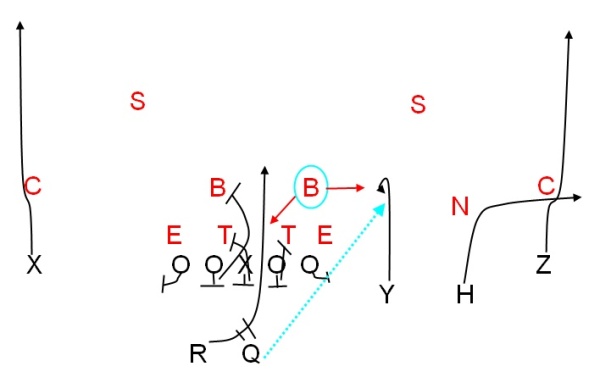
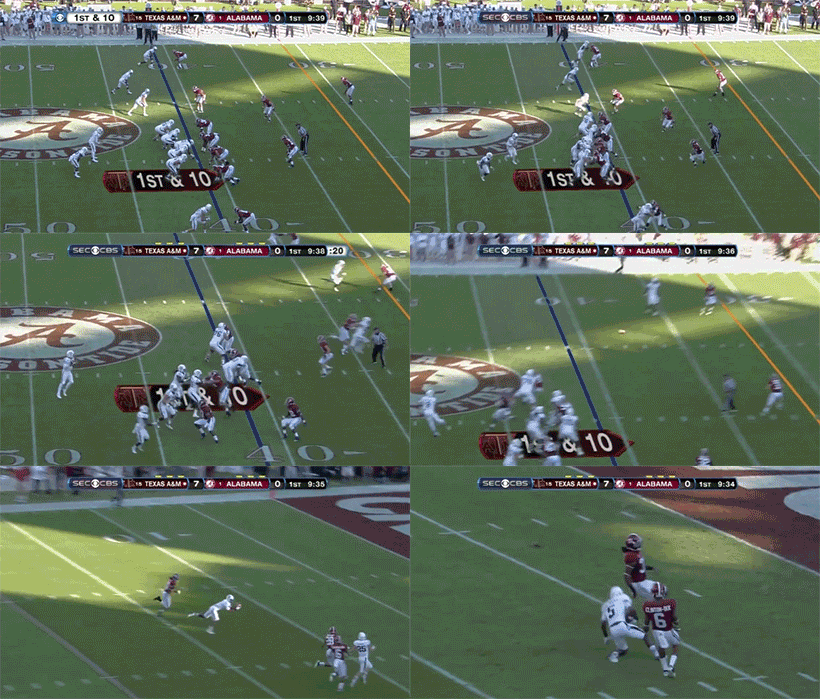
Well, well, let’s talk about Jora’s concept. What is the concept of the day? This is the game of the day.
But in fact we are talking about RPO - a pass option. Starting with the 2018 Super Cup, in football everything depends on the RPO. I talked about this a little earlier, first with Illinois and more recently in an OSU publication . But I want to add a little more depth because there seems to be some confusion and misunderstanding. So I want to do the basics first. This first post tries to lay the groundwork for an explanation of “reading the game”.
happiness Let 's start with the origins of the popular "alternative" play Faith of the 1960s. Faith basically laid the groundwork for everything that was to happen. At first you were inside and out. They then added a field option to create a three-chance loss. And so on: reverse option, speed option, center line, spring, trap, wall and so on.
Read Like the Rich Road reading story, they called it a two-minute attack (the origin of HUNH) and the place where they escaped with their weapons. But QB noticed that the last DE cheats and haunts him throughout the race. As soon as he strikes or deliberately pulls the ball out of the belly of Belarus, he gets a big win.
And now it has led to everything from a quick pass to a busy game. We will talk about this in the following articles.
Rich Rodriguez is often explained the current RPO frequency, which leads to one of the biggest mistakes: you need a mobile QB. Rich Road took the opportunity to read, and mostly wanted to know how to switch from one reading option to three, so he introduced a pop-up as a second reading. However, most teams that use RPO are limited to one metric and often do not expect a real QB race.
dual screen The dual screen is the same as the standard RPO. Use the fast screen on one side (mode) and then the slow screen on the other. There are pre-stream read numbers with post-stream read. This allows the attacker to attack on both sides of the field.
Skip the startup option It’s another word for the race option, but now it’s PRO, but I wanted to give it my own class. ADVERTISING. Drawing with sticks is a thing of the past sometime in 2010, the difference being the “quick” option and the quick pass when the hole isn’t open. In recent years it has expanded due to shooting and paddling.
A step-by-step option This word always refers to socks. Basically, I understand that in every passing game there are many opportunities to pass, how is it different? You can complain about his name (I promise, I didn’t expect that), but then during football we can talk business and go for a day. The basic idea here is that your basic passing game is different.
Pass options ( another link ) often combine a fast path / path to one side of the pharmacy, followed by the concept of transition to the other side of the pharmacy. If the first path is open, throw it away, if not, keep going in the opposite direction. This often eliminates unnecessary receiver outside of deployment packages.
in particular. Some even accept previous readings as RPO. In my personal language RPOs are read immediately, not preliminarily. I call pre-tagging tags “alerts” or “alerts” for gameplay, smoke loops, transition tags and so on. They are based on numbers and use a prefix to make read and issue decisions, not to convey an emergency.
We will then consider some of the barriers associated with RPO, and then move on to the blockchain plans used in RPO plans.
This is a question that is often asked. "Whydoesmyfavoriteteamalwayslackafield?"______- In almost every game they teach you the idea of using boundaries as an extra defender and in football it is no different. And in the current era of football, the concept of space is given much more importance. You have a wide WR section, you have a light crew, you have expanded the field not only horizontally, but also laterally. So why does jogging always seem to use this zone?
The universe is the main source of success in modern football, but it is not just the insults that control the use of space. Defense also has a role to play. The universe is only a fundamental aspect, everything else includes levers and numbers. And when you consider all these features, it explains why they often reach their limits. Let's see.
I want to give an example that teams come down to the field. Here I am drawing a thumbtack (usually you need to connect to Y, but here is an example). Look at the useful angles for pitch safety, 2 defenders are stuck behind the pitch. Number / angle pic.twitter.com/04sJljzpBt:
The first thing we need to talk about is the size of the area. How do you make lateral changes based on hash width? In the NFL, there is almost no difference between a wide "short side" because of the narrow hash (70.75 'versus 89.25').
College football has really started to show significant distance differences as a result of hashes (from 60 'to 100'), but it should be noted that 20 yards distance is still important.
Then high school football (in many places) (from 53.33 'to 106.67')
Funny facts. No previous hash mark: the ball is only placed where it fell (with extra points). So it is really possible to push from the edge, you have to find a way to get away from it. Check out some great photos and hash stories here
History of Complaints
Actually, I'm not as old as any of you. But I am old enough to know that a) Tom Osborne is one of the most successful college football coaches of all time. B) Fans regularly complain that the sideline is short.
Complaints of goods crisis are not new. Many fans may be high school footballers. Historically, what was consistent at the lower level was being a top player, keeping him in Arabic, putting him across the pitch, where he has room to avoid less talented players. It's all well and good (OK (it makes sense in a strategic sense, we'll get to that later), but when you get to a level where sports inconsistencies are less pronounced, you need to start looking at other aspects.
So here we are, at the end of the Osborne era, playing on the border of the Nebraska Tennessee loadout option. "But he's the 12th defender on the finish line." Someone shouted. But let's see the picture.
Before I mention it, look at how Tennessee is defending. As I mentioned in the article above, there is a "space" of defense as well as a sense of contempt. Here, the groove guard has an external lever (which makes it difficult to get out of the WR lane), which is a guard that limits the space of the lateral court. Also, the defense has set up two box defenders outside of the offensive EMOL, so if you read one of these defenders it will be very difficult to get out of both. Even revealed, MIKE is the equivalent of 10 strategies, protected from the 3T 5T zone.
So in terms of space, it's not that hard to keep it on the field. In terms of numbers, Tennessee has the advantage of predetermining numbers. On the lever side, it is very difficult for Nebraska to find a way to cover the lever so that that aspect of the structure could be strategically threatened.
But instead, let's look at the short side of the field. Space is more limited from a terrain perspective. But from a defensive standpoint, they only have one defender, except for the attacking EMOL, and from the defensive style of the box, it can be read that EMOL is missing. In terms of numbers, Tennessee must believe that QB launches (C, RG, RT, WR, FB, TB vs Shade, WDE, WILL, MIKE, CB, FS) can weaken the FS by trying numbers without the threat (you throw QB). Stuck in FS with threats.
So let's take a look at the download options, which shows how it really works. Take full advantage of Nebraska Leverage to see how the sidebar opens.
And it's probably worth noting that Nebraska doesn't block these things. RT throws itself down the hill leaving WILL, which can be violated (fB forces it to lock). Failing to force the QBE to do so, he was able to move the ball to the side. The middle cut only slows the nose, but does not lower it to the ground. However, despite failing, despite missing the back, Nebraska was able to create two blocks against MIKE, managing 4 yards, to block the box.
It is not good for attack, but to achieve it requires a frontier attack with KAMK FS, which usually attacks immediately. It's not hard to see how long it will last.
But sometimes it doesn’t, but it shows another short-term weakness that Nebraska took advantage of right after the push. The defense is torn, roaring, hard to count, exploited and the Nebraska 32 trap version is back.
Modern age
In 2019, Notre Dame faced the same dilemma as the pair against Michigan. Here they actively try to block the rotating edge by placing the load on this side, only breaking the diagonal position. These ramps raise the LB lever because they quickly break the opposite side of the ramp when the box is locked in Michigan to find extra locking work.
Again, Michigan blocks the box with WILL, causing the ship's movement to disappear into it. When the upper block falls in front of the CB of the OG block that can actually open the hole, the only downside is that C is opposite C, but that too needs to be wide enough for the lower block to explode CB. Towards the end (especially when he has the advantage of knowing that the center hit the right shot first). So now you are asking the security guards to control the damage in space. Unfortunately, he failed to clear the ball (և 74k).
So, of course, the defense response. They cover 3 small side slits. Mike's shadow. They were often burned there, because the border in the back was screaming.
The modern era, similar reactions. It's a trap.
How to stretch?
Yes, it works by stretching. Look at these corner blocks, I don't have to draw them
But I draw or stretch.
I want to give an example that teams come down to the field. Here I am drawing a thumbtack (usually you need to connect to Y, but here is an example). Look at the useful angles for pitch safety, 2 defenders are stuck behind the pitch. Number / angle pic.twitter.com/04sJljzpBt:
The nice thing about the stretch is that it makes a vertical cut when the defense catches it, so you can play defensive action - just use numbers - leverage.
Return to the OZ border. This time TE-RT was pointing to the same pancake page for RT, but TE could not get vertical as soon as it closed. Good job from RG C Piggy, keep up the good work. Confusion to my fields also accidentally created LB pic.twitter.com/Hm1kw8CEHG
It doesn't matter! Number, lever, space. Speaking of the threat of the Minnesota movement, someone is falling off the arch, there is a clear "bottom of the side" pass (remember they don't have to stop here because of the threat of running inside, they can successfully block: security).
In general, when long-range threats (i.e. pressure-like blocks) are taken advantage of, small edges make it easier to identify the block; Limited, where they are, will not be able to use the plan.
Defensive alignment
So space is possible, but numbers and levers can help create a planned advantage over the short side of the field. Let's look at Alabama at 2 heights. There is nothing special about it, but look at border security, it involves hashing. Filling the side isle is much more difficult than field guard or field security.
And as more teams use scatter training, the defense contrasts with Apex defenders, usually on the field (based on an offensive structure). But when it comes to "space", this Apex Defender (combined with the top safety lever) often effectively "shrinks" that space for hand play.
In addition, defensive responses often require the defenders to rearrange the numbers on the short side, often requiring defensive rotation and then controlling the action of the game as they cross the pitch.
I'm not advocating for all races to be small. Of course, there is the advantage of a space on the wide side. And if you're on a more athletic team, it might be a good idea to focus on sending kids into space without relying on blockchain assignments. Also, if you are a weak team overall and have a guy you really like consistently, your best bet will probably be space. And, of course, when defenders begin to appreciate short distances, they adjust their alignment to be more balanced, when downfield attacks become more convenient again.
You can do this by finding ways to increase your home court advantage, use your RB as a primary blocker as a reactive sweep (i.e. add blocks to pick numbers), run or run an unbalanced structure (see above). Boundary formation (FIB) to increase the area of the zone (i.e. to create space for reducing the area).
But traditionally, on set, the edges will probably give you better numbers and effects. I asked Coach Alexander if the dodge protection equation had changed compared to the traditional box defense when running on the short side of the court. The answer is "it's always a matter of leverage, if you pour it you need some energy right now or it becomes a flashy tip." Coach James added: "Why not attack when your box / strength / leverage player is in the corner or when a defender is playing 8-10 yards? Adding can complicate the draw pattern. May be weak for terrain (Scratchers need to follow your athletes so they don't get stuck.) But I generally agree with both that it doesn't change the equation completely.
Again, it's a balance. Of course, the great courts have advantages, the distance between them, allows your athletes to play in space. But in the end, when adding space, numbers and levers, smaller aspects of the field are usually preferred. And that's why your favorite band works.