Showing posts with label History and Evolution. Show all posts

Saturday, 4 June 2022

History and Evolution: Power O - Part I - The Power Series Origins

God's game.

Talk to most of the players and they will tell you that one of them is The Force, even though it's not the best football game. He is dynamic, controlling, explosive yet graceful; His name gives the attitude that is implied in the unique game. However, unlike styles more popular due to a nostalgia for a game that no longer exists, the history of strength remains an integral part of modern football, even if it dates back to the invention of a visionary. Like everything, it has changed and adapted, but in essence the show retains its main features:

  • lower front blocks
  • Head unit for controlling an external protector
  • Rotate excavators on the side of the game.

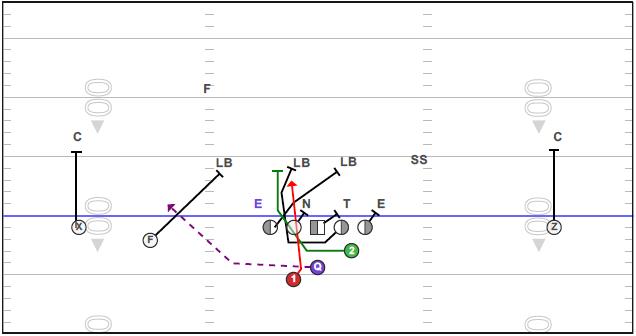
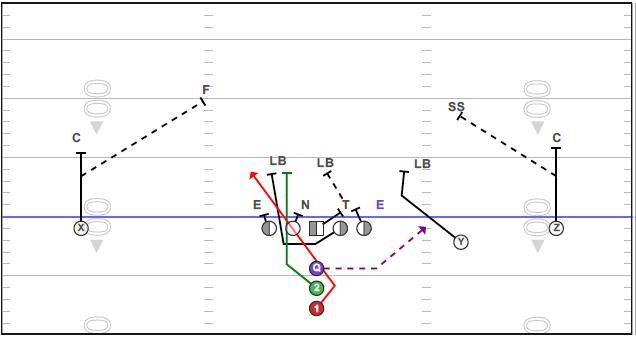
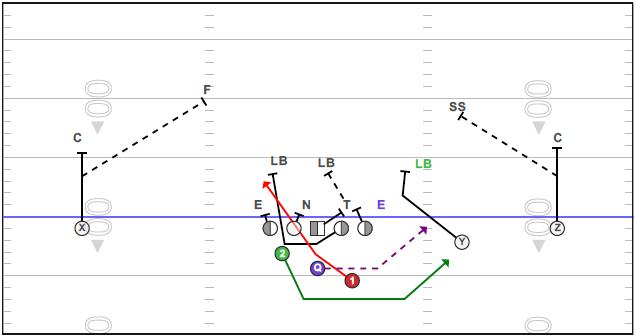
It looks like this:


Here is the introductory book

Going back to the origins of the game, including the various iterations that make up football around the world, numbers and power dominated the day. This is the strength of American football. In this article, we look at the origins of the Game of God and how it has adapted to remain one of the most popular styles in modern football for centuries.

single leaf

At some point, we eliminated the corner game and, in fact, started a "draw on the ground" in order to gain an advantage over the opponent. As early as the 1930s, Bauer's idea of ​​a single wing emerged (the single wing itself coincided with the turn of the century, with changes such as the Notre Dame Lodge in the 1920s).

Back in 1933, I saw the creation of modern power, even if it was not yet called Power. Remember, one wing is an unbalanced design. The front of the group, including Wing Back, was a 5-man deck. This means that the FSG app was the same as the BSG app on a modern three-person rooftop. Traditionally at this time you would see the obverse and reverse sides of the coin, but even at this time there were several iterations of more than one series.

Of course, as you can see from the video above (Direct maneuver), using the FB as an additional bullet blocker, you can get into the stern (BB) and deploy both tractors inward.

But you can also create a loophole with something like "Spin Maneuver" or "Back Maneuver". And of course mismanagement itself has always been a threat, sending the FB back or as a dive.

1940 Princeton Sings Wing Playbook


Of course, if you learn to do this on the long side of the shaping, you can simulate it on the short side of the shaping as well (often incorrectly).

1940 Princeton Wing Directory


And soon things like duplicates were born, including highways.


Of course, this thing still works in today's NFL.


And at the university


T-shape and vacuum

The T Formation was resurrected in the 1940s, and as a result, the 1950s First Wing assault will end and almost be wiped out (although you'll still be stuck with a few teams and still be in the high school ranks). Passing forward improves the ability to block and distract 4 attacks back. And, of course, in 1941 "Variant Football" was created. By the 1950s, several iterations of the T formation (including the Wing T and a few Split Back violations in Delaware) became the norm, and pick-and-pick football dominated at the time. But there is still a need for “strong” football. Woody Hayes described the 1950s Power series as an important part of the game book.

1957 Ohio State Book


Finally, in the 1960s, the Packers defined dynasties such as the Green Bay Packers who ruled over things known as the Sweep .
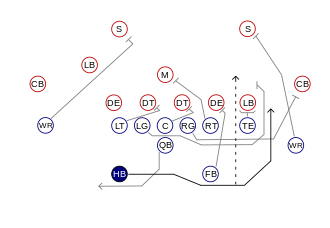


But of course, as Power became more and more successful as an outside rider, it made sense to create a similar inside threat. The modern version of Power O is finally out.

String power and processing power

Force, originally a more aggressive one-wing type of game, has essentially evolved into a stealth game in which teams lose the ability to play against the jersey. However, like Woody Hayes, teams often made unacceptable changes to the rules of the game, stating, "It's a T-wing power play fit for a single wing. Its advantage as a single T wing is that it is both sides of the line. When Power Sweep began to dominate, the need to run and rely on games with similar moves became apparent, and so the illegal Power Run began to dominate again.

1957 Ohio State Attacks Book


Tom Landry was another football fan, and the bulk of his book focused on The Force.


1968 Dallas Cowboys Playbook


1957 Cowboys Offensive book


47 NO Fit should look familiar.

They all remained in the T wing until the 1970s.


1975 Delaware Playbook


But the sea is coming now. Fouls often occur in teams with four midfielders and two TEs. Teams are now starting to run two WRs regularly, with 21 employees becoming the norm. Thus, attention to animal husbandry began to decline. A new wave of charts was about to appear. Sid Gilman's influence began, and coaches such as Don Correll (and later Joe Gibbs), Dick Vermeil, Chuck Knoll, Al Davis and Bill Walsh emerged as innovative new minds developing with a more balanced offensive attack. The Formation I upset would start gaining popularity due to breaks based on the split T formation. Remnants of the old Power series would remain on compilations from the start, but "Power" was already there, while various iterations of Power series pieces were given new names and originally were demoted in rank. Therefore, the changes are often completely outside the scope of the game's manuals.


continue reading

Part Two - Get rid of the power of struggle and gain the power of the name

Part three . The modern era of multi-rule


History and Evolution: Power O - Part II - Off Tackle Power Earns the Name "Power"

prior to:

Part I - The origins of the series of powers


Off-tackle Power O will be "Power"

That i-formation began in the early 20th century, right in the early 1960s, when a man named Don Correll started spreading aerial crime. At the moment it is not known what he will do after he leaves his position. At this point, most of the group has now moved on to 21 members, with backward / near / distant forms still visible. But, for example, in 1968, the Schaefer Council sees what we know today as normal government (although it should be noted that the cleansing of power was an important part of the crime).

1968 "Scheffer book".


Note here how combat progresses to the second or third degree when the latter ED is not heavily affected. This solution will tell you what has changed from gap C to today's future changes. At this point, after Power O, we start to see changes instead of a brighter version (from the years though). The groups began to realize they could know about energy, so ideas like Power Trap came out the window.

1968 "The book of the assault on the boss".


Although the name Power was sometimes used for the commercial version of the game, the parties began to identify the name as "Pinch" which is a paired block name among TA OT players.

1974 New England Patriots Playbook


1974 Giant Toy Book Book -


At the time, the patch was reserved for the TE-PST rig in the case of the New England Patriots and this power would be used for the PSG-PST rig.

1974 New England Patriots Playbook

A.D. In 1974, the New York Giants Pinch mentioned the ban, but Power also mentioned the drama.

1974 Giants of New York


But like most soccer balls, the word "pinch" or "power" wasn't everywhere. Some people even prefer any polling station that acts as a "force", as depicted in Rams' disgusting playbook.


Ramos's disgusting 1970s book


A.D. The force exerted by many circles in the 1980s is now widely known as "power". And here we start to really see how different branches of government fit into different plans. During this time, these 21 workers will be out of work before moving to other areas.


The goal is change.

Although some people started installing i-formation quickly, the overall transition was very slow. And, of course, the teaching of ideas has gradually changed.

A.D. It can still be seen that in the early 1980s he was similarly trained on a broken posterior eye structure. Here we compare Bill Walsh's 1982 book with a note from 1985. Of course, the threat disappears when the handler cuts the ball inside out and stays on the stretcher.

1982 San Francisco 49ers Disgusting Book

1985 San Francisco 49ers Disgusting Book

Note, however, that the dramas are the same, with the target starting in 1985. But even so, in formation I groups such as Houston, it can be seen that the power really began with the launch (it should be noted that the ram is out of the open plan to be used primarily on the battlefield).

1983 Houston Euler's disgusting book


A.D. In the 1990s, you can see compelling evidence of how i-shape shapes the direction of energy. Here the RB destination point is moved slightly outside the PST.

1990 Disgusting Book of Colorado


And now, in the TA, you can see that it is probably leaning towards the second level instead of jumping. The destination point has started to move inward.

In the 2000s, teams began targeting the inside leg of overtime or even the outside guard leg.

2001 Disgusting book by the Dallas Cowboys


2000 Disgusting Book of Tennessee


For now, the opposite level
In addition to reinforcing the fate point, the next step you will see is the introduction of anti-game actions. Although the goal is relatively unalterable at first, returning to the starting line-up is like a clock that provides the correct "distance" between the "carrier".

1997 Buffalo Math Disgusting Playbook


1998 Oakland Raiders playbook


2000 Disgusting Book of the Cleveland Browns


But in the end, at the counter level, you can see that the destination point has just passed.

2003 Nebraska Toy Book

Surprisingly, Nebraska didn't have a chance to win in the mid-1980s (we'll be back). They did this in the mid-1990s, when they started supporting more training I offenses. And in 2003 he came up with the same disgusting plan (Osborne was the head coach of Nebraska from 1973 to 1997 and Frank Solich was the head coach of Nebraska). from 1983 to 1997, head coach from 1998 to 2003).


1997 Nebraska Disgusting Book

Interestingly, in the mid-2000s, the power zone began to lose some of its popularity. Ladinyan Tomlinson of the Miami dynasty of the USO national title team was killed, but the inner area was still comfortable. But when the time came for change, there was no resistance from the groups, the power returned. And with the success of Power Reed and the Stanford / 49ers, Power Football has found new life.

ABC without power supply
A.D. In the late 2000s, Arby Road was downhill, intending to bridge the gap. When reading the distance from A to B በመጠቀም using a random drag, the drag does the same thing (including the first light color control).


2010 Auburn Disgusting Playbook


Disgusting Book of San Francisco 2014

See how David Shaw talks about running, now that he's moved to drawing with his feet, sinking the ball into his back to close the gap.


and so -
But the evolution of power has come a long way. In the next article we will see how the alternative to power is abused, how the revolution is based, how parties try to keep power and the 3 elements that initially described power. .

Part III - The modern age of diversity of power

Friday, 3 June 2022

History and Evolution: Power O - Part III - The Modern Era of Power Diversity

Just like any other

Part I - The Origin of the Power Series

II . part - Off Tackle Power is entitled to title


Hold the power series

Although “Power” was defined as a variant of Power O without being caught in the 1980s, most crimes, including West Coast crimes that predominate in the background, still take most of the Power Series games in textbooks, among other names. This involves using multiple defenders to change the flow of the backfield, change the shot lock, lock the head, or send someone else somewhere.


The path to power exploration

18/19 BOB (Big-On-Big, Back-On-Backer) Classic Power Sweep

1982 San Francisco 49ers textbook


It’s similar to a winged game, Buck Sweep, popular in the 1970s. And it was definitely on the 1975 Delaware Wing T playbook

Delaware Wing Testbook since 1975

And this will be the main problem as Wing T adapts to modern games.


Auburn Offensive Textbook 2010


As the outside force becomes more basic, the team begins to introduce a version of the standard power "bounce" to focus on blocking shots.

1995 Florida Invasion Collection


2000 Louis Rams Attacks Playbook Playbook


While this is probably the standard power and call, the EMOL defense and the standard momentum and depth allow this game to pass.


A source of modern bluffs and counters

The 16/17 bluff is a repetition of this scale of power, when the FB falsifies a follower and the PSG pushes it to act as a downward scheme. But most importantly, it holds the shock unit and the wrap unit.

1982 San Francisco 49ers textbook

It’s similar to the way some groups are down today. Here with BSG instead of central push


Currently we do not want to cover Global Counter OT and Counter OF / OH, but it is almost impossible because:

1989 Alabama Offensive Collection

It is true that they are cousins. In the 1990s, most game books included both, but not in the beginning. Many command options (and the use of field lock for many of these commands have already been introduced) rarely attract OL. But they still include trap blocks as a change. So your strength in fighting this system depends (or not in this case) on the BSG strike bloc and the FB leadership.

1968 Houston Hurl Playbook

Until now, counterattacks were based on the wrong direction in the background, including game simulations. This cousin power has changed the game a lot. The opposite OT, like most counters that day, started in the wrong direction from the back and from the game.

This could be a FB trap and a back attack (or else a return of the wing).

1983 Nebraska Offensive Collection

Or there could be a false back and forth with the FB, a remnant of an era split with a modern configuration of igniting without being captured.

1985 UConn Offensive Player

In the mid-1980s, there was a revolution in zoning and teams like the Joe Gibbs Washington football team. It allows the FB and 12 people to seal the back with their wings.

1992 Washington Redskins Playbook

And when it was difficult to lock the back, the opposite appeared, using the same two shoes and collecting games as power, but changing his responsibilities.


1994 Penn State Offensive Playbook

Power away

Another thing that area / option commands use is breaking blocks as an internal change in the basic model. This has changed the strength of the A-gap in many textbooks.

90/91 O is a form of power gap, so OL splits the defense and goes to ESR MIKE.

1982 San Francisco 49ers textbook


At the time, it also appeared in the book Nebraska Choices

1983 Nebraska Offensive Collection

He gained new life when North Dakota began actively using A-gap power


Technician deal6

TE’s head back has given Power a lot of trouble in the past. To shoot too tight, it’s not far enough to get a good combination inside the board and drive on the board. The key to playing with Arc TE TE Stress often affects the natural spread of technique 6, such as playing a sharp pass or defending a range block.

14/15 HB O is a variant of Y-Arc Power O, which has become a natural way to block a defender with the help of 6 technologies. Arc blocks typically extend the player to impact and allow TE to deal with grease.

1997 Buffalo Bill: An Offensive Book

1982 San Francisco 49ers textbook


16/17 BIM (seen above, but this time with Y-arc) C-Gap Defender has PST and FB off-Y-arc and PSLB, with a possible double command to avoid the extractor.

1982 San Francisco 49ers textbook

Fraud support

Lag OA Gap is a form, the only back force with a split flow at the back, is an early form of darts. In the 80’s and 90’s the teams basically supported different types of split streams so that the defenders wouldn’t immediately see the direction of the chef’s career.

1983 San Francisco 49ers offensive book


1998 Wisconsin Book

The only force behind it

While the answer may seem obvious now, with all the Power Solid and Split Flow versions you’ve seen above, the initial expansion commands were difficult to determine how to capture power in their frame. Some went straight to the modern answer.

1998 Washington Husky Offensive Textbook


Others tried to avoid catching it, as we have seen with early groups in the region, that Air Raid mostly retains the main blocking pattern (note: F doesn’t matter if it’s here in a slot or lined up in the back).

Oklahoma 1999 Offensive Collection


Darts were another favorite of the time

Northwest 2000 Offensive Collection


And some teams are starting to realize that kicking the field is the easiest thing to do

Kansas Offensive Text 2002


The Patriots put the shot into the series and allow them to draw BSG or BST depending on their defensive position.

2004 New England Patriots Offensive Tutorial

And now it’s run by a group of 11 to 10 people


Ohio State Textbook for 2014


The 11th team tried again to find a way to handle the 6th technique, this time without the benefit of stopping the blow. TE vs DE can be a bad game and can go into a side-by-side twist or often without the help of OT if someone is practicing 4i tactics. The solution is another type of BIM block, with a combined lock from PSG to BSLB, until the PST comes out.

Ohio State Offensive Textbook 2014


Accept a multi-use attack

Since the 1980s, teams with different defenders have sought to maintain some of the numerical advantages of 3-RB T formation. This led to games like BOB Trey O, which was Power O, where both defenders played OL.

1992 attacker textbook


Locks have been added to the game using multiple TE or WR moves


San Francisco Offensive Text 2014

I wrote two articles about Wisconsin using exactly that ( link 1 , link 2 ).


In a more modern sense, this led to the Q-Run game, which used RB as an additional blocker.

2014 San Francisco 49ers Offensive Book


Teams have also learned to use WR or TE to take advantage of the power lock on the balls.

Utah 2004 Textbook


Reading opportunities
Despite the expansion, one of the main ways in which teams have tried to "add blockers" is to return to the alternative set of games, with an interesting twist on the use of force as a limit to the possibilities of the game. T-formation time parameters.

People knew he wanted to use a power lock on a reading circuit, but it was hard to understand at first.
2007 AFCA "The Power Game"

During this time, they become TCUs known as power reed.

Ohio State Textbook for 2014


Here the WR uses 2-back access and lead power readings

Ohio State Offensive Textbook 2014


This, in turn, used many features to add a set of options (Y-Arc, Lead, etc.) along with the second blocker and Dart on the wrong side. This basically closes the cycle of the original T-shaped material.

Pennsylvania Crime 2019


In order to prevent the articulation from overturning in terms of security, another way to read the force effectively is to return it to the face of the Republic of Belarus.


Other repetitions of the reading include:


More in US football


And it’s now widely used in RPO games, both for screens (already seen when Auburn did it in 2010) and for field attacks.

Follow the video link


2022 WNBA Week 1 National TV & Streaming Schedule

Friday, May 6 19:00 - "Indiana Fever" at Washington Mystics   Facebook : Megan McPeak, Christy Winters-Scott 20:00 - Los Ange...