Showing posts with label Iowa. Show all posts

Wednesday, 29 June 2022

Football Fundamentals: Cover 4 Front Seven Leverage


We previously talked about Cover 4's various coverages, which allow defenses to change their appearance and how they respond to the trajectory while playing, which is basically the same as the original. This time around, I'll take a step back from what happened after the snap and see how the defense can benefit from a pre-snap pose. They are: leverage and depth. This allows you to fend off some of the attacker's strengths while maintaining your archetype. This article focuses on the seven forward positions and what they can do to take advantage of the hedging program.


line of defense
I won't go into details here as this has already been discussed . The point here is that you can play around with some techniques, especially with your DL, to help your LB adjust its leverage. Let's focus on the clock and cage modifications that drive the ED rather than the abusive EMOL.


In each of these cases, he put DE in it so that it could penetrate the space within the EMOL more easily. This is useful for the following reasons:

  1. However, given the location of the OLB, ED is likely to be responsible for the gap; If you push it, it will get there faster and without giving the barrier a chance to close it. It also puts OLB in a better position to fulfill its fitness and scope responsibilities.
  2. Identifies offensive player shots, making it easier for defensive players to read running/passing conflicts. When the EMOL is free, the OLB knows that it is progressing to bind the edge. When the TE falls vertically, they know how to run their coverage sequence (depending on whether TE is #2 or #1), when the EMOL stops, the OLB knows it's running on their outer shoulders. Basically, it looks simple: touch the outer shoulder EMOL for a race fit.
  3. It is very difficult for EMOL to create second level screens and therefore run/pass conflicts are hard to sell in play because the ED is oriented upwards and inwardly sloped. Which makes it difficult for EMOL to obtain an internal copy.

The drawback here is that overtime or TE has clean throws against the OLB which means the LB has to be strong at the point of attack and not hold back. In this case, you must rely on your DE to stay focused on your target and as an OLB stabilizer, scratch the game from the inside out.
Let's see how it works

backside
We'll look at five OLB positions that can play defense: Inside, Stack, Loose, Top, and Split. The interior is aligned in the defensive EMOL. Stack is stacked in EMOL. Loose has an outer color on EMOL. Apex will split the attacking EMOL and the next attacking player equally. The split is played within the split receiver shoulder, and the closer the receiver is to the configuration, the more the impact is matched to the outer shoulder.

in
From a 4-3 perspective above, the inside is the standard OLB position. He stands on top of his space and stands between him and QB with his offensive switch (usually OG). This position certainly helps the defense to deal with deep training and can be performed against pro or double formations. The key to the latter case is that security needs to understand their LB location.

Against a pair of twins, the Safety might want to play close to the LOS but more shaded on the receiver's inner shoulders. You're still reading n.2 as normal, but you should be able to accommodate fast exits because OLB won't be able to exit quickly. The degree to which you play against LOS depends on your game plan and the capabilities of the vault. The OLB can't be redirected to the bottom, so it's likely just a man-to-man cover on the outside. If security isn't great, you might want to play around a bit and move it around depending on how your LOS receiver looks. However, he blames himself for more running/passing disputes at other LB sites because security knows his eye has to be on a number. 2 in the whole game (and can't get into it that often). in the backcourt) and the OLB knows to run first and doesn't have to worry too much about getting out fast until the ball is thrown.

The main benefit of such a spread is that it makes it extremely difficult for attacks to cross the road, especially in shallow lands. There is a lot of clutter in the box, but OLB is in a position to clog inside easily. This allows the security to read all of the shallow interior spaces and move quickly to fill the doorway in a racing game.

Let's look at some graphs:


Note, however, that with any outing style, especially when an OLB is underway, you won't be able to go out to defend the ground. So security has to play consistently and jump quickly on whatever comes out. The security advantage here is that he doesn't rely so much on run/pass conflicts, and his eyes are always on second.


The advantage of this deep mode for WILL is that it blocks any escape route from #2. SAM in this case #2 moves to its side (when RB is less than Y-TE, it becomes RB #2 and follows SAM), but this leaves two LB to block All inner track dividers and the entire tone split into two outer sections and eliminate midline space while providing a security assist at the top.


pile
Stacks are not much different. The main advantages are twofold: it is difficult for the candidate to achieve the OLB cleanly and the OLB and DE can play gap responsibilities or even require the OLB to implement the appropriate DE depending on how it is liquidated.

It also brings the LB firing a little closer to the outside, but not too much. This gives you more chance of a flat spin compared to the standard deep poses. It can also help against the TE because it is in a head-on position at the time of the snap and it is not always possible to come out clean, especially in off-field action where the TE threatens to flatten the PA.

The stack doesn't hold transactions much differently than I would expect based on the lineup.


However, it allows the defense to play some responsible play in the gaps, forcing attackers to quickly adjust their blocking patterns on the fly.


If the SAM is stacked, it will be difficult for him to carry the Y-TE from the inside, so MIKE WILL KILL Y-TE and SAM will continue to attack the outer shoulder of the Y-TE. So when Y blocks that MIKE (eg Power-O) that automatically brings the SAM into the hole; If Y tries to exit, it corrects DE and maintains the correct gap (if DE is closed, it stays outside, if DE is open, it stays inside).

overseas
This is often associated with cage or jam technology, but not always. If so, you can check out the benefits and concerns above. But if DE is always on the outside, it has a slightly different front and bottom.


On the other hand, it can be sensitive to internal running, especially when MIKE is having a hard time filling up quickly. However, it is very effective against games and scenarios that take place abroad. Teams looking to unblock OT or TE on the spin screen or tunnel screen will now have to play slower development screen games, as these must be unblocked outside before the OLB is unblocked. This gives the OLB time to read, interact and play with the ball. Likewise, you can overload the edge and prevent attackers from picking you up and trapping you inside. They are basically forced to play fouls between tackles if they want to run the ball.


Here you can see that stick in #2 allows Will to get back into play and allows the upper security to assist.


summit
Now we go a step further and divide the difference between offensive EMOL and post-receivers. It is also often associated with cage and jam technique, but not always (particularly if the offense is committed on a larger stick, such as 11 sticks when two LBs alone can explain all the difference).


However, the main benefit of this lineup lies in the scrolling game. This puts the OLB in a position to cover the floor with a rapid overhang while still blocking any internal ventilation. Likewise, it can even allow redirection when the receiver enters the interior for the first time. Even with bubble screens and the like, an OLB can get to the point of attack faster and continue playing from the inside out without having to start from inside the box.


All external playbacks force receivers to think OLB with screens because they can force players. This allows for safety play on the inner shoulder of No. 2 Take into account the gaps outside it. This track filling technology can significantly overload the secondary and jams are difficult to bypass.


However, most of them still allow free exit from the hatch. This emphasizes the run/pass conflict where safety lies. OLB is a bit of a scrolling game, which is a nice aspect of positioning, but it adds to the run/scroll conflicts for LB. And security.

split, rip
The common attitude obviously took OLB out of the running game a bit. Having said that, security is often more involved because they have a responsibility to fill in the gap at #2 (OLB has responsibilities outside of #2). However, due to MIKE streaming, security does not need to be as responsive as other systems.


Security can also start a little in the future. Because OLB is well positioned to maintain the flat/curved plane of the field. However, it cannot be set to prevent internal versions; Each internal release must be countered by changing the path and then looking for another threat to replace the free receiver (as in case #2 blocks the internal gap or RB performs the swing path; OLB follows no internal release). This means that MIKE now has the responsibility to block cross roads, but recipients have more room to adjust their paths, allowing them to easily evade MIKE and swipe cleanly.


The biggest advantage of this is that OLB can forward any vertical path. This forces the receiver to define their intentions and puts far less security in run/pass conflicts. It also reduces routing time, giving the security more time to respond and position itself properly on recipients who will have trouble getting in and out of the break.


In addition, this mode greatly hinders the operation of the screen, especially bubble screens. The OLB is organized in such a way that it can meet the number 2 and follow it on every mission abroad. Besides, impose everything. Whereas the inner position (inside, back, and out) divides the plane in several ways, and the peak position divides the plane into three (outer end, middle end, and outer edge); Separate mode only fills the playing field, forcing objects to pass inside, and works against tight or sparse formations.


conclusion
The point here is that you can make tweaks on the frontend to help with the backend. Play OLB in stacking boxes with 7 defenders and force the attackers to pass the ball. Likewise, it reduces the running/passing conflicts that safety often encounters in Cover 4 layouts because it is known to be responsible for passing play at all times and can allow players in the box to focus more on running care. It also blocks the midfield, forcing attacks to play from flat ground.

At the other end of the spectrum, the split mode allows the OLB to prevent the release of loose slots. This slows the game down a bit and provides a safe time to read, react and make informed decisions when playing with playtime from an offensive perspective (OLBs can crash knowing they have more support). It also forces strikers to play in the middle of the field, which many modern strikers do not like. This reduces space and reduces the basic principle of violation: use field width.

Then there is the first place. Apex is basically trying to take advantage of everything. Segmentation of teams allows OLB to be part of the movement and execution. This increases the number of passes and ends the game if executed correctly. The difficulty is that more and more players are involved in play/pass conflicts, including OLB and security. But if they diagnose their keys correctly, there's nothing they can't remember.

Splitting this random formation forces attacks into a guessing game. You stack squares and the focus should be on outside play. You split the OLB and the focus should be inward again. It adapts to the higher position and the focus should be on creating run/pass conflicts. But the constant change of these positions forces the offensive line to constantly change what they want to do, and prevents them from increasing the speed or perhaps taking their favorite game from them in certain situations. It's about defense that controls what an attack can do, and if you can do it defensively, you're one step ahead of your opponent.

Tuesday, 21 June 2022

Inside the Playbook: Iowa's Lead Stretch Zone


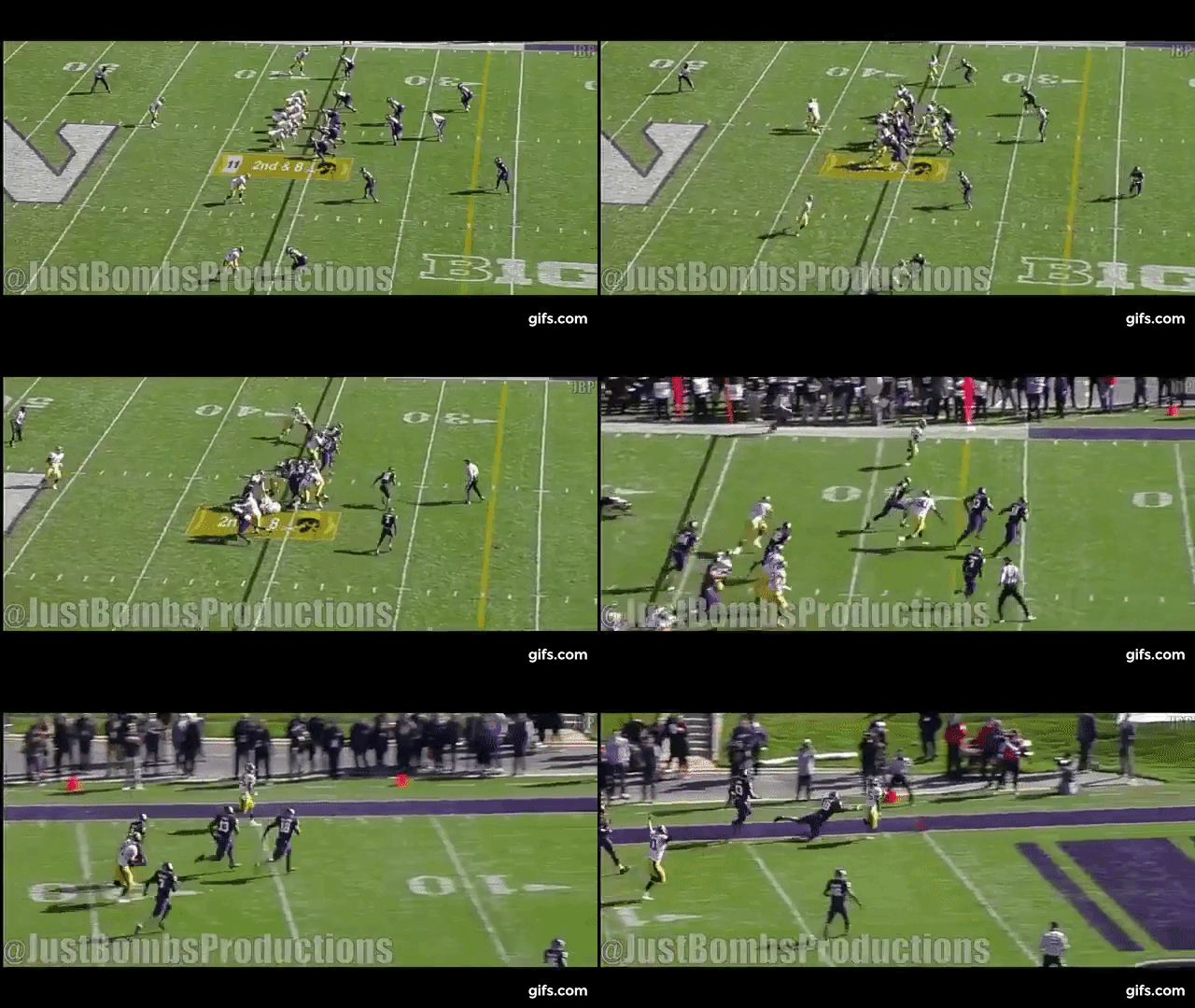
Iowa football used the basic streamer pattern that dominated the Washington Redskins and Denver Broncos in the 1990s and the new century. I’ve talked a lot about the area outside , as well as many other places ; Instead of continuing like this, I will make one and the other distinction regarding Iowa football. There is an open area, also known as a wide area, where the goal is to get past the defense and reach the edge; this is most commonly observed in scattered groups. Then comes part of the ball's rebound zone, but for the most part it gets inside EMOL, which is a classic attack by Joe Gibbs and Shanahan. Both can be called elongated, broad or external, which is a more philosophical difference (although in Gibben's case it was just a part called "bounce" and a part called "outside"). Iowa is also adding a big blockchain (Gibbs also did a lot of this, not a new invention), and that’s what I want to focus on today.

facebook block
I like being able to talk on FB. FB I is one of the most underrated and critical participants in any form of crime. When FB LSU star John David Moore (and, in fact, should be considered a star before Furnet) was injured, LSU’s game was greatly shortened. Often for a position filled with bulk, FB needs fast intelligence, the ability to adapt to flying and a strange madness to work in a blockade. But when done effectively, it gives the carrier all the tools they need to succeed.
Discuss some FB rules to make the main game fail. We will see four types of blocks: split, kick, seal (arc) and attack. Keep in mind that many of these rewards may be awarded up to the point to give you a better idea of ​​what is expected from the offense, but you may need to adjust as the game progresses. That is, the original route can be transferred between OL and vice versa. The order for further throwing or blocking by defenders depends on the reaction of the defender.
divide the area
The Broken Block, also known as the Sealed Block, is for the final part of the game, and I mention it only because it’s another option outside the range zone. The FB cleavage area will have an EMOL (usually weak OT side) inside the thigh; During the game, the OT defender usually works on the 2nd level of defense, leaving the DE defender free. FB will work the other way around. (Note: this is not an Iowa cut.)

Naked
Responsibilities FB is a defender № 4 on his side or a quarterback № 3 on the weak side of the game (many teams in the zone believe that the defense front better defines its blocking scheme earlier). center in the play area of ​​the work). Basically, this means that he is responsible for managing the defenders' forces. His trajectory and initial binding will be to the defender’s chest or outer armpit, and his attack will match the defender’s game. When the forward rises and tries to put a hard edge (forcing everything), the FB's task is to get to his inner armpit, turn around (or at least give the ball carrier a clear idea of ​​the straight cut). : in the example of a blocker), then throw back and forth, increasing the space for RB.

The seal
Often a strong level 2 defender gets in the way and blocks a bow that never goes out. The goal here is to work outside of EMOL (provided EMOL was able to seal its defender) and reach level 2, direct the outside of its armpit / shoulder and seal the level 2 defender into the box. However, this is rare as it causes a strong explosion of protection.
Instead, here’s a more typical example. This is an example of a hairpin and a pull-out site. Note that the shooting defender shoots at the level 1 starting defender (the first color he sees), so FB goes ahead, cutting and sealing the rest of the defenders in the game.

Offensive
The OT / TE side of the game should be responsible for covering up defenders on the side of training. This DE / OLB is also a defender of power, OT will work to push it further. FB needs to read this and adjust its trajectory (although this can be reported a lot before binding depending on the defensive training and what the LO covers / opens); he no longer works outside the OT, but works inside it, towards the defender, furthest from the prepared playing field.
This is different from a standard lead block because the front view is different. Instead of cross-stitching the inner armpit FB will always deal with the outer armpit of the defender. When he comes in contact, he has to push with the outside hand (tied at the end of the shoulder) and pull with the inside hand to lock the defender inside (this usually doesn’t work because the game is too hard and too fast). ). for this to happen, but the blow or force must be on the outside of the defender to expand and seal from the inside). This gives Belarus a clear path to attack.
Based on pre-press messages and post-press readings, this unit can be further executed internally. If the OL side of the game can reach the second level and get support from the game side, FB can get LB to play behind. LB for LB, however, is a complex proposition, so the RB FB should double its number. Again, his goal will be the defender’s outer hand, but if the defender fails or aligns to push his impulse aside, the blocker can use that impulse and continue to lead / hit outside. as it is done here. Note that even if your cute spot is on the defender’s outer armpit, you attack the defender’s inner armpit as soon as the defender repeats this.


conclusion
In each of the above clips FB paved the way for Belarus in the long run. The more groups choose a bright look, the more LB and DB are inadequate and poorly equipped to handle lead blocks. That’s why FBs tend to turn regular wins into long TDs. The fact that their example is the evolution of GPS, which the ball carrier follows in the course of the game, makes Belarus much easier to win big wins. FB are the heroes of the unknown, but they are the heroes of any crime they use. The ability to adapt to their flight and the ability to attack defenders is key to the success of any attack they make .

Sunday, 19 June 2022

Film Review: Iowa vs MSU (and applicability to MSU vs UM)

Photo by AP / Al Goldis


I need to review the MSU-Iowa game in detail. Here are my brief conclusions (most come from Twitter with a few changes, so sorry if it was misspelled).

Moscow State University d

  • The MSU DL did most of the expansion in Iowa. He did a good job of creating a stitch for the skirt and narrowing the gaps in the stitch.
  • Iowa's success was somewhat down in circuit-based playing circles when the DL's piece of the gap crossed further than previously thought; Not fully playable in UM
  • However, there is something about UM: MSU is good at detecting / protecting trends. The need to strategically break the tendency to get out of position (this is common with good, well-trained D'Antonio defenders)
  • LB / Security still spills a lot. Harassment is often disciplined, but you can pick it up from the gaps and pick up the grass in the open far from the action.
  • And you can still play practice games to get the RPG you want. narrow chains / TEs = auxiliary handle = receiver fuse; etc.
  • I think Maurice did a great job with you. Michigan would be better off attacking with WR because they have a weak spot in the background. I think both valves are weak points of the case and can be used. Morrissey more than that, but I think the other smelters left a good chance; You need to know how they are deployed in WR / TE configurations
  • The new team, MSU plays a lot in C1, especially with a notable pass. QBs need to be smart before continuing to read the security precautions.
  • You can still get the games to your advantage, turn down support, but you have to understand how to start moving forward. You need protection to pass the time. DB MGU is not very good in C1 technology; Of course, this is not essential, but it does allow recipients to get leverage in times when they are not getting the support they really expect.
  • I think the UM OL will really be up against the MSU DL for most standard bass. Limited time games. Once behind the chains, lots of games
  • MSU is likely to break the trend a bit based on the UM movie. UM must be ready to install points to get level 2 phones for free.
  • Goodbye for a long week. The unified messaging system needed to solve connection problems in OL will put strong and rapid pressure, especially from the parties.


Moscow University

  • Without MSU up front, OL has lost a lot of leverage. This was O's biggest problem all day. Release the levers and stop moving your legs.
  • Most of them are in the cabin, but not alone. Iowa DT can enter the body and control OL in LOS and they are stacked inside
  • The interior looks solid enough, it does not sag constantly, but it loses its arm and loses its ability to drive. Driver's license required
  • I still do not like to put the MSU PR in the hands of some salon. They like to play the microphone, not to play. First bring the little doll to unbalance the king
  • One player is constantly surprised, especially, does not receive calls. He constantly bypasses the body, embraces himself, does not walk. Allen had a very difficult day and was hit several times in the back, which made the shot difficult; Jarvis struggled a bit to figure out how and where to shoot, which can be expected in the region of France.
  • As for Leverker, you need to get back on your feet. If you implant your foot and release the w-technique, it is very accurate.
  • When you knock on the legs or force them to fall, the technique breaks, the accuracy becomes constant, the strength of the hands is greatly affected.
  • It will be very difficult to get under pressure and immediately stop going on the field.
  • The inner OL is strong enough to prevent a large pressure. OT offers some basics, but it reflects well. It should be a fun match.

Thursday, 16 June 2022

Inside the Playbook: Iowa's Outside Zone Gap Counter

Iowa has long been known for its patterned walking style. FB likes to be part of this pattern for many reasons . In fact, one of his favorite races is the off-zone game . As part of this offensive, protesters stressed the need to defend themselves in the face of Iowa, and Iowa created several "banks" to use these defenses. It is the most common pin-pool plan in Iowa, but it includes other options. In this post, we will take a quick look at how the defense protects the Iowa stretch pattern.


Keep your stretch
As with any race defense, the main focus is on defense during extended play. Let the gap spread, the attack should not have a place to move.

The idea of ​​stretching is to move horizontally at the end of the game and fill in the gaps. This is done by improving the defense. Regional blocks Ö‡ double orders Ö‡ The break works in combination blocks up to the secondary level to create folds in the LOS. You can use the defenders' pressure to close down the defenders and push them down.

Therefore, a healthy immune system needs to maintain disciplinary action, blockers prevent smoking or swelling. In LOS, this means that the defender wants to wear the hat in the designated area, keep their shoulders parallel to the LOS, and maintain their position. Winning a helmet during the holidays, expecting a rest guarantee; They let go of their arms, letting go of the dam. With a peer (which requires you to win sideways and keep your shoulders parallel) you will prevent the attack from crossing the border. All this does not allow it to be closed with a cloth, but it prevents horizontal movement. This "defines the boundaries" and the internal adjustment reduces the rotations that can occur in the front foot, closes the tracks, and facilitates the flow of secondary players.

Second, LBs are usually read in a cloud environment. With that said, they have to scrape until they get an open cream that sticks to their blanks. This clear reading allows them to work up to the top until a hole is found, then hammer and burn on the LOOS. If this unlock is created immediately by the player, they want LB to take it immediately.

Again, the goal is to put the white space in order. Scratch your defense, but attack when you can. As a minor LB, you do not want OL to work at a secondary level where you can be locked out. You want to stick them so that they do not move or fold in the VOC. Also, a clean slate forced him to cut the ball. This forced interruption reduces the number of passes and makes it easier to defend the game. The whole idea is to build a smooth viewing wall, penetrate to reduce the size of the game, and move to the ball.

Iowa Stretched Belt
Iowa also does a lot of stretching with a lead block . Here are some examples from how they used a lead block to close the defense at the end of the game.


In the state of Iowa, it often uses flow, because stretching always benefits, reduces flow.

Reference
And the gun!

Reference

And with a lead block.

Reference
Location calculation
In the jokes above, you can understand what the defense was trying to do, how it could not stop the stretch. But of course the teams could have stopped the game, and in the video above with MSU, Iowa did not show much success in the game. So Spasio Conte has arrived.

When is the blockchain device for LOS Gap Counter released when it comes out on the counter? They all walk the "side of the game" by working in blocks from the first to the second level. Here, instead of going deep into the bucket, they grab the hat and close the gap instead of reaching the defender. This is contrary to the plan, but VPS is gone and the gaps are closed. If there is a DL in the blank, block it; If the gap is not filled, raise the LB level á‹« Pack the LB.

The breeder, in turn, will have support. Before returning to the end of the piece for the third step, the first two steps resemble the work of the stretched legs.

Picture

Examples
In the first example, Iowa is about to return with a compact body. Lists all blocks Ö‡ CB loses its power responsibility when chasing an external WR.


It is managed by 11 employees here. A WR breaks his back, forcing the central bank to be a strong defender. It goes too far, Ö‡ Attacks benefit remotely.


Here they use FB as a leading block. In this case, the operating system goes to the opposite edge, which is the same as the class zone. If EMOL crosses the line again, FB will re-register. If it picks up external power, the FBI will try to push it.


to run
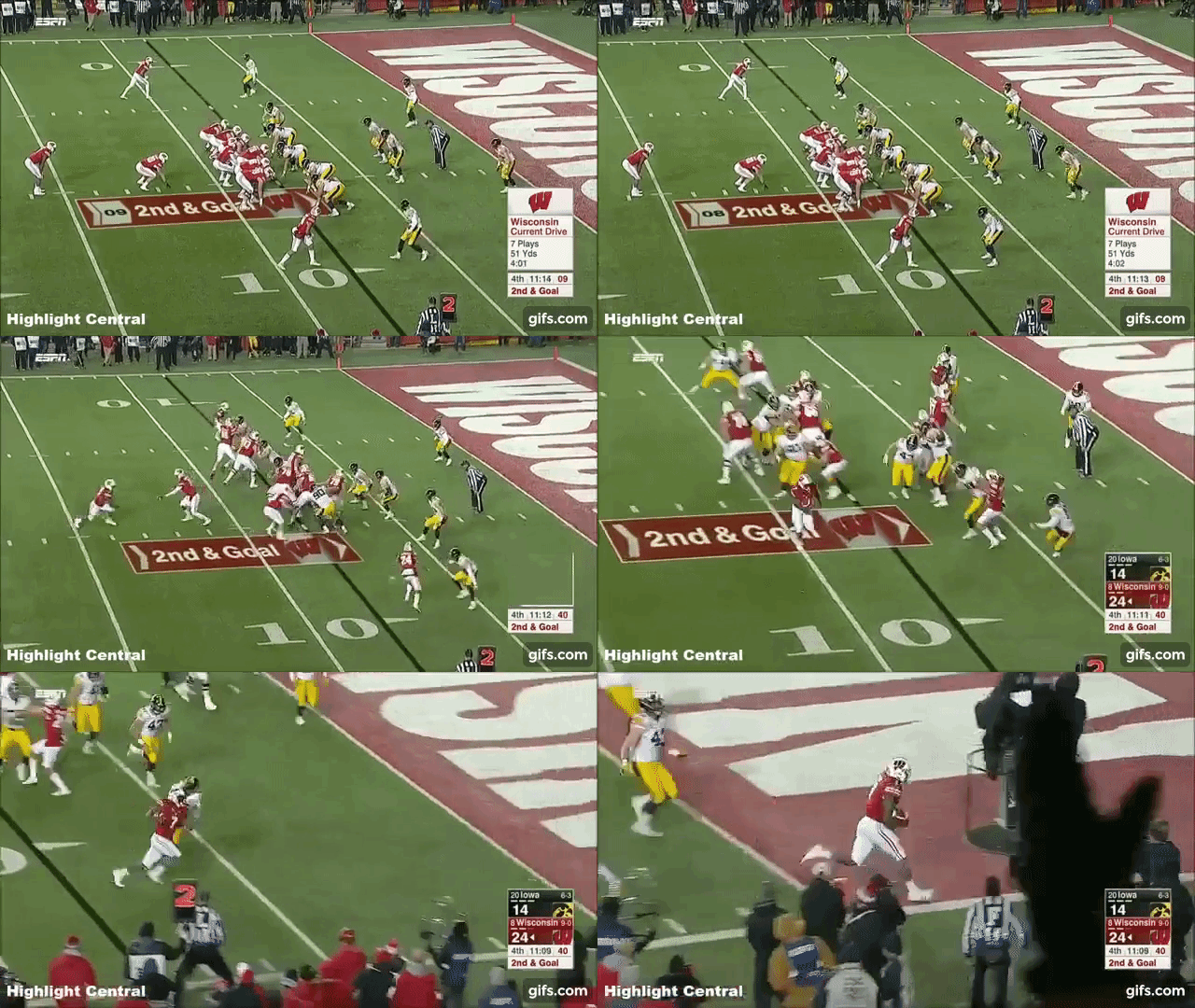
Wisconsin had an unusual game plan for Iowa in 2017, which I will discuss in more detail in the next article. Wisconsin, like Iowa, has as many states as possible. The Hawkeyes made their debut for the Bagers' 10th season.


Sometimes when you study your opponent you get good ideas. Specify how LOS Ö‡ FB can be locked in.

Closing
You can see how the opposition, without a tractor, is still very effective, as the teams try to prevent stretch marks. In each of the above games, you can see DL hitting the boot to get the "side of the game hat" just to finish the wrong part of the game. In each game, you see LBs start to lose and fall out of the game. The first step everyone says is to "stretch" to protect yourself, because tension is so strong what to do with defense, this simple method is very effective as an additional brace.

Sunday, 12 June 2022

Inside the Playbook: Iowa TE-Wing Dig-Wheel Concept

Iowa could not beat Wisconsin, but that does not mean they did not do some good things. They first released TD T-Wing and launched the Dig-Will concept. In this article, I want to show you how this concept works in your link and why you should pay attention to design.


All curves
Let's start with another game that Iowa launches from time to time. This game can be played 5 to 12 meters deep as a defense and fall. About all-hits, it's a secret swamp and a quick hit of the ball before the cover. In-depth road concepts (All-Curs) are more about sectors risk and the gap between levels.

Because of the way pushers respond to tight shapes, te-wing pumps can often be an effective way to emphasize tight return paths, where pushers are nailed to accommodate the narrow formation and therefore the shield requires more movement to return to the shell. Zones (QB also helps identify potential gaps).


TE-Wing Drilling Wheel
Let us now take a closer look at this work. First, the structure.

I like these shapes where the TE wing is on the short side of the game and the arbitrator goes to it. This effectively creates a close-knit community that does not consider itself a close union. This means they do not use their banjo cover or anything, they can play inside / out or up / down with two TEs, but they limit the coverage because they are not known as a group.


I agree with the woman. To receive.

At the other end, the WR fields are transferred to the pile, which helps to determine the coverage area and free up low receivers.

Like I said, after clicking, this game will be very similar to the entire obstacle course. The TE then stands at 10-12 yards (as he does on the return) and shoots salvation with him. Now, when the breeder falls, it has a lower speed to the CB along the adjacent side line (the nearest side allows the passerby to reach the receiver faster, making things difficult for the conflicting defender, especially with the safety behind him).

The wide receiver on the wide side was pulled out of the warehouse and dragged across the field. This effectively helps to establish a QB Triangle, with two lower options: flat plate arbitrator and drag WR. If the CB is deep, it reads the QB OLB from its short side and drops it from the movement (Wait, drop RB, exit for cover, drag WB from LR into space).

If for some reason the clouds are overcast, there is a concept of a stairway above the middle of nowhere, a te-teapar can escape into space because the X-WR is covering the Go trail.

Here is what it looks like:


The good thing here is time. The first high and low readings are relatively fast, once the wing reaches around 12 yards, the QB receives the CB reading (blue box). Dragging occurs a bit later, so moving to the next task key (dark blue square) is a natural transition. And in shock, you have a big one that closes the coffers.

Here is the video:


Two things to remember. The holes will be removable and this is not a difficult crossroads, so keep in mind that TE is slightly tilted to the top of the course and slightly back to the ball. This is because you do not want to get into the rock on the other side (cover 4 safe houses in the house when resistance goes to LB).

The other thing is the way the wheel. He knows that the attacker does not need to be far away, since the handle on the short side covers the hole. Then, like prism, it starts to run in the middle. This gives the latter quarter more volume, more room for volume, and generally makes it easier to hit.

What happened next?
It is not difficult to create this game with a swing screen. If the defense starts to block straight paths, use the TE block on the DB and let the RB attack the LB in space. If you can get OLL to leave the bottom field, they are completely stuck.


Wednesday, 1 June 2022

Film Review: Iowa at Iowa State, 2021


Monday, 23 May 2022

Inside the Playbook - Throw Back Play Designs

Previously, we looked at why game restore works.

Below, we take a look at USO , who made use of the wings in the game against Minnesota .

This publication will cover the various translated versions that can be added to your book.

Elsewhere - Loss

Everyone talks about leaks, but at least I don't write them directly on my blog. So let's assume it's an option. The following table of losses:

Falcons Guidebook 2016

There are now many iterations of Leak, but I want to point out some things I like more than others.

I'd rather have two receivers coming from opposite sides than one receiver. You can find examples of both, but I've seen that if one receiver pulls on the shield to rotate along a curve, it's quite common to go back and close the safety line or lose the CB.

I also like this TE-Wing with the internal TE removed at a loss. Almost always, if one TE-Wings is blocked, it is the TE in the queue. If you swap this mission, you will most likely get lost in the Y-TE shelter and open on the opposite side.

Here's a solid option

TE delay elsewhere


Elsewhere - RB Rail

Elsewhere - Cover

There are several options for this.
Falcons Guidebook 2016


I really like these two Iowa side WRs with the inside WRs breaking in the corners


Elsewhere: Back screen

The fourth area to strike with a line is the flat bottom. The back screen is usually the best way to get there.

Elsewhere - Back tunnel

d


Elsewhere - etc.

RB delay


Back to QB:


2022 WNBA Week 1 National TV & Streaming Schedule

Friday, May 6 19:00 - "Indiana Fever" at Washington Mystics   Facebook : Megan McPeak, Christy Winters-Scott 20:00 - Los Ange...